
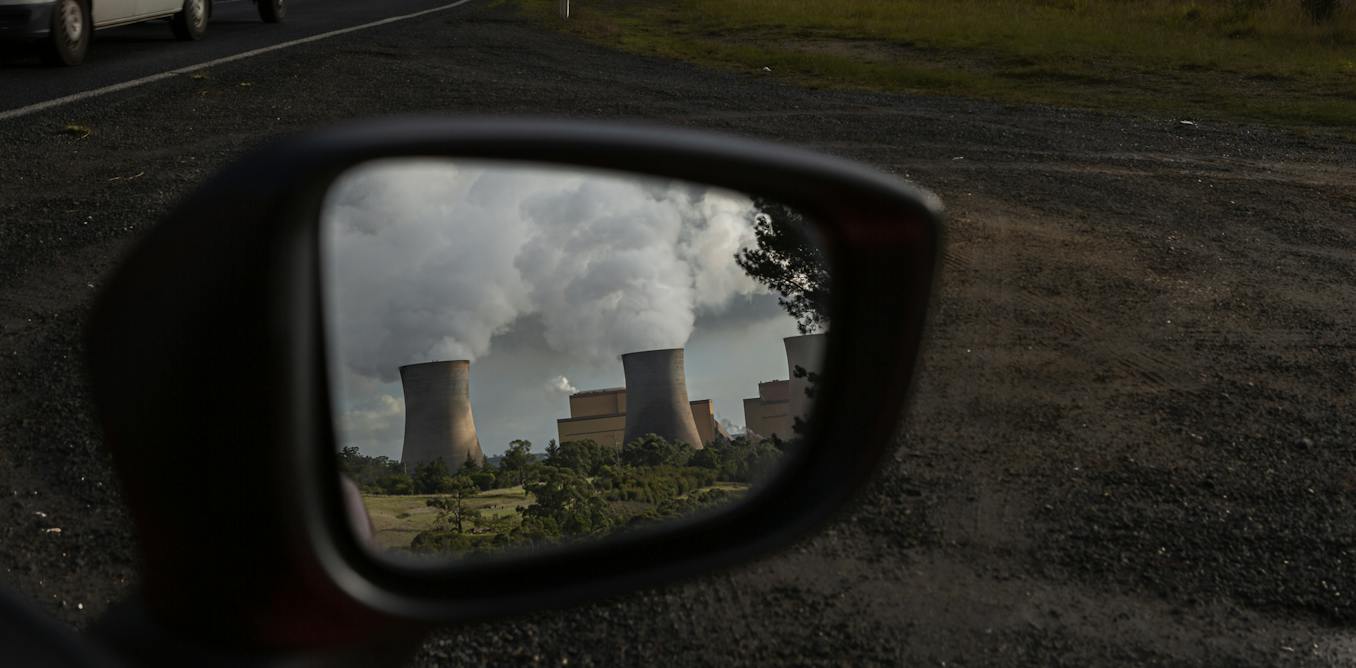
A new report suggests this year, carbon emissions may begin to trend downward for the first time. But it’s important to take this with a grain of salt. While news reports have hailed this event, it will take years to confirm it wasn’t just a blip caused by the US-Iran war. Carbon emissions are produced by the burning of coal, gas and oil in power stations, factories, vehicles and heating systems across the globe. To avoid the most dangerous consequences of climate change, the world must reach net zero emissions by mid-century. Worryingly, research shows CO₂ emissions have been on an upward trajectory for most of the industrial age, with 50% of all emissions produced since 1990. But a new report offers some hope. The Global Carbon Project collects data on fossil fuel emissions, as well as how much carbon is being absorbed and released by oceans, forests, grasslands and soils. This week it published its 2026 report, just as world leaders are gathering in Turkey, also known as Türkiye, for the COP31 climate conference. It’s a momentous read if its central finding – that CO₂ emissions are now on the decline – proves true. After all, similar claims were made back in 2024. Read more: The world’s carbon emissions continue to rise. But 35 countries show progress in cutting carbon A potential peak The new report shows emissions from fossil fuels are set to fall slightly, from 38.4 gigatonnes (Gt) in 2025 to a projected 38.2 Gt. That’s a very modest decrease of 0.4%. There are several reasons for this drop. Conflicts One key factor is the ongoing energy crisis, triggered by the wars in the Middle East and Ukraine. Both conflicts have disrupted a significant portion of the world’s energy supply, in particular oil. Crude oil prices have surged from around US$60 (A$87) a barrel at the start of 2026 to the current figure of US$100 (A$145) a barrel. In Australia, the average cost of petrol increased from 175 cents per litre to about 240c/L in October, and diesel prices from 186c/L to around 280c/L. Even at the low end of these prices, running an electric vehicle would save a typical Australian driver roughly A$2000 each year. Cars High oil prices are accelerating the uptake of EVs. A quarter of new cars sold in Australia in 2026 were fully electric. That’s quite a turnaround for Australia, which was an EV laggard compared to the rest of the world. This trend is very likely to continue as the barriers to buying EVs – such as cost, range and charging infrastructure – are being overcome. Even if petrol and diesel prices return to pre-Iran war levels, EVs will likely be the preferred choice. China China is the world’s biggest fossil fuel emitter. Historically, China’s emissions have largely come from coal-fired power stations. But over the past few years, the country’s fossil fuel emissions have plateaued and even begun to slide as China installs wind, solar and hydropower infrastructure at a world-leading rate. In the first half of 2026, less than 50% of China’s electricity came from coal, putting it well on track to meet its net zero by 2060 target. This downward trend could make a major dent in global emissions. Read more: As diesel from the Gulf and Russia dried up, Australia had to find new suppliers – at a cost Not the first time It’s worth noting, global CO₂ emissions from fossil fuels have dropped several other times in history. In the 1970s, the influential Organization of Petroleum Exporting Countries (OPEC) reduced oil production and cut exports to countries that supported Israel in the 1973 Yom Kippur War. The consequent oil shocks of the 1970s and 80s saw oil prices quadruple within months, triggering fuel rationing and economic chaos in major oil-consuming nations. Global emissions also fell sharply after the collapse of the Soviet Union in 1991. Most recently, fossil fuel emissions dropped during the 2008 Global Financial Crisis and COVID pandemic. Both were major disruptions to the international economy that slowed travel, industrial production and general growth, leading to reduced fossil fuel emissions. In each case, fossil fuel emissions returned to even higher levels once the economy recovered. Read more: Yes, carbon emissions fell during COVID-19. But it’s the shift away from coal that really matters More work ahead So assuming the current fuel crisis eases, will fossil emissions simply start to increase again? It’s difficult to know for sure. It depends what policies and actions various countries put in place. For example, fossil fuel-driven economic growth in developing countries could offset the emission reductions in countries embracing renewables. However, what’s certain is the world must keep working to curb fossil fuel emissions. Take Australia, for instance. Data from the National Greenhouse Gas Inventory show our fossil emissions have slightly decreased since their peak of 415 megatonnes of CO₂ in 2017 to the present value of 374 megatonnes. This is almost entirely due to emissions reductions in the electricity sector, as wind and solar gradually replace coal-fired power stations. Meanwhile, stationary energy – which includes burning coal and gas to heat buildings and run factories – has remained stagnant. In the case of transport, emissions have even increased between 2017 and now. This is because more fossil fuel-powered cars and trucks have hit the road in recent years, despite significant EV uptake. On a global level, our oceans and terrestrial ecosystems – such as forests, grasslands and tundra – are increasingly under pressure from climate change. These systems absorb roughly half of the carbon we emit, but warmer seawater and heat- or water-stressed plants store carbon less efficiently. So the future of our oceans, forests and entire planet depends on whether we meaningfully and rapidly reduce global emissions. Read more: Australia’s hidden opportunity to cut carbon emissions, and make money in the process
Global carbon emissions may have peaked in 2026 – but only time will tell
Full Article
Original Source
Read the full article at Theconversation →KhanList aggregates and links to publicly available news content. We do not host full articles from third-party sources. Always verify important information with original sources.