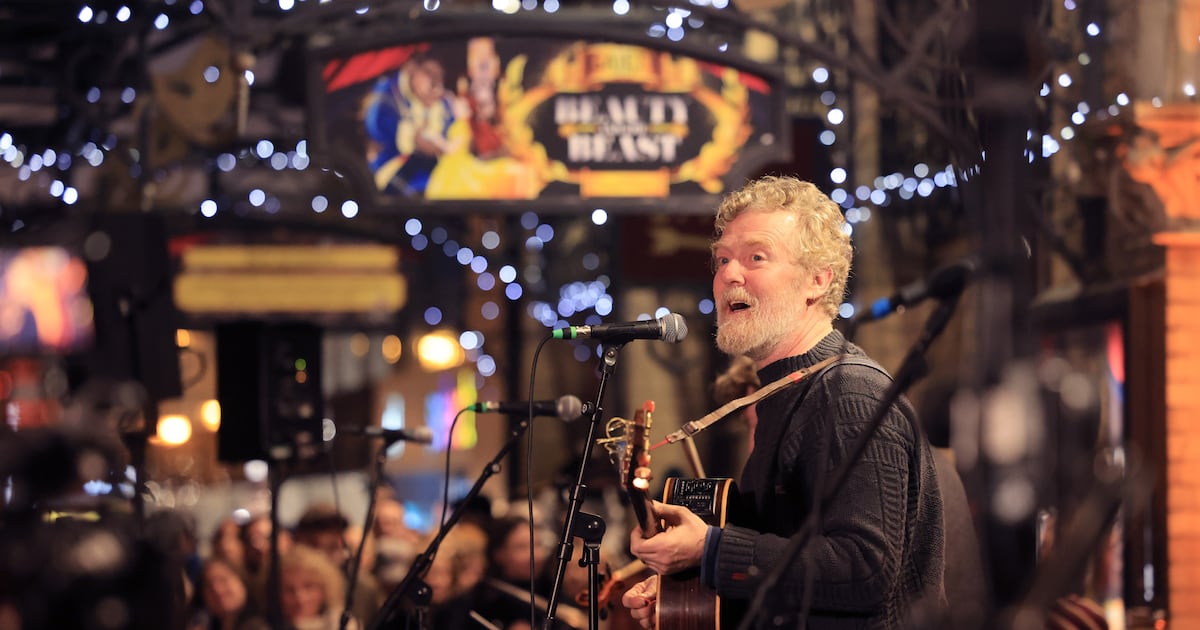
The Frames’ frontman was the still-yet-chaotic centre of an indie-folk storm, whose job was to hold it all togetherGlen Hansard projected his charisma around everyone else like a shield. Photograph: Dara Mac Dónaill / The Irish Times In the 1990s, I wasn’t convinced by The Frames. They felt a bit mainstream. A bit major label. I was a young idiot. Later, a friend convinced me that I was missing out and to give them a chance. She was sure that, if I went to a gig, I’d get it. So I went to a gig and … I got it.It was all because of Glen Hansard. He wrote beautiful songs, but he was also the still-yet-chaotic centre of an indie-folk storm. His job was to hold it all together, and he projected his charisma around everyone else like a shield.He was a frontman, but he was also a band leader. A lot of singers are, in fact, terrible band leaders and need sidemen to perform that task. Nick Cave had Mick Harvey. Morrissey had Johnny Marr. Liam Gallagher had Noel. Glen Hansard had a great band, but he didn’t need a foil.His ability as a frontman was linked directly to his ability to pull the people around him into a functioning musical outfit, whoever those people are. It went back, I assume, to his days as a busker. It takes a special kind of person to marshal random people of differing musical ability into vessels for songs. The boundaries between performer and audience become fluid when people are busking (there is, after all, literally no stage).READ MOREAnd I think that’s why Frames gigs, and the first Frames gig I attended, felt so powerful: the collective magic of music creation at a Frames gig didn’t stop with the band, but spilled out to include those watching. He could produce anthems like Revelate and delicate beauties like Lay Me Down but, more importantly, Hansard let the audience feel like they were part of the band.This is very rare. It was no surprise to me that, as time progressed, he became an international representative of Irish musicality, particularly after he starred in John Carney’s Once, which was a beautiful, low-key statement about Dublin and about music as a communal endeavour. He became Ireland’s band leader. Bob Geldof was too shouty. Van Morrison was too grumpy. Bono was too distant and out there in Dalkey. Even in the David Letterman-fronted Apple documentary about U2, A Sort of Homecoming, it’s Hansard who turns up representing the earthy reality of Irish music. It’s Hansard who doesn’t look out of place in a pub session.He was always supportive of other musicians. He was very kind to my band the NPB when we supported the Frames at a gig in Limerick back in the early aughts. And he took the piss out of us too, for swapping instruments so much between songs (The Frames then did this when they played, as a joke, to demonstrate how impractical it was). It made us feel like we belonged.Glen Hansard was, by the time of his death, at the centre of Irish music in a way that bigger artists such as Enya, or U2 or The Script couldn’t ever hope to be. Photograph: Joshua Bright/The New York Times Years later, in 2023, I met him again when we were both performing at a concert for Ukraine in Vicar Street. At the soundcheck, as I performed a song with my wife and sister-in-law, he called “put more jizz into it” from the side of the stage. We did. It was better for it.In 2024, I saw him co-ordinate a disparate session of musicians, including Hozier, Damien Rice and folk legend Joan Baez, after a screening of a Baez documentary in the Lighthouse Cinema, Dublin.I met him only once when there was no music involved. It was at a dinner at a mutual friend’s house. He was funny and thoughtful, but he wasn’t the centre of things at the time. He spent a lot of that dinner holding his baby. I could see where soft and delicate songs such as Star Star had come from.The very last time I met Hansard was right after American actor John C Reilly performed his Mister Romantic vaudeville show last November in Dublin’s Ambassador Theatre. It was after the performance, in the Parnell Mooney pub, across the road. At around 11.30pm, Hansard asked me to get the barman to turn the music off so he could get people to sing unaccompanied and, before I knew it, he was leading a session. Reilly sang something mournful. American country musician Sierra Ferrell harmonised on something jaunty and rootsy. Hansard sang Rocky Road to Dublin. It was full-throated and rowdy. He knocked glasses off the table in time to the beat as he went (we picked them up). He sang like he was possessed.The singing lasted 15 minutes because the pub was closing, so Hansard convinced us to go up the street to the heaving rock club, Fibber Magees. There, he commandeered the stage from a confused metal band so that he, Reilly and an assortment of musicians could play some songs. I can’t remember what they played but he was, once again, being a band leader.Glen Hansard was, by the time of his death, at the centre of Irish music in a way that bigger artists such as Enya, U2 or The Script couldn’t ever hope to be. The Irish music world seemed to orbit him. He represented the throughline from kitchen sessions to concert halls because he was comfortable in both. He was, in a way, our national bard and it really felt like he’d be doing that job for a very long time. It was why he was the person urging other musical legends along as they sang at Shane MacGowan’s funeral. His ability to connect music from players to listeners, often blending the two, helped people to mourn. Now I wonder who’s going to do that for him and who is going to do that for us.IN THIS SECTION
Glen Hansard was Ireland’s band leader, something Bono or Geldof couldn’t be
Full Article
Original Source
Read the full article at Irishtimes →KhanList aggregates and links to publicly available news content. We do not host full articles from third-party sources. Always verify important information with original sources.