
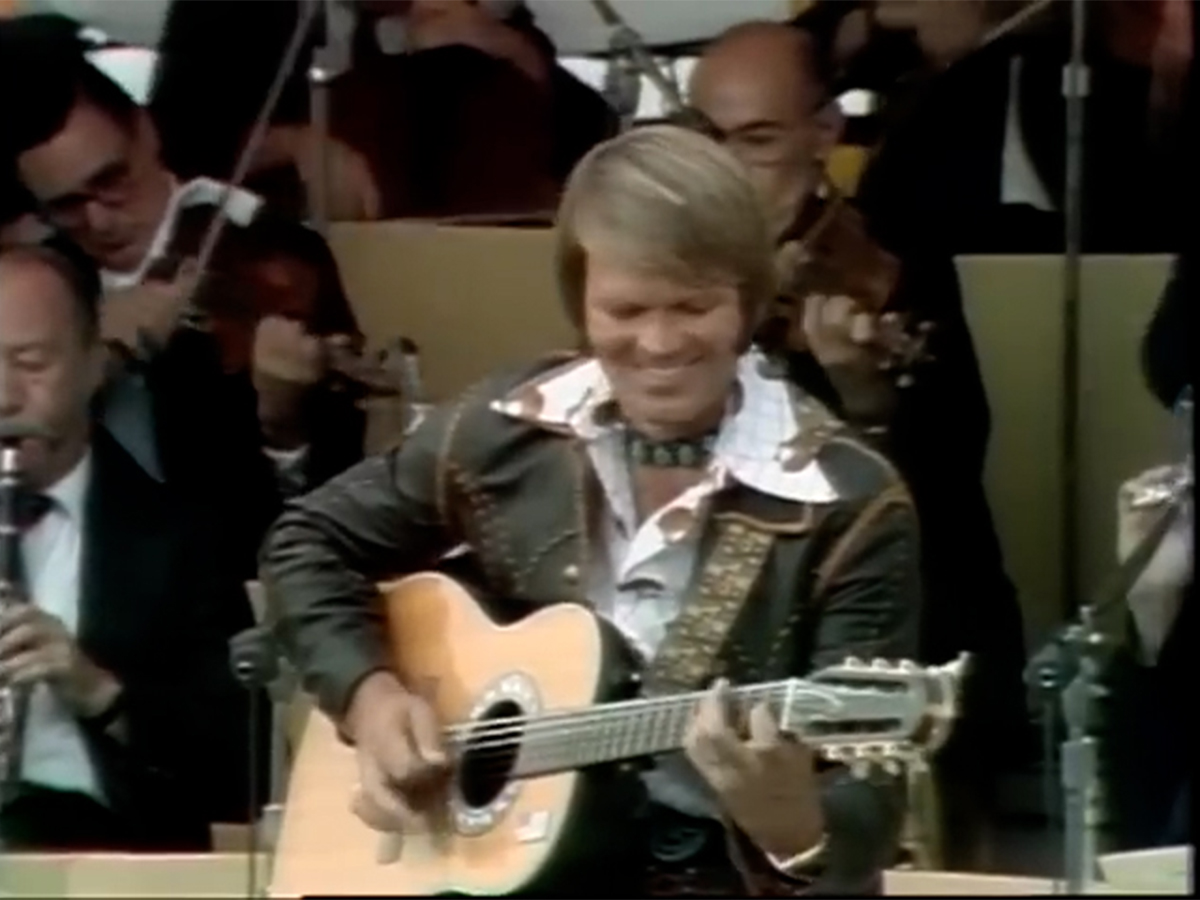
In September of 1974, Glen Campbell performed an incredible acoustic guitar version of “The William Tell Overture” in New York City’s Central Park. The famously fast composition is difficult enough to play, but watching Campbell tear through it in a YouTube video shows just how talented a guitarist he was. According to Guitar World, legendary comedian and entertainer Bob Hope introduced Campbell to the Central Park audience. Dressed in a colorful western-themed outfit and holding an acoustic guitar, Campbell took on a piece of music most Americans might recognize, even if they couldn’t name it. Generations of Americans know “The William Tell Overture” as the theme music for The Lone Ranger. Its galloping rhythm is instantly recognizable, but hearing Campbell play it at that speed on an acoustic guitar is something else. He makes it all look rather easy. Campbell was known for hit songs like “Wichita Lineman” and “Gentle on My Mind,” and would go on to have another massive hit with “Rhinestone Cowboy” in 1975. But before becoming a household name, Campbell spent years playing guitar on other artists’ recordings. During the 1960s, Campbell joined the Wrecking Crew, a group of Los Angeles musicians hired to play instruments on recordings for some of the biggest names in popular music. According to Campbell’s official biography, he played on an astonishing 586 recording sessions in 1963 alone. He contributed to some of the era’s best-known music, including Frank Sinatra’s “Strangers in the Night,” the Monkees’ “I’m a Believer,” and the Beach Boys’ album Pet Sounds. He also toured with the Beach Boys, filling in for Brian Wilson before establishing himself as a major solo artist. By his 1974 Central Park performance, Campbell was already a Grammy-winning recording artist and former host of The Glen Campbell Goodtime Hour, which ran on CBS from 1969 to 1972. A 1967 photo of singer-musician Glen Campbell, LEFT, and a photo from his “Goodtime Hour” television program, RIGHT. Capital Records/Wikimedia Commons and CBS Television/Wikimedia Commons This acoustic performance was a little different from his usual version “The William Tell Overture” became a regular part of Campbell’s live performances, but he mostly played it on an electric guitar. That makes this 1974 acoustic performance a little unusual. The rapid notes require extraordinary control, yet Campbell seems completely comfortable moving through the arrangement. His picking hand maintains the rhythm while his fretting hand moves quickly across the fretboard. Even more impressive is how relaxed he appears while doing it. No elaborate stage production or anything distracts from the performance. It’s just Campbell, his guitar, and an opportunity to appreciate how great he really was. The performance impressed plenty of viewers on YouTube. “I am speechless. There are no words to describe what I just heard and saw,” wrote one commenter. Another viewer brought decades of perspective to the discussion, writing, “The best guitarist I have ever seen in my 72 years!” This person was impressed by Campbell’s precision, commenting, “Glen Campbell was straight on the mark. Did not miss a note. Awesome performance!!!” Glen Campbell performs, 2004. Photo credit: Alan C. Teeple/Wikimedia Commons Glen Campbell was more than his biggest hits In a tribute published after Campbell died in 2017, Reverb highlighted his versatility. The same musician who could entertain a television audience with a dazzling guitar solo could also provide restrained accompaniment when recording with other musicians. For anyone who remembers Campbell primarily as the man who sang “Rhinestone Cowboy,” watching him race through “The William Tell Overture” on an acoustic guitar might come as a nice surprise.
Glen Campbell picked up an acoustic guitar and tore into the ‘William Tell Overture’
Full Article
Original Source
Read the full article at Upworthy →KhanList aggregates and links to publicly available news content. We do not host full articles from third-party sources. Always verify important information with original sources.