
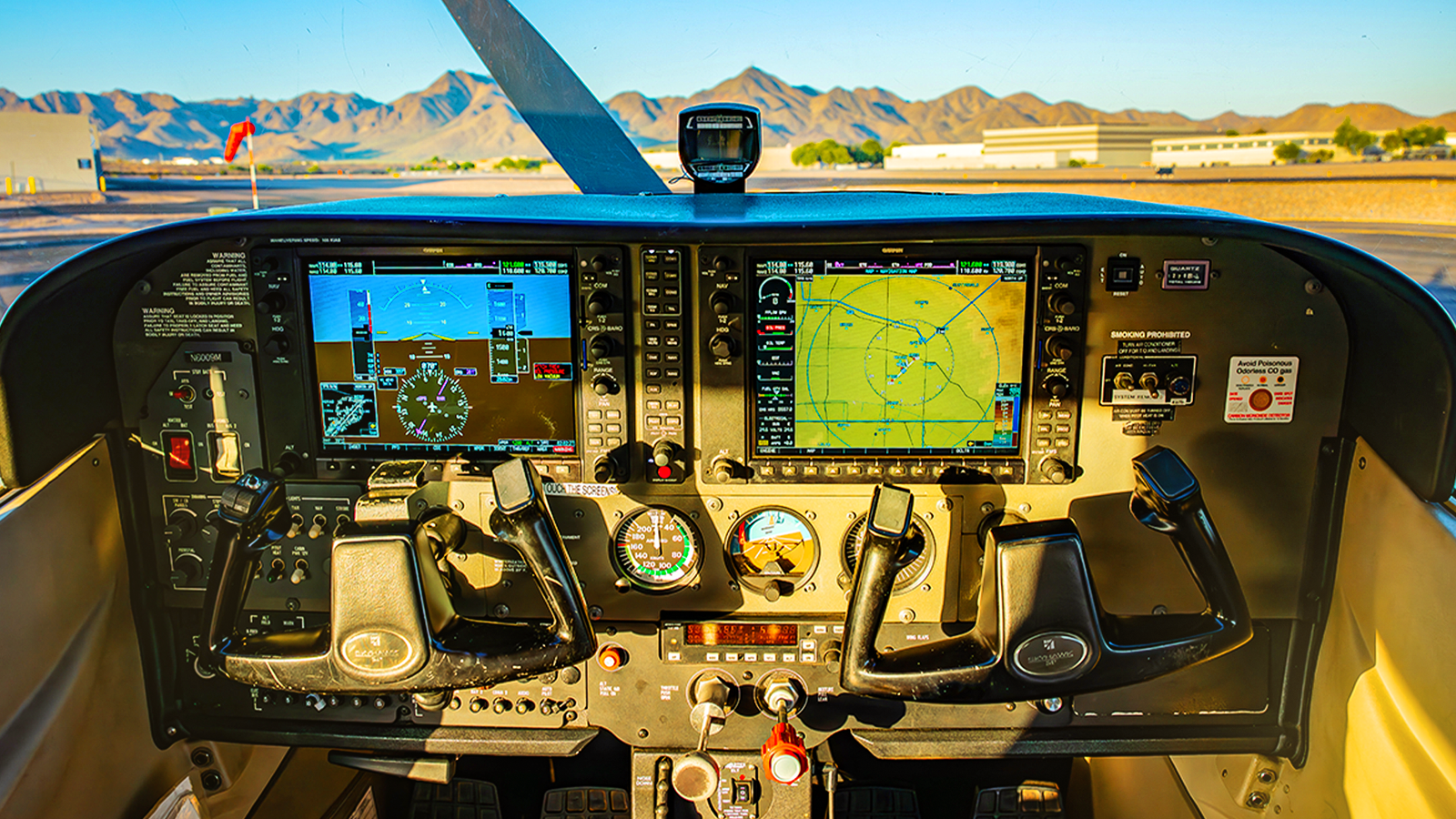
Published Oct 31, 2026, 7:00 AM EDT Chris earned a Master’s degree in Defense and Strategic Studies (Highest Honors) from the University of Texas at El Paso. His graduate work concentrated on Global and National Security, Low-Intensity Conflict, Modern Warfare, and US grand strategy. He also undertook extensive regional studies, analyzing how key regions integrate into the broader US security architecture. This rigorous program provided him with a comprehensive understanding of U.S. military operations, global strategy, and weapons systems. Additionally, he gained a strong appreciation for great power competition.—an increasingly central force shaping international relations and conflict for the foreseeable future. Sign in to your Simple Flying account For owners of aging Cessna 172s and Piper Cherokees, modernizing the cockpit can be a practical alternative to buying a newer aircraft. Glass cockpit technology replaces traditional analog instruments with electronic displays that integrate flight data, GPS navigation, terrain awareness, and engine monitoring. However, upgrading an older aircraft involves more than installing new screens. From retrofit costs and certification requirements to the practical benefits and limitations of modern avionics, there are several factors owners must consider before deciding whether the investment is worthwhile. Legacy Instrument Panels & Why Glass Cockpits Are An Attractive Option Credit: US Navy A legacy Cessna 172 or Piper Cherokee gives the pilot what has been termed the standard "six-pack" of flight instruments, as noted by PilotMall.com. When operating one of these aircraft, the pilot must monitor six separate instruments: the airspeed indicator, attitude indicator, altimeter, turn coordinator, heading indicator, and vertical speed indicator. Surrounding the central six-pack, depending on the aircraft model, may be engine controls, flap controls, elevator trim, a fuel selector, electrical switches, and communications and navigation avionics. Taking this to another level, airliners built before the widespread adoption of modern flight-deck automation and glass cockpits often had highly complex instrumentation displays and required a three-person cockpit crew: a captain, a first officer, and a flight engineer. This was partly because flight crews had to monitor and manage a large number of instruments and systems in the airliners of that era. Such a vast amount of information, whether in a commercial airliner or even in the less complex environment of a light aircraft such as a Cessna 172 or Piper Cherokee, can contribute to what is known as the "cockpit workload problem." This refers to the challenge of pilots being presented with large amounts of information across separate instruments and displays. Under the stresses of flight, this can complicate prioritizing critical information. As technology advances, a glass cockpit replaces many traditional analog flight instruments with one or more electronic displays. Depot Avionics states that these " . . .systems consolidate attitude, altitude, airspeed, vertical speed, heading, and navigation data into a unified, easy-to-read interface. Many systems also integrate engine monitoring, traffic alerts via ADS-B, terrain awareness, and weather data overlays." The result can be a reduced workload for the pilot, with particular benefits when flying in challenging meteorological conditions or navigating complex airspace. Converting A Legacy Panel To A Modern Glass Display For the small aircraft owner, moving from an analog panel to a glass cockpit lets the pilot upgrade a potentially aging aircraft and add modern features without buying an entirely new or relatively expensive used aircraft. Access to detailed flight information, accurate GPS navigation, moving maps, terrain awareness, and detailed engine monitoring can attract an owner to the glass cockpit camp. Before committing to a modern avionics panel upgrade, it's worth looking at what the process involves. First, the work should be done by an appropriately certificated repair station or qualified aviation maintenance provider with the necessary avionics expertise. Further, the installation must comply with applicable FAA airworthiness requirements and, where relevant, the terms of an FAA-approved Supplemental Type Certificate (STC). These certificates approve modifications to an aircraft's original, certified design and specify the conditions under which the approved equipment can be installed. The conversion process will generally begin with a detailed assessment of the current panel layout, existing wiring, and the structural integrity of the instrument panel. This will allow the shop to determine whether the wiring needs to be partially or fully replaced to support a modern avionics system. Depot Avionics states that the "avionics shop will work with the aircraft owner to determine which combination of displays, GPS navigators, transponders, communication radios, and supporting hardware best fits the mission profile and budget." Following the assessment and the ordering of the desired equipment, installation involves fitting the new displays, installing wiring harnesses and GPS antennas, and integrating the new system with existing autopilot hardware, where applicable. After the retrofit, the installation must undergo the required inspections and functional tests before the aircraft can return to service. Depending on the scope of the work, this process can take two to four weeks to complete. How Much Could An Upgrade Cost? Credit: US National Archives An owner looking to modernize an older Cessna 172 or Piper Cherokee could start with a relatively economical avionics package listed by HangarMath. The hypothetical package would include a Garmin G5 electronic flight instrument for $2,200–$3,500 (£1,646–£2,617), requiring approximately eight hours of installation work; an Insight G4 engine monitor for $2,500–$4,000 (£1,870–£2,991), involving around 12 hours of labor; a Garmin GNX 375 GPS navigator for $6,000–$8,500 (£4,487–£6,357). Continuing, with an estimated 16 hours of installation time; a Garmin GMA 245 audio panel for $1,600–$2,500 (£1,197–£1,870), taking about six hours to install; a Garmin GTR 205 communications radio for $2,000–$3,000 (£1,496–£2,243), requiring roughly 10 hours of work; and a TruTrak Vizion digital autopilot for $6,000–$9,000 (£4,487–£6,730), with approximately 30 labor hours. Together, these upgrades would cost an estimated $20,300–$30,500 (£15,200–£22,800), including typical installation costs. The GNX 375 incorporates an ADS-B In/Out transponder, providing traffic and weather capabilities with compatible equipment, so a separate ADS-B unit or transponder would not ordinarily be necessary for this configuration. The listed installation estimates total about 82 labor hours, but that does not mean the aircraft would be out of service for only 82 hours of work. Wiring changes, aircraft-specific certification requirements, equipment availability, testing, and the avionics shop's schedule could extend the actual turnaround to several weeks. The final cost and compatibility depend on the aircraft's exact model and existing equipment; this is an illustrative budget, not a certified installation quote. The estimated retrofit described here would cost $15,854 before taxes. However, owners seeking a more comprehensive upgrade could opt for Sarasota Avionics’ Garmin G3X Touch Certified Package D10-B, priced from $44,495 (£33,290). The package includes dual 10.6-inch touchscreen displays, an engine-monitoring system, a Garmin GNC 215 navigation and communications radio, a GNX 375 GPS navigator and transponder, an audio panel, a remote communications radio, and a G5 backup flight instrument. Although considerably more expensive than upgrading individual instruments, this integrated package offers a more unified cockpit, with key flight, navigation, communications, and engine information presented through interconnected systems. Dual large-format displays can also make information easier to organize and interpret, while the separate G5 provides a backup flight instrument. For owners planning to keep an aircraft for years, a comprehensive installation can offer more substantial modernization than a piecemeal upgrade, though installation costs, aircraft compatibility, and certification requirements still need to be considered. The Benefits And Drawbacks Of Both Systems Credit: Piper Ultimately, whether a glass cockpit retrofit is worthwhile will depend on the aircraft's condition, the owner's budget, and how the aircraft is used. For an owner of an aging Cessna 172 or Piper Cherokee that remains mechanically sound, upgrading the avionics could be a practical way to introduce modern capabilities without the expense of purchasing a newer aircraft. Features such as GPS navigation, moving maps, traffic awareness, terrain information, and integrated engine monitoring can be particularly useful for pilots who regularly undertake cross-country flights or operate in more complex airspace. However, weigh the cost of a comprehensive retrofit against the aircraft's value and maintenance needs. Spending tens of thousands of dollars on avionics may be difficult to justify if the airframe or engine requires a major overhaul or costly repairs. Furthermore, while glass cockpits can simplify access to flight information and improve situational awareness, they do not automatically make an aircraft safer. Pilots must learn the new equipment, its menus and alerts, and the procedures for handling system failures. Depending on the installation, appropriate backup instruments and electrical redundancy are also important considerations. For owners who plan to keep their aircraft for many years, a carefully planned retrofit can be a worthwhile long-term investment, especially when the airframe and engine still have substantial useful life remaining. Others may find that a more modest upgrade, focusing on GPS navigation, traffic awareness, or selected electronic flight instruments, provides the best balance between cost and capability. The key is to select equipment that suits the aircraft's intended mission and the owner's budget, rather than assuming that the most comprehensive glass cockpit package is necessarily the best choice. Modernizing The Cockpit Without Replacing The Aircraft Credit: Textron Aviation Inc. Glass cockpit technology lets owners of aging Cessna and Piper aircraft add modern navigation, flight displays, and monitoring capabilities to airframes that may have decades of useful service remaining. With options ranging from modest instrument upgrades to comprehensive avionics packages, owners can choose an approach that suits their aircraft and budget. These improvements can also enhance access to critical information during routine flights and more demanding operations. However, the investment requires careful consideration of installation costs, certification requirements, and the aircraft's overall condition. Ultimately, a well-planned retrofit can extend an aircraft's usefulness, provided the technology meets the owner's needs. For many pilots, the goal is to balance modern capabilities with affordability and long-term ownership costs.
Glass Cockpits For Less: How Retrofit Avionics Are Reviving Aging Cessnas & Pipers
Full Article
Original Source
Read the full article at Simpleflying →KhanList aggregates and links to publicly available news content. We do not host full articles from third-party sources. Always verify important information with original sources.