
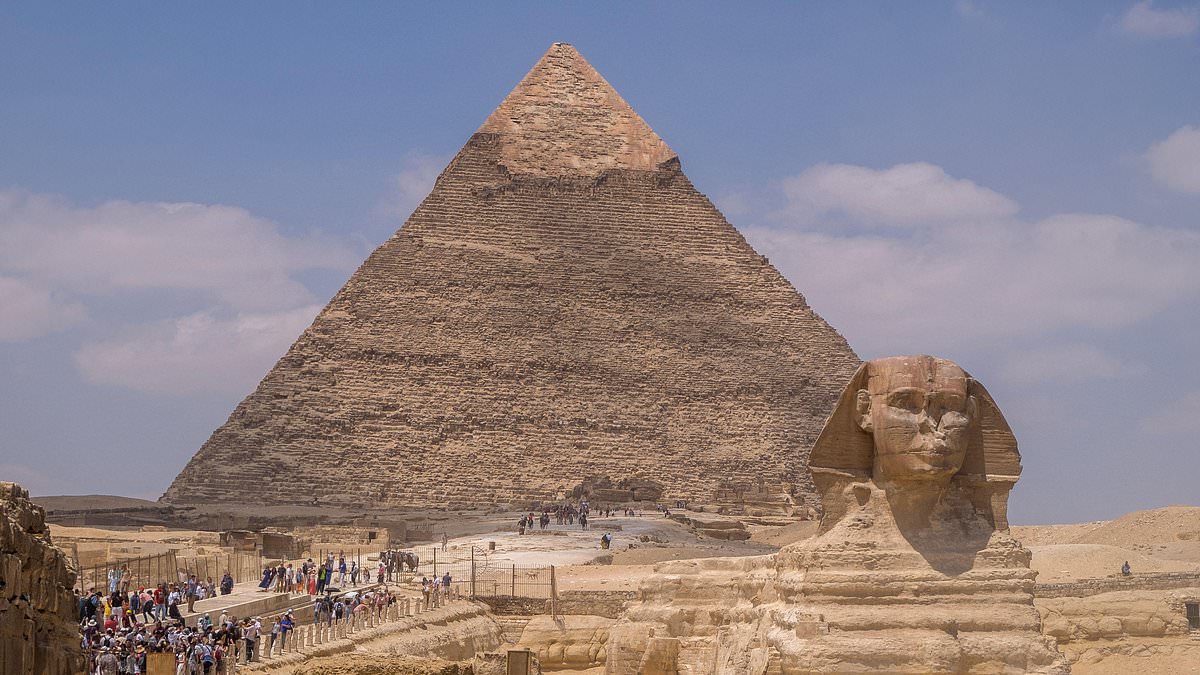
See more Daily Mail on Google - save us as a Preferred Source Published: 14:47 EDT, 27 September 2026 | Updated: 14:47 EDT, 27 September 2026 It is one of the most photographed tourist destinations in the world as people look for a permanent reminder of their visit.But one visitor to the Pyramids of Giza back in 1902 left his own reminder that he had been by carving his name on one of them.Geologists believe it is the work of one of the most recognised ‘citizen scientists’ of his era in Scotland, although they say nailing down his exact identity remains an ‘interesting mystery’.The unusual ‘graffiti’ was uncovered in images taken by Egyptian photographer Osama Sherif Elmedany, which expose carvings made when tourists were free to climb the structures that date back 4,500 years.The inscription reading ‘J Neilson Glasgow 1902’ has been spotted at the peak of the pyramid of Khafre, the second largest of the three main pyramids at the historic site near Cairo.It is believed that the author of the message is James Neilson, a prominent 19th and early 20th-century Scottish scientist, who served as council member and vice-president of the Geological Society of Glasgow. J Neilson left his mark on the Pyramids of Giza in 1902 - but geologists say nailing down his exact identity remains a mysteryNeilson, of Dennistoun, led trips to Scottish sites including Arran and Ailsa Craig with the Andersonian Naturalists’ Society.He also travelled overseas, and in May 1902 produced a paper titled Notes on a Recent Trip to Egypt, which was published in the Transactions of the Geological Society of Glasgow.Ian Millar, secretary of The Geological Society of Glasgow, told The Herald: ‘The year carved [on the pyramid of Khafre] looks to us as 1902. 'This tallies with his time in Egypt, his interest in the rock types used in the construction of the temples and monuments there, and his interest in archaeology as well as geology.’However, he added that the J in the inscription ‘could be John, Jonathan, or Julian, for example, so in the absence of an admission verbally or in writing or other witness evidence, it could never be proven conclusively - [It is] an interesting mystery.’The geological expert added that inscribing names or symbols onto sites of historical or cultural importance ‘appears to be as old as human history’ - although he stressed that such activity is ‘not to be encouraged’.The 1902 author of the pyramid inscription was, however, beaten to it by Sir Thomas Lipton, the Glasgow grocer who became one of the first global entrepreneurs through his Lipton’s Tea brand. He is reported to have paid to have his surname and ‘Scotland’ inscribed into stone above the entrance to the Great Pyramid while in Egypt in 1882.
Glasgow 'graffiti' from 1902 found at the top of one of the pyramids of Giza
Full Article
Original Source
Read the full article at Dailymail →KhanList aggregates and links to publicly available news content. We do not host full articles from third-party sources. Always verify important information with original sources.