
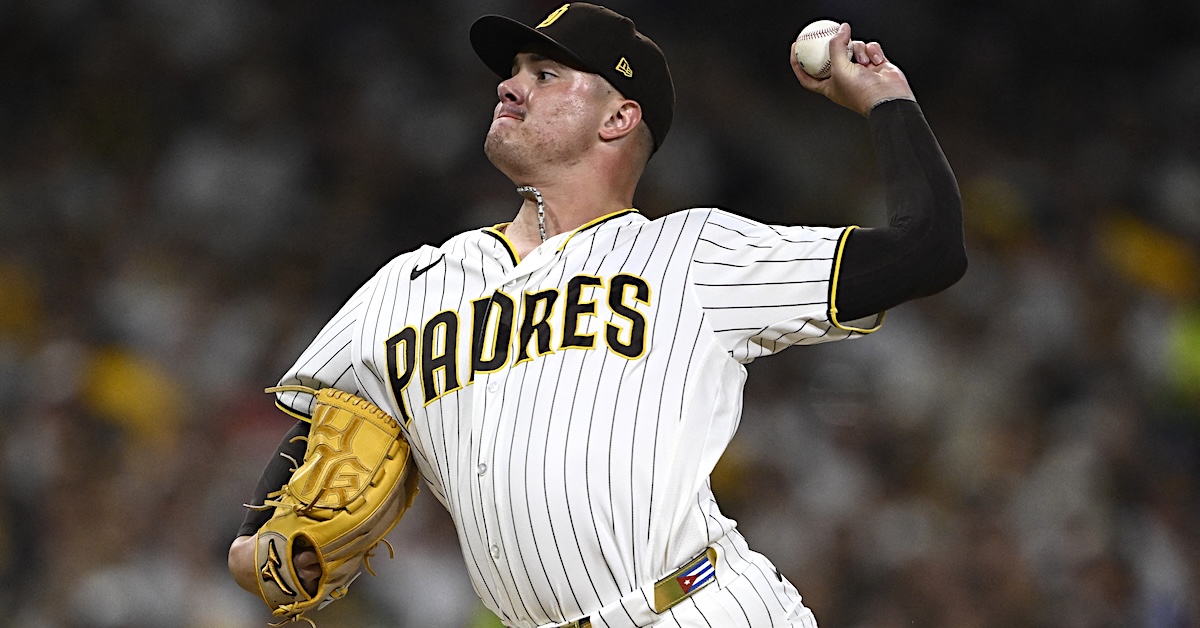
Denis Poroy-Imagn Images I’ve decided that my guy in this free agent class is left-handed pitcher Adrian Morejon. Ben Clemens ranked him eighth on the top 50 free agent list, and predicted that he’d get $72 million over three years. Our readers came to a median estimate of $64 million over four years. I think they’re out of their minds. Me? I would’ve had Morejon no lower than fifth in this caffeine free Diet Pepsi of a free agent class, perhaps as high as third. I’d give Morejon $100 million over five years without blinking. I don’t get the sense that I’m sticking my neck out too far by saying this; someone’s going to pay over the odds for this non-closer reliever because they think they can translate his upper-90s velocity and elite groundball rate to the rotation. Morejon got four or more outs in 25 of his 78 regular-season appearances in 2026, and he has the elite changeup that conventional wisdom requires from a lefty starter. But I don’t want Morejon to start. I’ve got something better in mind. Over the past three seasons, Morejon leads all relief pitchers in innings pitched. He’s third in ERA, sixth in xERA, and ninth in FIP. The Padres used him as a setup guy and general high-leverage stopper, on account of having at least one of either Robert Suarez and Mason Miller available to close games out. So over the past three seasons, Morejon has just eight saves, but that usage pattern put him in position to rack up 60 holds (ninth among qualified relievers), 95 shutdowns (eighth), and a win probability added total of 7.32 (sixth). Morejon also won 25 games over that span, five more than any other relief pitcher. In 2025 alone, he picked up 13 victories; only one of that year’s six Cy Young finalists had more wins. This sparked off a familiar itch in my brain. You Aren't a FanGraphs MemberIt looks like you aren't yet a FanGraphs Member (or aren't logged in). We aren't mad, just disappointed. We get it. You want to read this article. But before we let you get back to it, we'd like to point out a few of the good reasons why you should become a Member. 1. Ad Free viewing! We won't bug you with this ad, or any other. 2. Unlimited articles! Non-Members only get to read 10 free articles a month. Members never get cut off. 3. Dark mode and Classic mode! 4. Custom player page dashboards! Choose the player cards you want, in the order you want them. 5. One-click data exports! Export our projections and leaderboards for your personal projects. 6. Remove the photos on the home page! (Honestly, this doesn't sound so great to us, but some people wanted it, and we like to give our Members what they want.) 7. Even more Steamer projections! We have handedness, percentile, and context neutral projections available for Members only. 8. Get FanGraphs Walk-Off, a customized year end review! Find out exactly how you used FanGraphs this year, and how that compares to other Members. Don't be a victim of FOMO. 9. A weekly mailbag column, exclusively for Members. 10. Help support FanGraphs and our entire staff! Our Members provide us with critical resources to improve the site and deliver new features! We hope you'll consider a Membership today, for yourself or as a gift! And we realize this has been an awfully long sales pitch, so we've also removed all the other ads in this article. We didn't want to overdo it. In case you didn't read all that, here's the short version. Membership includes:✓Ad-free browsing✓Unlimited FanGraphs & RotoGraphs articles✓Historical & platoon projections✓Leaderboard & player-page stat heatmaps✓One-click data exports✓Customizable player-page dashboards✓Dark & Classic site modes✓Weekly Members-only mailbag✓FanGraphs Walk-Off, your year in review✓Optional homepage photo removal✓Gift articles to non-Members✓Full postseason coverage On a long enough timeframe, everything I write about baseball will eventually circle back to one core belief: They should bring back the 1970s-style relief ace. Unless I get fired before Christmas or something, this is not going to be the last time I write about it. Over a long season, it makes a lot of sense for your best relief pitcher to be consigned to protecting close leads in the ninth. Maybe have him throw in a tie game every so often when he hasn’t had a save opportunity in a while, or stretch him out to two innings in an emergency or the playoffs. It makes bullpen management simple, settles everyone’s expectations, massages the relief ace’s ego, and lessens the temptation for overuse. But all things being equal, the modern one-inning closer is not how you get the most bang for your buck from a relief ace. Integration is a useful historical dividing line for professional baseball history, but 1947 is also about the time when relievers started to come into fashion as a distinct pitcher role, rather than a less desirable alternative to the starter. Hugh Casey came back from military service and finished 12th in NL MVP voting in 1947 without making a single start. The Yankees converted Joe Page to full-time relief around the same time, with similar results, and in 1950, Jim Konstanty won the NL MVP Award ahead of teammate Robin Roberts, who threw 304 1/3 innings and tossed five shutouts. The modern closer role has definitely led to some of the best per-inning relief pitcher performances in baseball history. Since 1947, there have been 7,582 individual seasons in which a pitcher has thrown at least 50 innings in relief. The best of those seasons, in terms of ERA-, are almost all from modern closers. The top four are Zack Britton in 2016, Emmanuel Clase in 2024, Fernando Rodney in 2012, and Dennis Eckersley in 1990 — all memorable campaigns. Of the top 100 reliever seasons in ERA-, 84 came from a pitcher who averaged fewer than four outs per appearance. In 44 of those cases, the pitcher in question also registered either a save or blown save in more than half of his appearances. Only one of the top 27 ERA- seasons — Blake Treinen in 2018 — ran 80 innings. What if you sorted by a different metric? Like WAR, for instance? The top 100 WAR reliever seasons include 39 by a pitcher who met my criteria for a closer — fewer than four outs per appearance, more than half of appearances resulting in a save or a blown save — but only one of the top 15 fits the bill. The one exception is Eric Gagne’s 2003, which is not only probably the best season ever by a one-inning closer, but it came at an unusually high volume for that role: 82 1/3 innings. The no. 2 WAR total for a one-inning closer was Mason Miller this season; he only threw 70 innings. If you sort by WPA, you get a mix of one-inning-closer seasons and traditional-relief-ace campaigns: 59 closers, 41 non-closers. Of those 41, another 15 averaged fewer than four outs per appearance. That breakdown makes sense. The one-inning sprinters get the best results, but the multi-inning stoppers throw more volume. WAR and WPA are both counting stats, which reward volume, but WPA especially penalizes pitchers who get overextended and blow up in crucial moments. For example: One of the best and most famous relief seasons ever came from Mike Marshall in 1974. Dodger manager Walter Alston called on Marshall 106 times for a total of 208 1/3 innings, both single-season records for a reliever. And Marshall pitched well, with a 2.42 ERA and a K%+ of 125. He won, and I’d argue, deserved, the Cy Young for doing the work of three high-leverage relievers. To this day, that’s one of the 10 best relief seasons since integration, by WAR. But Marshall finished with a negative WPA, because when you pitch in almost literally every close game, you’re going to have a few stinkers. What we have here is the stolen base conundrum in a different form: Use your relief ace too little and you’re leaving high-leverage outs on the table. Use him too much and you’ll overextend him and get beat. To say nothing of the long-term effects on the pitcher’s body; by the end of his career, the inside of Marshall’s shoulder looked like shredded cabbage. He’s arguably most famous now for his second career as an exercise physiologist. In his one-man lab in Florida, he reinvented the overhand pitching motion in a way that, he claimed, would eliminate elbow injuries. But like so many iconoclasts, Marshall lacked the diplomatic skills to get his techniques adopted — or even tested seriously — by the mainstream. Clearly there’s a middle ground between the conservative modern closer and spreading the relief ace too thin. One thing is for certain: The modern closer role isn’t putting the best pitchers in the highest-leverage situations. Since 1947, there are 61 seasons in which a reliever posted a gmLI (leverage index when entering the game) of 2.2 or higher. Just six of those came from modern one-inning closers. If you lower the gmLI threshold to an even 2.0, you get 237 seasons, 59 of them from modern closers. There has to be a way to make a relief ace’s bullets count for more: Target not just save situations but all late-and-close situations, perhaps even sometimes throwing the relief ace when your team is trailing by a run. That is, of course, what the closer used to do. The top WPA and WAR seasons came mostly from relievers in the 1970s and 1980s, who did exactly that: Willie Hernandez, Dan Quisenberry, Rich Gossage, Kent Tekulve, and Bruce Sutter. I suspect that we’re getting into the Nolan Ryan Memorial Survivorship Bias territory here; these aren’t your normal relief aces. Quisenberry and Tekulve famously threw sidearm or underhand; Sutter had to invent a new pitch. But I dunno, if Miller can throw 70 innings over 66 appearances, and Morejon can throw 86 innings over 76 appearances, couldn’t one of them throw 90 or 100 high-leverage innings in a season through indifference to the save? This is far from an original thought, I’ll grant you. It’s the subject of an essay in Bill James’ New Historical Baseball Abstract, so this has been a thing for at least 25 years. A couple teams have flirted with that role — especially those that have a durable hard-throwing stopper (often, for some reason, a lefty) to pair with a traditional closer. There have been others — most recently Aaron Ashby — but the most famous example was Andrew Miller, on a 2016 Cleveland team whose nominal closer was Cody Allen. In honor of Miller, and at the risk of getting Derek Gardner’d, I give you a new stat: Multi-Inning Lots of Leverage Relief Appearances, or MILLER Appearances, for short. These are relief outings of at least four outs, with an average leverage index of 1 or higher. In the 2026 regular season, 8.6% of all relief appearances were MILLER appearances. That’s the highest percentage since before the pandemic; actually, 2019 and 2020 beat 2026 by less than a hundredth of a percentage point. The last time the MILLER rate got to 8.7% or higher was 2008. And guess who had more MILLER appearances than anyone else this past season? MILLER Appearance Leaders, 2026 Regular Season Source: Baseball Reference Three lefties in the top four. It’s like the three-batter minimum has caused the LOOGY to be replaced by the Lefty Multi-Inning GuY (LMIGY). Someone remind me to come back to this if I get bored during the lockout. Back to Morejon in particular. He had 24 MILLER appearances in 2026; outside of Will Venable’s Bullpen of Perpetual Emergency, no other pitcher had more than 15. Morejon also leads the league in MILLER appearances since 2024; only 12 other pitchers have a 24-pack of MILLER over the past three years combined. And here’s the best part: During this three-season run of excellence, Morejon has been excellent no matter the conditions. But he’s been better when he’s pitching more frequently, and longer. Adrian Morejon by Usage, Since 2024 Split G IP BF ERA Rank Percentile Opp. OPS Rank Percentile 0 Days’ Rest 44 40 2/3 153 0.89 2nd 99th .364 2nd 99th 1 Day’s Rest 74 82 336 2.52 62nd 76th .571 52nd 80th 2 Days’ Rest 42 44 2/3 183 3.22 89th 58th .682 111th 47th Pitch 1-25 211 207 1/3 855 2.78 51st 91st .584 31st 95th Pitch 26-50 27 14 55 0.00 1st 100th .345 5th 96th Source: Baseball Reference Rank and percentile among pitchers with at least 20 relief appearances within the split It’s pretty rare for the high-performance version of a thing not only to be durable but also to get better with repeated usage. Morejon is to relief pitchers what cast iron is to cookware. The actual usage of a relief ace is going to vary wildly, but just for the sake of argument: If last year’s Padres had thrown Morejon for exactly two innings whenever he hadn’t pitched the day before, he would’ve thrown 172 innings. And when Morejon went multiple innings last year, he averaged 5.03 pitches per out; 30 pitches every other day doesn’t seem like a crazy workload. And that’s probably overstating things some; a lot of those six-out outings would probably end up being four or five. He might throw the odd back-to-back, but go two or three days without pitching afterward. But if managing to the save rule gets you 70 innings over 65 appearances, Morejon could have a bigger impact on 70 games over, say, 110 innings. Proposing this has the effect of yada-yada-ing some pretty important particulars: Specifically, you need a manager who’s really good at identifying high-leverage situations before they happen, so Morejon has time to warm up. And he’d have to have the confidence and discipline not to warm Morejon up just in case, and then not bring him in. Over the course of a whole season, with a flesh-and-blood human being to consider, the gap between theory and practice is gigantic. But consider what even a successful relief ace-to-rotation conversion looks like. Let’s set my idea to re-create Goose Gossage from first principles; are you really getting more value by converting a relief ace to a starter? I’m not convinced. Adrian Morejon in Real Life, vs. Some Reliever-to-Starter Conversions Name Seasons G GS IP ERA WAR WPA Clay Holmes 2025-26 26 25 134 3.44 1.9 .760 Griffin Jax 2026 34 23 112 1/3 3.53 1.6 .360 Reynaldo López 2024-26 18 13 73 1/3 2.99 1.4 .840 Adrian Morejon 2024-26 70 0 74 1/3 2.58 2.1 2.430 Source: Baseball Reference Per 162 Team Games And that’s not even considering the possibility that a conversion goes sideways. Don’t get me started about Jordan Hicks. In short: Don’t sign Morejon to be a closer. Don’t sign him to be a starter. Give that man however much money he asks for, and roll the calendar back to 1980.
Give Adrian Morejon All the Money in the World, but Don’t Make Him a Starter
Full Article
Original Source
Read the full article at Blogs →KhanList aggregates and links to publicly available news content. We do not host full articles from third-party sources. Always verify important information with original sources.