
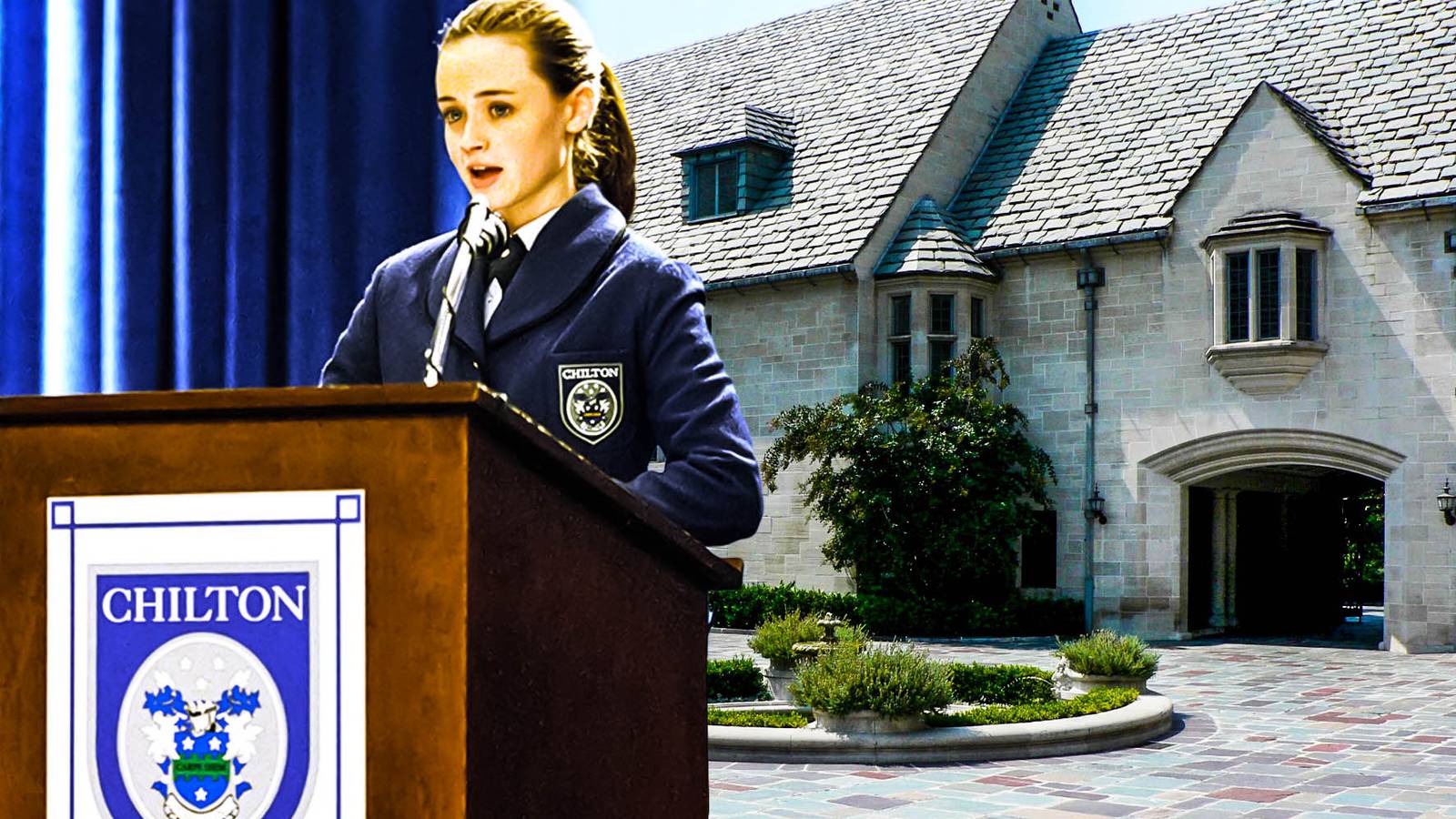
Image via Everett Collection Updated Nov 26, 2026, 2:30 PM EST Sign in to your ScreenRant account The Chilton school, Rory’s prep school from Gilmore Girls, is inspired by a real-life school with a long list of celebrities who went there. In Gilmore Girls, Rory attends the illustrious prep school, Chilton, where the marble floors were once walked on by Harriet Beecher Stowe, a set of banisters was donated by Robert Frost, and a sconce was ceremoniously lit by Thomas Edison. These details may seem far-fetched, but the school that Chilton is based on boasts an even more impressive history. Chilton plays a huge role in Gilmore Girls during the first several seasons of the show and helps lay much of the show’s groundwork. It’s where Rory meets Paris Geller, Rory’s friend throughout the entire series, and it’s the reason for the Gilmore girls’ notorious Friday night dinners at Emily and Richard’s house. Chilton also facilitates Rory’s acceptance to Yale, where Rory meets her boyfriend, Logan Huntzberger. Not only was the Chilton school important in the fictional world of Gilmore Girls, but the real Chilton school had its fair share of famous attendees. The Real Chilton School Choate Inspired Chilton Like in Gilmore Girls, the real Chilton school is located in Connecticut, only 26 miles from where Chilton is set in Hartford. And, like Chilton’s historic marble floors and banisters, the real campus includes a building built by an American patriot with a secret passage behind the chimney that may have been used on the Underground Railroad. At Chilton, Rory participates in many extracurricular activities in preparation for college. She is on the school paper, The Franklin, and Rory argues hemlines and tree-planting on the Chilton student council. Likewise, the real Chilton school, named Choate Rosemary Hall (known as “Choate”), has a prestigious school paper, The Choate News, and a student council, along with many other specialized clubs. In Gilmore Girls, Rory gets accepted to Yale, Harvard, and Princeton, like most graduates from Choate who go to Ivy League schools and continue into upper-echelon careers. Since its founding, Choate has educated hundreds of celebrated alumni, including directors, writers, actors, politicians, Olympians, and even a future president. Who Went To The Real Chilton School Many Politicians And Celebrities Went To Choate Having educated a host of the country’s greatest minds and celebrities, the real school that inspired Chilton also possesses an impressive list of alumni. One of the earliest graduates from Choate in 1910, Caresse Crosby was known as the “literary godmother of the Lost Generation of expatriate writers in Paris” after founding the Black Sun Press and publishing the first works from names like Ernest Hemingway, Henry Miller, Anais Nin, and Charles Bukowski. Pulitzer-prize-winning playwright Edward Albee is also a graduate. A-list actors Michael Douglas, Glenn Close, Jamie Lee Curtis, and Paul Giamatti all went to the real Chilton school. State representatives, senators, ambassadors, a U.S. Congresswoman, a U.S. Secretary of Commerce, as well as the country’s 35th president, John F. Kennedy, all walked the halls of Choate, creating a remarkable legacy even more distinguished than Chilton’s from Gilmore Girls. Rory Gilmore's Experience At Chilton Rory’s Experience Differs Slightly From Reality One of the big differences between Chilton and Choate is that Choate is primarily a boarding school. Students live on campus in dorms as part of the way the school helps to prepare them for university life. Rory, on the other hand, drives back and forth to school on a regular basis. Choate also offers a program called their Postgraduate Year, allowing students to apply to spend a year at Choate after graduating high school for the academic year before going to college. It allows students another year to prepare for university, taking additional courses, and pairs them with a counselor to help prepare them further. Chilton never gave Rory the option of a postgraduate course schedule. One thing that classroom studies have demonstrated over the years is that smaller class sizes lead to better education. Teachers are able to devote more time to individual students instead of simply lecturing a class. Choate follows that philosophy. Classroom sizes in 2026 range from five to 14 students, according to their official website. That’s not the case when Rory is at Chilton. Other than these specific differences, however, Rory’s experience at Chilton doesn’t seem to be all that different from students attending Choate in the real world. She is still engaged in rigorous academic courses, multiple extracurricular activities, and actively preparing to attend a university after she leaves high school in Gilmore Girls. Release Date 2000 - 2007-00-00 Network The WB, The CW Directors Jamie Babbit, Amy Sherman-Palladino, Lee Shallat Chemel, Kenny Ortega, Michael Katleman, Matthew Diamond, Michael Zinberg, Gail Mancuso, Lesli Linka Glatter, Steve Clancy, Bethany Rooney, Jackson Douglas, Robert Berlinger, Steven Robman, Alan Myerson, Lev L. Spiro, Rodman Flender, Adam Nimoy, Arlene Sanford, Bruce Seth Green, Danny Leiner, David Paymer, David Petrarca, Eric Laneuville In the fictional town of Star's Hollow, single mother Lorelai Gilmore raises her high-achieving teenage daughter Rory. Mother and daughter rely on each other throughout their own life changes, romantic entanglements, and friendships. Writers Rebecca Rand Kirshner, David S. Rosenthal, Sheila R. Lawrence, Jennie Snyder Urman, Joan Binder Weiss, David Babcock, Bill Prady, Gayle Abrams, Gina Fattore, Jane Espenson, Jenji Kohan, Keith Eisner, James Berg, Stan Zimmerman, Allan Heinberg, Jed Seidel, Jessica Queller, Lisa Randolph, David Grae, Rina Mimoun, Jordon Nardino, Scott Kaufer, Joanne Waters
Gilmore Girls: The Real Life Chilton School (& Celebrities Who Went There)
Full Article
Original Source
Read the full article at Screenrant →KhanList aggregates and links to publicly available news content. We do not host full articles from third-party sources. Always verify important information with original sources.