
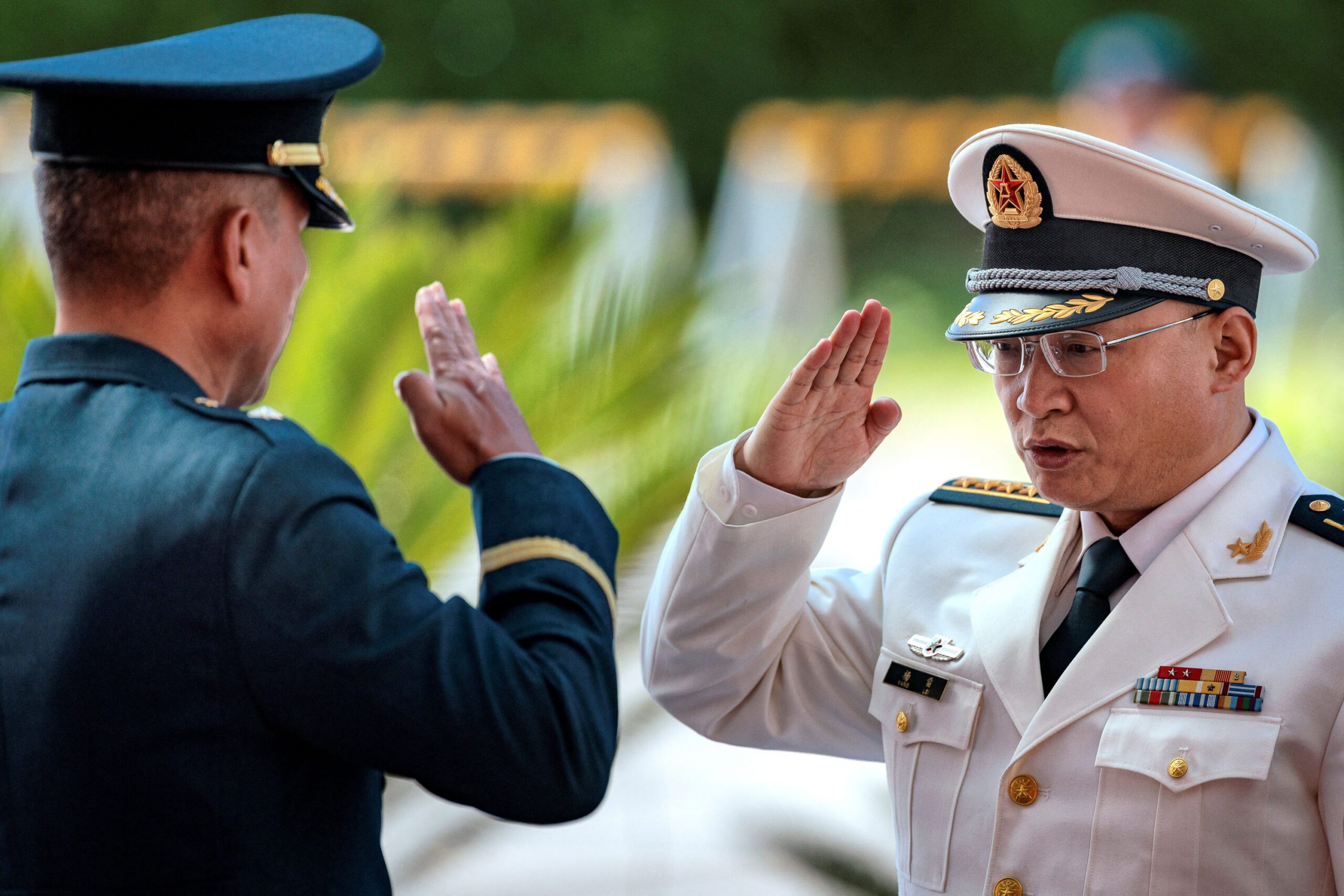
CHINA REPRESENTATIVE. China Defence Attache Senior Captain Yang Lei arrives for the ASEAN Defense Ministers' Meeting at Mactan Expo in Cebu on October 29, 2026. Ezra Acayan/Pool via Reuters Bilateral ties between the two countries take another tense turn as Beijing sends its Manila-based defense attache to a high-level ASEAN meeting chaired by China-sanctioned Defense Secretary Gilberto Teodoro Jr. It was but a bit of drama in what is usually a predictable ritual in any meeting under the Association of Southeast Asian Nations (ASEAN). As China’s representative to the ASEAN Defense Ministers’ Meeting made his way down a short red carpet walk at the Mactan Expo in Lapu-Lapu City, the camera panned to show the Philippines’ representative. Then a handshake and a quick pause for the cameras. What was not so routinary were the ranks of the two representatives. For China, it was the defense attaché assigned to the embassy in Manila. For the Philippines, an undersecretary who’s been representing the country in senior officials’ meetings. Just a few minutes ago, no less than Defense Secretary Gilberto Teodoro Jr. welcomed representatives of ADMM’s Plus partners — including deputy ministers ranked below him — to the meeting. It was a snapshot (or a preview, maybe) of the awkwardness and complications that can happen when a Filipino official sanctioned by Manila’s sometimes belligerent neighbor is also chairperson of a regional bloc. There are a lot of things to unpack from the quick exchange. First, for the first time, China sent only a defense attaché — who is based in the Philippines anyway — to represent it in ADMM, ASEAN’s premiere platform for defense diplomacy. Chinese Communist Party tabloid Global Times framed it this way: it was the “lowest-level Chinese representation at the ADMM-Plus since its inaugural session in 2010” and that, quoting analysts, the “downgraded attendance is attributable to the Philippines.” The snub didn’t originate from Beijing. In early September 2026, when asked about China’s participation in the ADMM-Plus, Teodoro was uncharacteristically coy when asked how he’d handle hosting his Chinese counterpart. When pressed if there was a chance they wouldn’t be invited, Teodoro played coy, too. By mid-October 2026, Teodoro conceded that it could be awkward for China to participate in person. After all, the Chinese embassy in Manila and Beijing itself have tagged Teodoro as a problem. In June 2026, the Ministry of Foreign Affairs imposed sanctions on Teodoro and his immediate family after he supposedly “repeatedly made irresponsible remarks on China, which undermines China’s legitimate interests and sabotages China-Philippines relations.” On October 23, or just days before defense ministers and other top officials from ASEAN and its partners were expected to fly to Cebu province for the meeting, Teodoro told a press conference that an invitation had been extended to China to participate in the meeting. The letter was signed by Undersecretary Ignacio Madriaga, who would eventually welcome the defense attaché. On October 26, Teodoro said he didn’t know if Beijing had replied to Madriaga’s letter. Although a country — be it an ASEAN member-state or any of its partners — must be invited by the chairman or host to participate in these multilateral events, these invitations are practically compulsory. The host country is expected to extend that invitation, regardless of bilateral issues. By the 27th, China’s Ministry of Defense announced that Senior Captain Yang Lei, the defense attaché to Manila, would represent Beijing in Cebu. There could be a myriad of reasons for Teodoro to skip welcoming Yang. Teodoro is, after all, ranked significantly higher than a senior captain. There are also many possible reasons for Chinese Defense Minister Dong Jun to skip ADMM-Plus. But everything is backdropped by what’s turning out to be the tensest turn yet for Philippine-China ties. Chinese ambassador Jing Quan was summoned and widely criticized for saying the Philippines should be thankful that China does not use force in its disputes with the Philippines, as he reacted to Teodoro’s insistence that it’s Beijing that’s causing trouble in the region. “Our functional cooperation must remain rooted in mutual respect and adherence to international law, including the United Nations Charter and the 1982 Convention on the Law of the Sea. ASEAN Member States and Dialogue Partners share the same principles, such as respect for sovereignty and territorial integrity, non-interference in internal affairs, the peaceful settlement of disputes, and the renunciation of the threat or use of force,” said Teodoro at the opening of the meeting. For years, of course, Teodoro has been among the loudest critics of Beijing in the Philippine government. Before China announced sanctions against him, Teodoro warned military and defense officials at the Shangrila Dialogue in Singapore that Beijing was not trustworthy in the context of South China Sea code negotiations. China claims almost all of the South China Sea. It’s a claim that overlaps with claims of Southeast Asian countries, including the Philippines’. For Manila, China’s claims have meant facing danger of harassment at sea in certain areas and features. For Beijing, it’s meant danger too — two of its China Coast Guard personnel died in a collision with its own warship, as both were trying to chase a Philippine Coast Guard ship. – Rappler.com How does this make you feel? Loading
Gibo snubs China at ADMM-Plus
Full Article
Original Source
Read the full article at Rappler →KhanList aggregates and links to publicly available news content. We do not host full articles from third-party sources. Always verify important information with original sources.