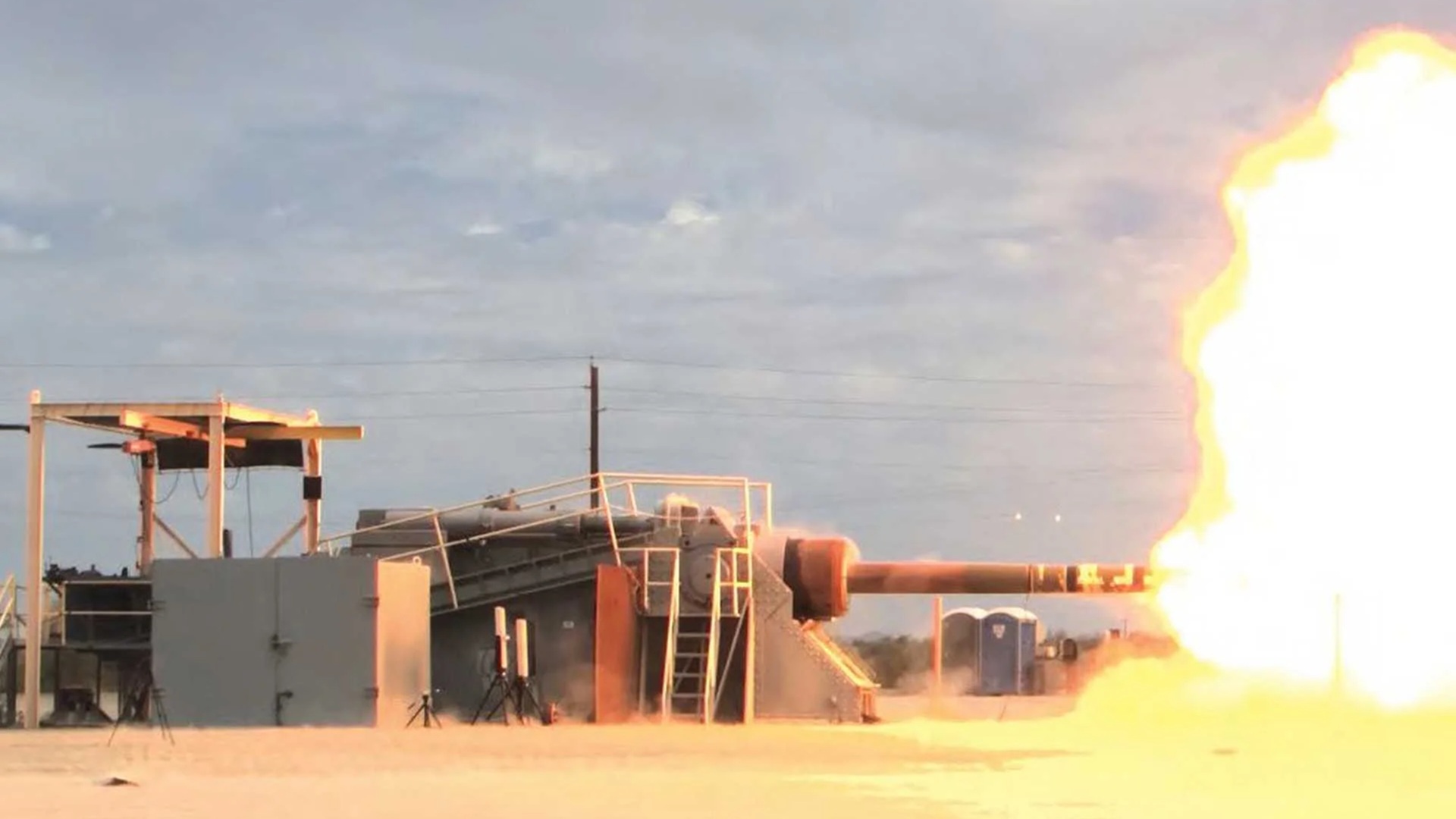
The Heavy Artillery Test System (HATS), developed under the US Army's Strategic Long Range Cannon (SLRC) program.U.S. Army The US Army has reportedly completed the first live-fire hypersonic test using the Heavy Artillery Test System (HATS), a repurposed launcher that was developed for the canceled Strategic Long Range Cannon (SLRC) program. The test took place on July 30, at the Yuma Proving Ground (YPG) in Arizona. The site is a massive U.S. Army military testing installation. It spans over 830,000 acres in the southwestern part of the state, roughly 30 miles north of the city of Yuma. According to reports, the trial was conducted through a collaboration between the U.S. Army’s DEVCOM Armaments Center, the Lawrence Livermore National Laboratory (LLNR), and the test range. For the project, the team fired a specially made Integrated Launch Package (ILP) from the HATS, instead of a hypersonic missile. ILP is a hardened test package carrying the experimental payload. The test demonstrated a faster, cheaper way to evaluate hypersonic payload performance at impact. Inside the trial The cannon used in the trial was adapted from the now-canceled Strategic Long Range Cannon (SLRC) program. The original cannon was intended to fire rocket-assisted precision-guided projectiles at targets over 1,000 miles (1,609 kilometers) away and far beyond the range of conventional 155-mm artillery. However, the program was canceled after the Congress ended dedicated funding in 2022. Now, instead of abandoning the technology entirely, the U.S. Army chose to repurpose the launcher as a test platform for hypersonic research. For the test, the U.S. Army launched only the warhead and its protective package from the cannon, rather than utilizing a complete hypersonic missile. Hypersonic speed is defined as Mach 5 (equal to five times the speed of sound or 3,806 miles per hour at sea level) or higher. Meanwhile, the ILP shielded the warhead during launch. The system also included a specialized electronic Safe-and-Arm Device designed to keep the fuze inactive until the appropriate point in the flight. Reusing the SLRC cannon During the test, the engineers tracked the projectile using telemetry, high-speed cameras, and other range instrumentation to evaluate how the package behaved after leaving the barrel and striking its target. The method isolated the final stage of a weapon’s mission. It made it possible for the engineers to study how the payload performs on impact, without the expense of an operational missile. It also marked the first live-fire test of the hardened ILP, confirming it could withstand the extreme forces during cannon launch. According to the U.S. Army, the resulting data is set to support the development of future hypersonic weapons while reducing the number of costly full-scale flight tests needed. Reports disclose that a single complete hypersonic missile test can typically cost anywhere from USD 9.5 million to over USD 15 million per launch, depending on the testing vehicle and program scope. By contrast, the cannon-based approach significantly reduces testing costs. While it can’t replace conventional hypersonic missile trials, the U.S. Army believes that the approach can complement wind tunnels, laboratory experiments, rocket sleds, and live missile launches, as part of a broader hypersonic testing strategy. Recommended ArticlesGet the latest in engineering, tech, space & science - delivered daily to your inbox.Based in Skopje, North Macedonia. Her work has appeared in Daily Mail, Mirror, Daily Star, Yahoo, NationalWorld, Newsweek, Press Gazette and others. She covers stories on batteries, wind energy, sustainable shipping and new discoveries. When she's not chasing the next big science story, she's traveling, exploring new cultures, or enjoying good food with even better wine.
Giant US Army cannon fires hypersonic warhead in first successful live-fire test
Full Article
Original Source
Read the full article at Interestingengineering →KhanList aggregates and links to publicly available news content. We do not host full articles from third-party sources. Always verify important information with original sources.