
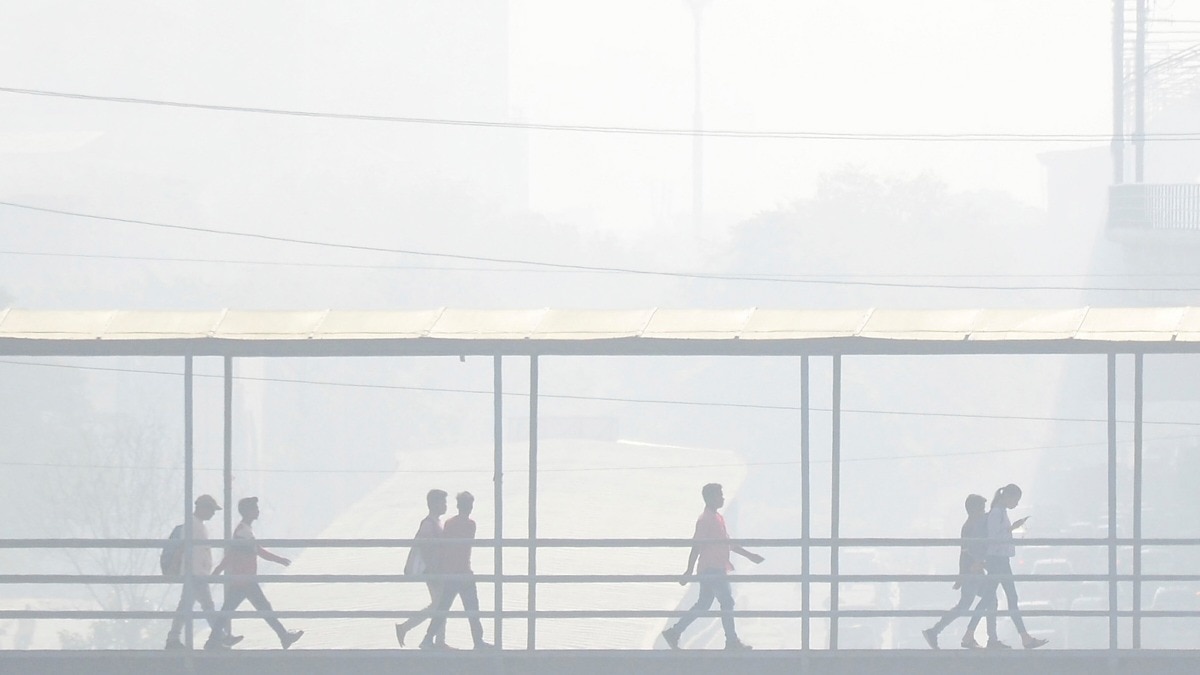
Delhi is battling toxic air, but Ghaziabad's pollution is even worse. Here's what's driving the AQI spike across NCR ahead of Diwali.Commuters use a foot overbridge amid smog in Delhi-NCR. (Photo: PTI)New Delhi,Nov 3, 2026 11:00 ISTGhaziabad's air turned worryingly unbreathable on Tuesday morning, November 3, with the city's Air Quality Index (AQI) crossing 500 and rising well above Delhi's, as pollution tightens its grip on the National Capital Region (NCR) days before Diwali.Ghaziabad recorded an AQI of 516 at 8:31 am, its highest reading in the last 24 hours, according to AQI.in data.Delhi, meanwhile, lagged behind with an AQI reading of 456 at the same time. A layer of smog envelops Delhi as air quality slips even further. (Photo: PTI) Both cities were battling extremely polluted air, but Ghaziabad's reading stood out as particularly alarming, and raised eyebrows as its pollution outshone the national capital, which is often associated with smoggy mornings and unbreathable air. The difference raised the point of how pollution levels can vary across neighbouring cities, even when they experience the same broader weather conditions.While Delhi's air quality has been deteriorating over the past few days, Ghaziabad appears to be bearing an even heavier burden. A graph illustrating Ghaziabad's AQI in the last 24 hours. (Photo: AQI.in) WHY IS GHAZIABAD MORE POLLUTED THAN DELHI?The gap in the pollution levels is not necessarily because of a single source of pollution.Ghaziabad's air is affected by a combination of vehicle emissions, industrial activity, construction, road dust and the burning of waste.Meanwhile, the Commission for Air Quality Management (CAQM) has repeatedly identified transport, industries, dust and biomass burning among the major contributors to pollution across Delhi-NCR. Commuters move amid a thick layer of smog, in Ghaziabad, UP. (Photo: PTI) Ghaziabad's industrial clusters, congested roads and construction activity often add to the local pollution load, while Delhi faces substantial emissions from traffic, industries and other urban sources.These pollutants, however, don't confine themselves to geographical boundaries, travelling across the region, worsening air quality in neighbouring areas, too.This is also why pollution levels can differ from one location to another. Local emissions, wind direction and weather conditions determine where pollutants accumulate and how quickly they disperse. A graph illustrating Delhi's AQI in the last 24 hours. (Photo: AQI.in) HOW PAKISTAN AND PUNJAB ARE FUELLING THE SMOGThe latest pollution spike comes amid a rise in stubble-burning incidents in Punjab, with satellite images capturing a growing number of farm fires.Smoke from these fires is now emerging as a significant contributor to the deteriorating air quality across northern India.But another factor that has emerged recently is the contribution of the farm fires across the border in Pakistan. Smoke from agricultural burning in Pakistan and Punjab could move towards Indian territory as northwesterly winds carry pollution eastwards, bringing it closer to Delhi-NCR. A satellite image shows the farm fire spots in Pakistan and Punjab. (Photo: Nasa) According to recent weather assessments, northwesterly winds are expected to continue for the next four days.This could transport smoke and pollutants from burning fields towards Punjab, Haryana, Delhi, Ghaziabad and other parts of northern India, adding to the pollution already generated locally.POLLUTION IS HERE TO STAY THIS WEEKAll of this is happening as Delhi-NCR enters its annual post-monsoon pollution season. A Namo Bharat Rapid Rail passes over a bridge amid smog, in Ghaziabad, Uttar Pradesh. (Photo: PTI) Falling temperatures, relatively calm winds and unfavourable atmospheric conditions can trap pollutants closer to the ground, preventing them from dispersing.The absence of an active western disturbance is another concern as such weather systems can bring rain and stronger winds that help clear the air. With no significant western disturbance expected for at least a week, the region may not receive that relief anytime soon. An AQI reading in Noida at 10:50 am on November 3. (Photo: India Today) The timing is particularly worrying, with Diwali just days away. Firecrackers, increased traffic and festive activity could add another layer of pollution to an already deteriorating situation.The CAQM has invoked Stage 2 of the Graded Response Action Plan (GRAP) across NCR to mitigate the situation.However, with farm fires increasing and northwesterly winds continuing, Delhi, Ghaziabad and neighbouring cities could face another prolonged spell of toxic air.- Ends
Ghaziabad's 516 AQI beats Delhi's 456: What's happening in NCR is worrisome
Full Article
Original Source
Read the full article at Indiatoday →KhanList aggregates and links to publicly available news content. We do not host full articles from third-party sources. Always verify important information with original sources.