
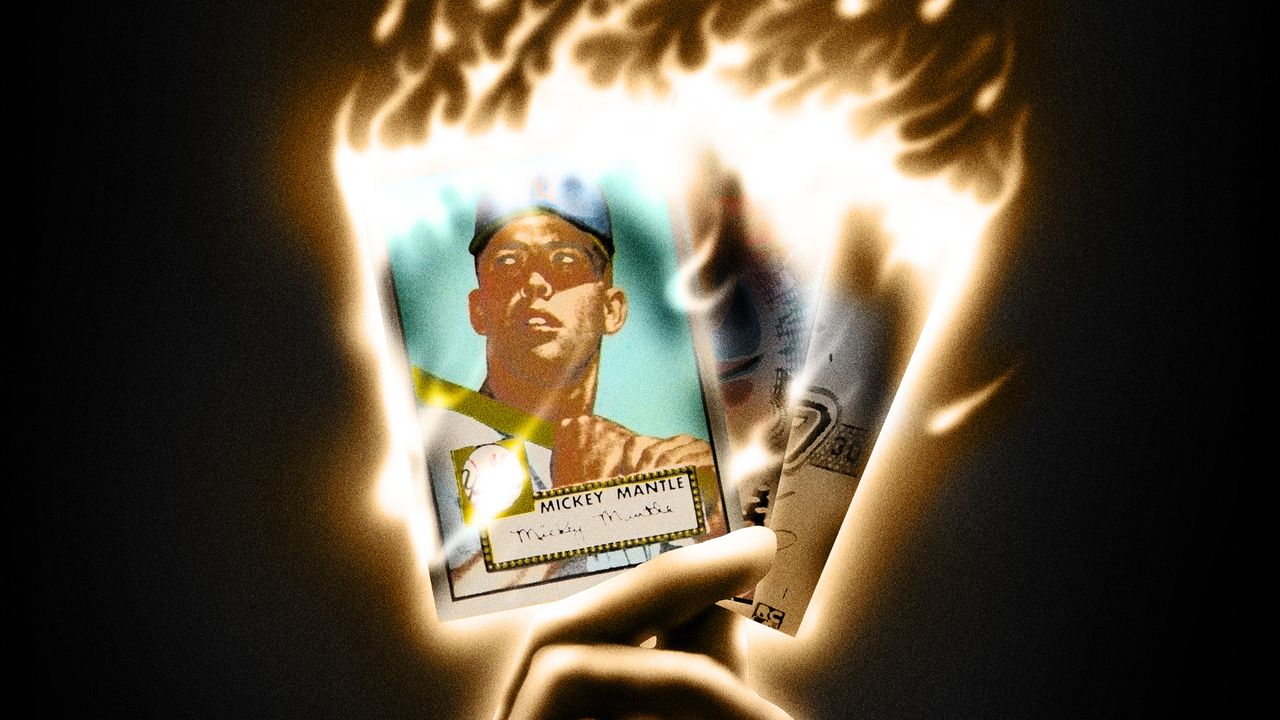
On a sunny afternoon this April, I pulled into one of the many strip malls dotting the Sopranoland sprawl northwest of Manhattan. Sitting there in Totowa, New Jersey, wedged between a Guitar Center and a tile wholesaler, was an outpost of a sports card and memorabilia business called Trace ’n Chase. I’d understood the store was making gobs of money. But, as I walked across the empty parking lot toward it, it didn’t look like much more than a warehouse.At the door, I had to be buzzed in, like at a jeweler. Inside, Trace ’n Chase looked like a particularly fancy version of the sleepy card shops I went to as a kid. It was brightly lit and pristine. The walls were covered with glass display cases full of sports cards. Signed jerseys and balls were stacked to the ceiling, which was tall enough to accommodate a basketball court that took up half the showroom. But why did the building need to be this massive? Danny Vallario, a 23-year-old employee, wanted to show me.He led me behind the display cases, past a locked door, into a two-story complex with around 80 employees, all dedicated in some capacity to selling sports cards online. We passed the shipping room, where about one million orders will leave the facility this year. Further back was “The Cage,” a padlocked steel cell holding thousands of boxes, each filled with unopened foil-wrapped packs of cards. But the heart of the operation was a handful of sound-proofed rooms adjoining a narrow hallway. From these rooms alone, Trace ’n Chase projects it’ll earn about $85 million in revenue this year.The rooms are studios for Vallario and his fellow Trace ’n Chase “breakers,” a new type of entrepreneur—part livestreamer, part QVC host, part auctioneer—who sells trading cards through internet broadcasts called “breaks.” Breakers stream themselves opening sealed packs of trading cards. Their viewers purchase the right to own particular cards that might lie within those unopened packs, hoping that those cards will surface and that their resale value will exceed what they paid.Breaking has exploded since the pandemic, amid a wider boom in trading card collecting—or as fans call it, “The Hobby.” Headlines abound of rare and sought-after cards fetching eye-popping sums. Last year, a one-of-one rookie card of Paul Skenes, the Pittsburgh Pirates ace, sold for $1.1 million at auction, just months after an 11-year-old boy pulled it from a pack he got for Christmas. In February, Logan Paul sold a Pokémon card (and a custom bust down diamond chain to hold it) for $16.5 million, up from the $5.3 million he paid for it five years earlier. A month later, Shark Tank’s Kevin O’Leary wore a similar necklace encasing a basketball card, estimated to be worth as much as $30 million, to the Oscars red carpet.Valuations like these have turned The Hobby into a Wonka-esque hunt for life-changing Golden Tickets. But joining the hunt isn’t exactly as simple as walking into a store and buying a pack. Card flippers track retailers’ restocks and vacuum up inventory as soon as it hits shelves, purchasing as many packs as they can. (In 2021, such frenzy reportedly led to a man drawing a gun in a Target parking lot in Wisconsin when four other shoppers allegedly assaulted him.) When the most coveted boxes of sealed packs are available on the secondary market, they can go for thousands of dollars a pop.To have a prayer of finding one of these rare cards (and with it, generational wealth), collectors turn to breaks. They tune in daily to watch hundreds of packs get opened over the course of hours-long streams. If this calls to mind a glazed-eyed person endlessly feeding coins into a slot machine, you’re not alone. Some have begun to argue that breaking has, in effect, smuggled gambling into The Hobby like a dog’s pill in peanut butter. Others say it’s just an entertaining update to an old pastime, connecting collectors together over a shared passion. Either way, breaking is yet another way men are getting rich and going broke on the Internet.The pristine showroom at Trace ’n Chase in Totowa, NJ. Courtesy of Charlie SosnickLooking around Trace ’n Chase, I gathered Vallario was doing well for himself. Just a few years ago, he was playing on the offensive line for Fairleigh Dickinson University’s DIII football team, and he looked like he still could. His buzzcut connected to an equally close-cropped beard, and he wore a gray sweatsuit. Almost every guy at the shop (and it was almost all guys) was wearing sweats.As we toured The Cage, Vallario led me to a black safe that contained the most valuable inventory in the facility. He eagerly showed me an autographed Luka Dončić card that featured the NBA patch from a game-worn jersey (known as a “Logoman” card). The shop was holding it for a client who needed to fly in from Hong Kong to take it home. The card’s owner, Vallario said, had already turned down $1.2 million for it. Cards like this are why you have to be buzzed into the store, and why surveillance cameras and panic buttons are situated throughout, and why, despite their ceaseless sports bar banter and backwards ball caps, Trace ’n Chase’s guys sort cards with the seriousness of bank tellers.Vallario started breaking six years ago, during his first college semester. Covid quashed his football season and, at his older brother’s suggestion, he began opening football and Pokémon cards on Discord. Vallario noticed card resale prices ballooning and did what he could to secure packs, camping outside of Target in the middle of the night to beat others to restocks.The next year, he moved to streaming on a site called Whatnot, which had emerged as the go-to platform for breaks, and eventually identified a market niche: If he worked the graveyard shift, from 3 to 9 a.m., there was no competition. As he grew his channel, football and school competed for his time. He developed an umbilical hernia, healed from a brutal surgery, then popped it again two weeks before the season. “ I called my coach, and said, ‘This is a sign from God,’” Vallario told me. “‘I'm living a double life trying to work a business and trying to be a college kid.’”So Vallario dropped out. Then it was “two years of just outworking everybody,” he said. Along the way, he started working for a breaking business called RipHamiltonRips, which teamed up with Trace ’n Chase, headquartered in Greece, to open the Totowa shop. As the roster of streamers grew to about 25 strong, Vallario became a de facto manager.The business is on pace to run about 7,000 streams this year. At least one Trace ’n Chase breaker is broadcasting almost 24/7. The night before my visit, Vallario had been up until two in the morning, opening 960 packs of cards for the camera. “My hands hurt so bad, bro,” he groaned in his Staten Island accent. During my tour, multiple employees recalled, with the unmistakable chuckle of a happy memory you never want to relive, when Vallario once ran a 38-hour long stream.Eventually we made our way to the streaming rooms. Each had two cameras (one to focus chest-up on the breaker, another on his hands), a table topped with a branded mat, a plastic tray for sorting opened cards, Yves Klein blue walls, and a garbage can filled with foil wrappers and cardboard.I settled into one of the rooms with Vallario and another breaker, his childhood friend Nick DiNicola, as they prepared for a stream. Five sealed boxes of 2025-26 Topps Chrome Basketball Sapphire cards sat on the table. Each contained eight packs of four cards (with one card in each box guaranteed to have an autograph). The boxes resell, unopened, for about $5,000 apiece. A single card enclosed within might go for multiples more, or the combined value of all the cards might barely come close.DiNicola turned on the new Ye album and fired up the livestream, triggering notifications for any of their 200,000-plus followers to join. They fell into an easy, endless repartee familiar to anyone who’s listened to a Tri-State area sports radio show: What’s up with Francisco Lindor? Who should the Knicks protect in an expansion draft? Should Jets fans just take the season off? As viewers joined, Vallario and DiNicola greeted many of them by screen name: “GMan, definitely bring the kids, bro. Come through whenever.”Learning the mechanics of a break can feel like having a complicated board game explained to you at a dinner party, but the goal for viewers is simple: to walk away with cards worth more than what they paid. At the start of a break, viewers bid on “slots” that guarantee them ownership of particular cards, should they appear in the packs opened during the stream. In some breaks, the slots represent individual players (win a LeBron James slot and, if a LeBron card is found in one of the packs, the breaker ships it to you); in others, the slots represent teams (a 76ers slot could earn you a LeBron or any other player from the team). Slots that can land more valuable cards, naturally, go for more money.That day, Vallario and DiNicola were running a random player break – this one had 328 slots, each auctioned off in 30-second bursts, then assigned to a random player with the spin of a digital wheel. The first one went for $36. “Not the greatest start there,” remarked DiNicola. The potential windfall, he tried to persuade his viewers, warranted a higher price. “These should be around $100. Take every slot at this price.”There was some excitement when someone landed on Dylan Harper with their $55 slot. Even the most common Harper cards in the set, in good condition, could be worth several times that, and rarer varieties could go for thousands of dollars. Or, if there wasn’t a single Harper card among the 160 in those boxes, that viewer would be shipped a consolation card instead, having forked over $55 for something that could be worth barely more than the cardboard it’s printed on.This process was merely prelude. Breakers don’t begin opening packs until every slot gets filled and, until then, the action would consist of little more than watching a roulette wheel populate a spreadsheet. There were hours to go and I couldn’t stick around. To that point, Harper was the only player of note the wheel had turned up. As other bidders landed on less collectible players like Aaron Wiggins, Cason Wallace, and Gradey Dick, they had almost certainly already lost money on their buy-ins. But still, the chance of huge hits had loomed over the chat, the way anglers talk about a huge fish they once saw and still believe is out there.As I returned to the parking lot, I thought back to the stream where Vallario opened the one-of-one Luka Dončić that sat in The Cage’s safe. When he unsheathed the card, he simply screamed, “OH MY GOD! OH MY FUCKING GOD!” Dismal as the odds may seem, landing a life-changing piece of cardboard like this was the hope that sustained. “That's the beauty of it, bro. This stuff is all hype,” Vallario had told me. “Sports is all hype. Trading cards is all hype. It's all hype.”Roughly $25,000 worth of sealed boxes of cards, lined up for a break. Courtesy of Charlie SosnickIf you collected sports cards as a kid, you might be wondering where all these six- and seven-figure cards came from, especially the freshly printed ones. Scarce cards (such as the 50ish known examples of the T206 Honus Wagner from 1909) and hotly desired ones (like the rookie cards of beloved stars) have long drawn big price tags. But never before have supply and demand for high-end cards been so perfectly calibrated.Though versions of sports cards have existed since the 1860s, their modern history begins with Topps in the 1950s. For decades, Topps was the undisputed king of cards, effectively controlling the stream of collectibles to collectors. While some cards from this era eventually became extraordinarily valuable, like the 1952 Topps Mickey Mantle, they were generally worth very little at the time. In 1980, an antitrust suit opened the door to competitors like Fleer, Upper Deck, Donruss, and Score, flooding the market with cards. Print run details are kept secret, but according to one estimate in The Athletic, Donruss printed somewhere between 3.7 and 10 billion cards in 1991 alone—and that’s just one company. Collectors refer to the peak of this production glut, the late ’80s and early ’90s, as the Junk Wax Era.Out of this dark age emerged perhaps the biggest innovation in sports card history: the insert. In the early-90s, manufacturers began putting a limited, publicized number of cards—eventually with shimmering holographic material—in with the rest of the pack. Within any print run, they could inject a finite supply of rare, flashy cards to work collectors into a froth.Card manufacturers continued developing increasingly baroque forms of special edition cards. In 1997, Upper Deck introduced the relic card, which includes a piece of game-worn jersey, bat, glove, or other equipment in the card itself. That same year, Fleer created the first one-of-one cards. Today, Rookie Debut Patch Autos—one-of-one rookie cards that contain a piece of game-worn jersey from a player’s first game and their autograph—represent the stratospheric top of contrivances in rarity and, by extension, price.Still, for various reasons—video games? The Great Recession?—demand for cards declined in the new millennium, the industry contracted, and The Hobby sputtered along. Then, a novel coronavirus appeared in Wuhan, China.Stuck inside with nothing to do, people picked up new hobbies or, as was the case for many collectors I spoke to, revisited old ones. Now, they could buy cards with their adult salaries instead of an allowance. Between stimulus checks and canceled vacations, many found they had some extra cash. eBay reported a 142% increase in trading cards sales in 2020, citing “an industry-wide surge in collecting and flipping” due in part to fans “turning to cards while there was a lack of sports on TV.” That year, for the first time since the industry’s early-90s peak, total sales of new sports cards reached an estimated $1 billion.Then, in January 2022, Topps was acquired by Fanatics, the $31 billion conglomerate that rose to prominence as a sports apparel retailer. Under Fanatics, Topps cemented exclusive trading card licenses with the MLB, NBA, NFL, and their respective players’ unions, eventually becoming the sole official card manufacturer for the three leagues. (Upper Deck still has the license for the NHL and its union.) Now, amid new highs in demand, one company is able to carefully manage the majority of the official sports card supply, avoid the overproduction of the Junk Wax Era, and double down on developing incredibly rare chase cards, all culminating in today’s mind-bending, headline-grabbing valuations.A one-of-a-kind Luka Dončić “Logoman” card once held in a safe at Trace ’n Chase. Courtesy of Charlie SosnickBreaking was primed to serve this market. Versions of it had existed since the 1980s, when collectors at hobby shops and trade shows would split a box of cards. By the late aughts, some sellers started offering break spots over the phone, then uploading videos of the unboxing later to show buyers what they’d hit. These evolved into livestreamed breaks, which play out across a number of platforms, but perhaps none have captured The Hobby’s enthusiasm quite like Whatnot.The site was originally launched as a marketplace for Funko Pops in 2019, but soon became a major player in the nascent commerce-tainment industry known as “live shopping.” The average user in the US spends 105 minutes—about the runtime of The Sandlot—on the platform daily. They can shop in livestreams selling Birkins, the contents of repossessed storage units, or live seafood; $8 billion in stuff was sold on the app in 2025. But one of the leading categories is sports cards and memorabilia. And it’s big business for Whatnot. The company takes a tiered commission based on a seller’s size—anywhere from 6.5 to 8 percent—on the price of every sports card dealt on the platform.Over time, Whatnot began partnering with sellers to grow their businesses, teaching them how to produce high-quality streams, market themselves, and handle logistics. (Whatnot requires that products be shipped within two business days of a purchase, a challenge for someone opening thousands of cards per day.) One-eighth of sellers on Whatnot do it as a full-time job and the number of accounts with lifetime sales over $1 million more than doubled last year.During the pandemic, collectors suddenly had time for these hours-long livestreams. In need of distraction and parasocial interaction, they found community in their fellow participants, and the charismatic breakers who learned their names and welcomed them back day after day. When the world opened back up, many never stopped.At 3:30 one morning last year, Jay Abrenica was woken up by his son. As Abrenica peeled his face off the keyboard, a break blared from the computer in front of him, so loudly that his son had come to check on him. That was the night Abrenica started to admit he had a problem.Abrenica, a 57-year-old legal marketer from New York, is addicted to sports gambling. He first got hooked after it became legal in the state in 2022. “ Sports has always been my thing,” Abrenica says. “I love sports so much that I think it just convinces me that I'm going to do something lucrative in it.”In just two years, Abrenica estimates he lost somewhere between two and three hundred thousand dollars betting on sports. With help from Gamblers Anonymous, he managed to kick the habit. Staying sober meant avoiding anything that resembled placing a bet. No more fantasy football. No office March Madness pools. He even stopped watching his beloved Yankees, and resorted to just checking the box scores. “ I am not allowed to watch sporting events,” he says. “I went cold turkey on that because I would get very upset because of the betting.”Then, in late 2024, he discovered breaking. Unlike fantasy leagues and bracket pools, breaks didn’t strike Abrenica as something that could derail his recovery. He’d been collecting since he was a kid, and had assembled complete rosters for the Yankees teams of his youth. “I started entering breaks here and there and I got beginner’s luck with it. I hit some big things right away,” he says. Before long, he felt himself in the thrall of the streams. “I had my Red Bull or my Celsius to stay awake, and I would sometimes go 12 hours straight, from eight at night ’til eight in the morning.” During lunch at work, he’d re-watch highlights from the recordings: “Jay, you won! You hit another banger dude!” he remembers the breakers cheering.By that point, one would be hard-pressed to call what Abrenica was doing “collecting.” He worked with a company to flip his cards for him on eBay. He told breakers to ship the cards directly to the reseller, bypassing him completely. The cards, he says, were basically like casino chips to him. Things got messier. He sold stocks for more cash, chased losses with more breaks, and lied to his wife, sons, and financial advisor. “I was just gaslighting myself, basically, saying: ‘You’re okay. You’ll win all this back,’” Abrenica says.A collector’s private gallery of cards. Courtesy of Phil ChronakisThe morning his son woke him up, Abrenica had passed out in front of the computer during one of his all-nighters. The break was still playing and his son demanded to know what it was. As Abrenica explained, his son became furious. He was aware of his father’s gambling addiction and immediately identified this as a relapse. “He was right. I had no real argument,” Abrenica says. By that point, Abrenica had spent nearly six figures on breaks. “ I knew in the back of my mind that this is a form of gambling,” he says. “But I was in denial.”The idea that breaking constitutes a form of gambling is steadily gaining purchase within The Hobby. Abrenica, and people who treat guys like him, certainly see the resemblance. “The definition of gambling that I like to use is risking something of value in hopes of gaining something in return when the outcome is uncertain,” says Jamie Glick, a practicing clinician and executive director of the Problem Gambling Coalition of Colorado. “ When you use that definition, it really opens your eyes to a lot of types of behaviors that could be considered gambling that I consider non-traditional,” Glick says. He uses the term “gamblified collecting” to describe the impact he sees breaks having on The Hobby.Glick first encountered a patient struggling with their relationship to collecting in 2024. As Glick learned more about how some people were engaging with breaks, he saw many hallmarks of a gambling addiction: trying to escape negative feelings or increase excitement, chasing losses, losing control, and spending money you don’t have. “It's usually not, ‘Hey, I've cleaned out my savings account,’” Glick says. “It's usually, ‘I've cleaned out my savings account and I have this big credit card debt, or I took out this loan.’”I heard many similar stories, firsthand, from guys who struggled with breaking. There was a pizza shop owner from California, flush from the delivery business during Covid, who spent $100,000 on breaks in a month. There was a gambling addict from the Mid-Atlantic, who had self-excluded from most casinos and sportsbooks on the Eastern seaboard, then got into breaks after his mom died and wife got sick. He enjoyed the distraction and told himself he wasn’t gambling. Five months later, he had spent over a year’s worth of his salary, emptying his savings and maxing out multiple credit cards. There was an accountant from Colorado who got so hooked that he connected his employer’s PayPal and company credit card to his breaking account after he ran out of his own money. When his wife finally confronted him, he realized he’d spent more than $2 million of the company’s money on breaks. He is now divorced, and sold his house to put toward his debt to his former boss.Many in these situations find that traditional gambling addiction resources are not equipped to help them. Perhaps because livestreamed breaking is too new—or the perception that trading cards are for children. “The people at the meetings are there because of casinos and sports betting,” one collector told me. “When I talk about my issues, I feel like I'm talking to a wall.”Glick also struggled at times to convince colleagues that collecting could resemble gambling, or destroy someone’s life. “If you’re buying a pair of shoes, if you’re buying a coin, you know what you’re getting,” he says.“When you’re opening up a pack and you don’t know what’s inside, that’s really when it increases the uncertainty of the outcome.”Under Glick’s leadership, the Problem Gambling Coalition of Colorado developed a curriculum about gamblified collecting (the nation’s first, he says) and is researching interventions. But, he notes, plenty of collectors manage to maintain healthy relationships with breaks, and the extent of problem collecting isn’t entirely clear. Sports betting has only been legal in his state since 2020. Gamblified collecting is even newer and more nebulous. “It’s a little bit like the Wild West out there,” he says. “Everyone’s just figuring it out for themselves.”In the view of Alyx Effron—a recovering gambling addict and compulsive collector, who, in 2025, founded Collectors MD, the first support group for those struggling with gamblified collecting—the impacts of breaking can be even more insidious than traditional gambling. “It's disguised as this childhood hobby of sorts,” he says. “How could something like collecting destroy my life?”To Effron, the difficulty of explaining breaks (and the risks that can come with them) to people outside The Hobby is exactly why a support group was needed. Within the group, the term “gambling-like mechanics” is often used to describe what can make breaking risky: 24/7 access. Variable rewards. Instant gratification. Spinning wheels. Dealers who learn your name and give whales the VIP treatment.One of clearest signs of a problem is chasing losses. The spiral deepens as people spend more and more on breaks, hoping to pull the huge hit that will make it all profitable. “The whole thing is, you might pull a $5,000 card and ‘10x’ your money, or you might pull nothing, right?” says Effron. “It just feels like, ‘All I need is one more pull. I'm due.’ And that's literal gambling psychology.”Courtesy of Phil ChronakisAt the 2025 National Sports Collectors Convention (simply “The National” to people who care) in Rosemont, Illinois, a man walked around the convention center wearing a custom baseball jersey—the nameplate on the upper back read: “HOBBY LAWYER.” This was Paul Lesko, a St. Louis attorney, who specializes in sports memorabilia cases. “Nonauthentic Game-Worn Uniforms” and “Autopen Signatures Passed Off as Authentic Signatures” are among his firm’s active investigations outside of cards.As he strolled among the booths and displays, Lesko was approached by a number of aggrieved collectors. They told him that they were spending more money than they had participating in breaks on Whatnot. Now, over a year later, Lesko is representing some 70 people in arbitration demands against Whatnot. The complaints contend that, "Functionally, Whatnot operates an unregulated online casino where it exploits its customer base by encouraging compulsive spending” while not having to offer “the safeguards required of regulated gambling operations.”Most of his clients, Lesko tells me, are successful businessmen who found their way to The Hobby out of childhood nostalgia and the belief that cards are a good investment. “People who’ve succeeded in everything think they can win at everything. You know: ‘I’m due. I’m gonna win this time.’ And it just does not work out that way,” Lesko says.After going public with his first fifteen cases in March, Lesko says more than 240 people contacted him about submitting complaints on their behalf. The filings focus in particular on alleged harms of randomized and “repack” breaks—ones using packs assembled by the streamer or another third party, rather than the card manufacturer. The cases, Lesko says, are still toward the beginning of the arbitration process. His clients are seeking not only monetary restitution and damages, but also a number of judgments that could alter how Whatnot conducts its breaking business.Licensed gambling operators, like casinos and sportsbooks, are subject to varied state-level regulations. Some statutes require them to disclose information about addiction risks and provide information about counseling resources. Others stipulate they must allow customers to set time and spending limits or exclude themselves from patronizing their business altogether. Whatnot, as a live shopping marketplace, isn’t compelled to offer similar protections. The complaints argue this can lead to “a high risk of addiction, reckless spending, and consumers losing control over their behavior and entering a reckless cycle.”Lesko’s clients seek recognition that randomized and repack breaks “constitute unlawful lotteries/gambling” and an order requiring Whatnot to “implement appropriate warnings about the addictive nature of its platform and to establish consumer protection measures such as self-exclusion mechanisms, spending limits, and addiction support resources.” It’s Lesko’s belief that “if you instituted all those, you could bring the fun back.”When I asked Whatnot about Lesko’s arbitration filings, a spokesperson told me, “We absolutely reject the characterization in this complaint. Gambling isn't allowed on Whatnot, and we strictly enforce this policy.” Breaking, the spokesperson noted, is “a long-standing format in collecting —at card shops, conventions, and in communities that have thrived for generations” and Whatnot’s platform added a layer of transparency and accountability to the practice. “On Whatnot, you buy and receive real products,” the spokesperson emphasized. “In gambling, you play for a chance to win.”There are signs that some concerns of Lesko’s clients are already being addressed. Whatnot now includes a one-tap option for buyers to set time and spending limits and the company “will continue to roll out new updates throughout the rest of the year,” the spokesperson wrote. The platform, which previously had a randomizer wheel built into its interface as a seller tool, now prohibits wheel-based randomization as part of its breaking policy.When asked if breaking constitutes a form of gambling, a representative from Trace ’n Chase, wrote: “What a customer is buying is a defined position in real inventory that exists. A kid opening a pack in 1952 didn't know what was in it either,” adding that they operate compliantly.Breaks have value beyond the opportunity to make money, Vallario argued. “It’s the entertainment I’m getting in the chat, getting from the beaker. It’s the experience I’m having with the people around me. If I hit a card that might not be worth my buy-in, at least I have something that I’m getting shipped in the mail in four or five days.”Courtesy of Phil ChronakisIn my fourth grade yearbook, my dream job is listed as “Baseball Card Maker.” At that age, little meant more to me than collecting baseball cards. I can recall my most precious cards, still in a box in a closet at my parents’ house: the 1975 George Brett rookie, the complete Yankees roster from 2006, Chien-Ming Wang in Triple-A. But my happiest memory is of a card that’s no longer in my collection. It was a 2003 MLB Showdown Barry Bonds, from a pack my grandparents bought for me at the mall. As soon as I pulled it, I screamed, not because I liked Barry Bonds, but because I knew its value. I immediately sold it on eBay for $75, and I still remember how good that felt.It isn’t the case that livestreamed breaking sullied some prelapsarian era of sports cards when all collectors were motivated by pure love of the game rather than profit motive. Price guides have been published, and obsessively tracked by collectors, since the late ’70s. Markets, albeit much smaller ones, were once made in fusty convention halls and specialty shops. The modern Hobby exists at the scale it does because cards can be worth a lot of money, not in spite of it.Instead, breaking might be best understood as a particularly gruesome polyp on an already metastasizing Hobby. Runaway valuations had already started turning cards into an alternative asset class, like watches or fine art, for the ultra-rich to diversify their portfolios with. Kevin O’Leary has said that he and his partners, with whom he purchased a $13 million dollar basketball card last year, “look at it no different than our bitcoin holdings, our ethereum holdings, our gold holdings.” That doesn’t sound like something a little kid can buy next to candy bars at the grocery store. Even that $1.1 million Paul Skenes Rookie Debut Patch Auto, charmingly found by an 11-year-old, came from a box his parents bought for $320 on the resale market.Perhaps breaking is simply making The Hobby look more like the rest of the sports industry. Gambling has infiltrated every other aspect of the fan experience since the Supreme Court opened the door to legalization in 2018. Broadcasters regularly discuss lines and suggest wagers. Advertisements for DraftKings and FanDuel blanket stadiums. Players keep getting embroiled in betting scandals.Or breaking could be just another example of America’s widening appetite for financial speculation. For every guy in Collectors MD, there is a leveraged meme stock investor, a shitcoin trader, a prediction market arbitrageur, a sharp selling daily parlay tips, and a teenager wagering their future on a Twitch or OnlyFans career. If you’re throwing Hail Marys to avoid the permanent underclass, why not chase a seven-figure card?The biggest winners in the breaking craze, of course, are the platforms that host them. After all, if you find yourself in a gold rush, sell shovels. But what of the losers? When you talk to someone who lost their job and wife and family chasing baseball cards in a livestream, what are you supposed to say? And underneath your empathy and your pity, there is still a part of you asking: How the fuck does that happen?While reporting this story, as I struggled with the ethical obligations of the breaker, I kept returning to the analogy of a sneaker store. (While I collected baseball cards, my brother collected Nikes.) Suppose a customer comes in every day to buy shoes, prompting concern about whether he can afford this. Does the shoeseller have a responsibility to stop selling him shoes? What if the shoeseller starts selling sealed shoeboxes that have low, but non-zero odds of containing an extremely valuable pair, and the customer plays the game every day? Do you have to cut him off?It’s something Vallario has thought about too. He avoided specifics, but allowed that “once or twice” he felt he had to intervene with an out-of-control customer: “I said, ‘Please, like please. I feel uncomfortable.’” For Vallario, relationships with clients amounted to more than just business. “I talk to 10, 20, 30, 40 guys every single day that buy in with me. Just regular day-to-day stuff, how their personal lives are going, whatever it is,” he told me in April. “I do take a lot of pride in trying to tell guys, ‘Yo, you should slow down. You shouldn’t keep spending.’” Doing right by them, Vallario said, is where he draws the line. “I will never try to take advantage of the regular customer. I’ll never try to take advantage of my top clients. Never, ever, ever.”This June, Vallario departed Trace ’n Chase to launch a new breaking venture with an unlikely business partner: Knicks center Karl-Anthony Towns. Vallario told me he’d connected with Towns, a well-known card collector himself, about a year before. Towns began buying from Vallario’s Trace ’n Chase streams. The two would talk cards and eventually hatched the idea to partner on a breaking operation. When the Knicks won the NBA championship, Vallario partied with the team in the locker room. “ He's a seven-foot NBA champion, 11-year NBA vet, and I'm a 23-year-old kid from Staten Island,” says Vallario. “But we share the same passion and the same energy and the same love for sports cards, and we wanted to create something great.”Vallario and Towns dubbed the brand Big Bodegas Cards (based on Towns’s nickname) and are currently streaming breaks exclusively on one of Whatnot’s competitors, Fanatics Live. Vallario even brought some old friends along, including DiNicola who now hosts breaks on the Big Bodegas channel.To kick things off, they hosted a ten-hour debut stream on July 13th, breaking six figures-worth of Topps Dynasty Baseball boxes. “I wasn’t lying when I said I was thinking about cards the whole Finals,” joked Towns. They pulled a one-of-one Aaron Judge for a buyer who went on to sell it for $108,000 at auction a month later. The card was so “cold” that Vallario and Towns pretended to shiver. One viewer commented, “New app SAME GOATS.” As buyers congratulated him on the successful launch, Vallario replied, “I’m a professional breaker. Put it on my tombstone, man.”
Getting Rich and Going Broke, One Pack of Sports Cards at a Time
Full Article
Original Source
Read the full article at Gq →KhanList aggregates and links to publicly available news content. We do not host full articles from third-party sources. Always verify important information with original sources.