
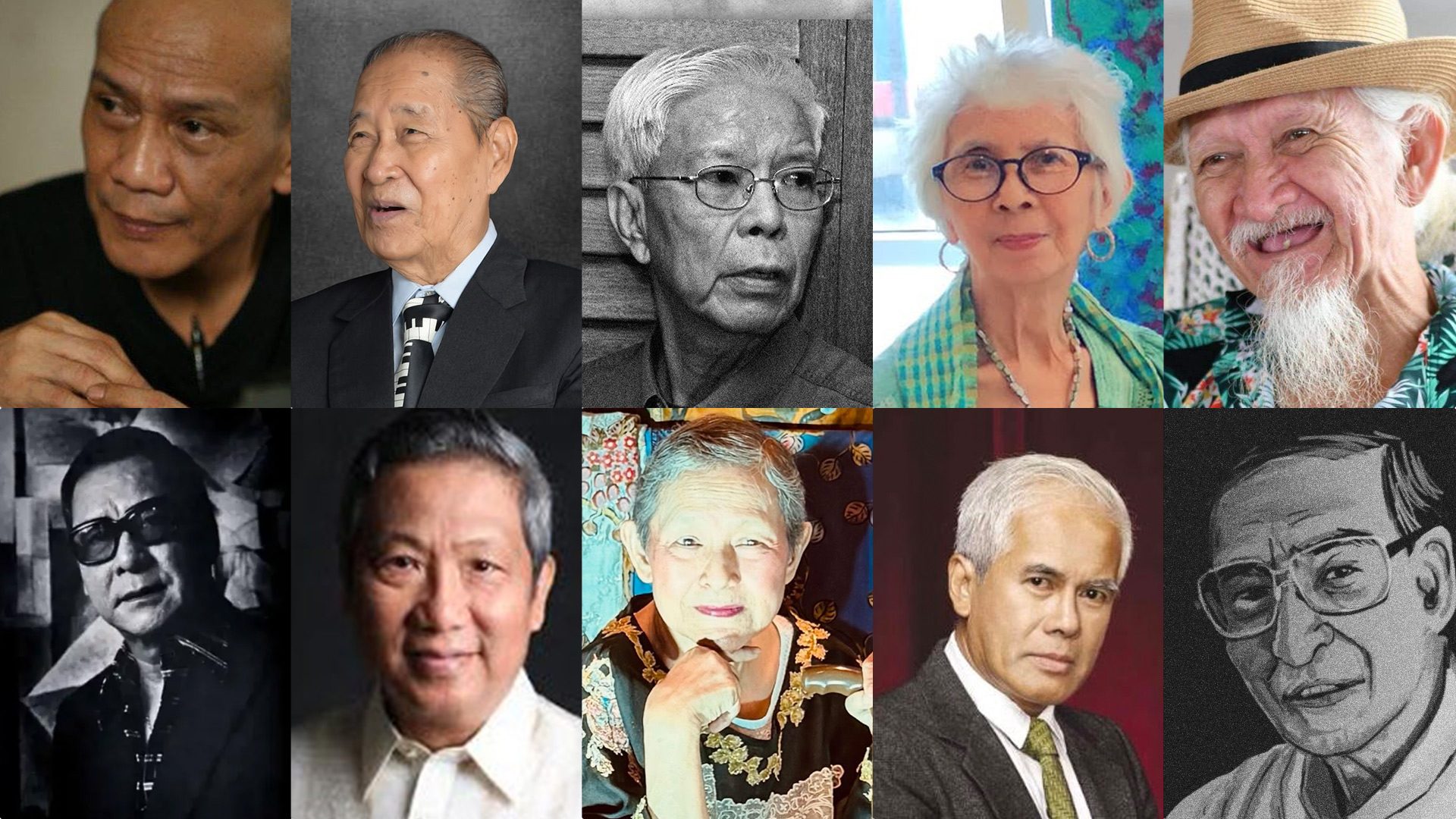
MANILA, Philippines – Every three years, a new set of Filipino individuals receive the country’s highest honors for their contributions to Philippine arts and all its forms. These pioneers are chosen and vetted by the National Commission for Culture and the Arts (NCCA) and the Cultural Center of the Philippines (CCP), and later conferred by the president of the Philippines. The last set of national artists were named in 2022 and included screenwriter and novelist Ricky Lee, dancer Agnes Locsin, stage director and theater actor Antonio “Tony” Mabesa, cartoonist Lauro “Larry” Alcala, poet Gemino Abad, fashion designer Salvacion Lim-Higgins, soprano Fides Cuyugan-Asensio, actress Nora Aunor, and director Marilou Diaz-Abaya. This time, President Ferdinand Marcos Jr. named 10 new national artists under Proclamation No. 1414 across the fields of literature, film and broadcast arts, visual arts, architecture, music, fashion design, and dance. Get to know them and their legacies here. Gregorio Brillantes (Literature, posthumous) Born and raised in Camiling, Tarlac, Gregorio Brillantes was a decorated author who was dubbed the “master of the Filipino short story” and “the godfather of Philippine speculative fiction.” Brillantes stood as one of the most defining voices in Philippine fiction in English as we know it today. He published a vast array of influential works that cut across generations, such as The Distance to Andromeda and Other Stories; Faith, Love, Time, and Dr. Lazaro; and The Apollo Centennial. He also wrote and edited for the publications Sunburst, The Manila Review, Focus, Asia-Philippines Leader, and the Philippines Free Press. Brillantes received his BLitt degree, major in journalism, from Ateneo de Manila University in 1952. He racked up several accolades throughout his decades-long career, including being inducted into the Carlos Palanca Memorial Awards for Literature Hall of Fame and receiving the Gawad CCP para sa Sining, among many other awards. He died on September 26, 2025, at 92 years old. Armando “Bing” Lao (Film and Broadcast Arts, posthumous) Armando “Bing” Lao was a filmmaker, director, editor, and screenwriter regarded as a pillar in Philippine cinema. He was the man behind the screenplays of the iconic films Takaw Tusko (1986), Itanong Mo sa Buwan (1988), Hati Tayo Sa Magdamag (1989), Fetch a Pail of Water (1999), La Vida Rosa (2001), and Biyaheng Lupa (2009), to name a few. Lao was named New Wave Best Director and took home the title of New Wave Best Feature Film at the 2013 Manila Film Festival for his film, Dukit. He was also the recipient of one FAMAS award for Hati Tayo Sa Magdamag and five Gawad Urian awards for Takaw Tukso, Itanong Mo sa Buwan, Fetch a Pail of Water, Larger than Life, and La Vida Rosa, among other awards. In 2024, he received the lifetime achievement award from the Film Development Council of the Philippines during its annual Parangal ng Sining, which recognizes luminaries in local cinema. He passed away on June 18, 2024, at 75. Gabriel Formoso (Architecture, posthumous) Born on April 9, 1915, in Manila, University of Santo Tomas alumnus Gabriel “Gabby” Formoso was a soft-spoken master builder who was regarded as the “Architect of a Modernizing Philippines.” He was one of the first 100 architects of the Philippines. He was nominated for the National Artist honors as early as 2003. Over 80 landmark buildings and 159 private homes bear his handprint, including the Bangko Sentral ng Pilipinas Complex, the wood-accented Asian Institute of Management, The Manila Peninsula, and the historic Club Filipino clubhouse. He graduated with an architecture degree from UST in 1937. Admired by the United Architects of the Philippines, he received the UAP Likha Award and Gold Medal. He died at the age of 81 on December 22, 1996. Teodoro Hilado (Theater, posthumous) Born on May 15, 1938, in Silay City, Negros Occidental, Teodoro “Teddy” Hilado was a theater administrator who was dubbed the “Father of Lightning Design in Philippine Theater.” Hilado served as the resident technical director for the CCP from 1969 to 1973, and a theater director of the Folks Arts Theater from 1973 to 1986. He brought back to life hundreds of iconic dance, drama, and opera productions for organizations like Ballet Philippines and the Bayanihan Philippine National Folk Dance Company — where he met the love of his life, Rosky Balahadia. Their heartwarming, real-life romance at the CCP later became the soul behind the award-winning music video for the Itchyworms’ “Di Na Muli,” where Rosky returned to the CCP stage after over 20 years to dance once more under the spotlights designed in Teddy’s honor by his former protege, Shakira Villa-Symes. Beyond traditional theater, he also designed ecosystem installations, including the Dr. Jose P. Rizal Light and Sound Presentation located at Rizal Park. He racked up several awards throughout his career, including being the first recipient of the Gawad CCP for Excellence in Lightning Design and Technical Theater in 1997, receiving the CCP Centennial Honors for the Arts in 1998. Hilado died at the age of 77 on December 23, 2015. Imelda Cajipe-Endaya (Visual Arts) Imelda Cajipe-Endaya is a Manila-based painter and printmaker known for her mixed media depictions of children, the environment, gender, empowerment, and Filipino identity, among many other disciplines. The 76-year-old is the first woman to be named national artist in the visual arts category. She earned her bachelor’s degree in fine arts from University of the Philippines (UP) in 1970 and later completed her graduate studies in art history and criticism in 1975 and 1976, respectively. In a video feature by Silverlens Galleries in 2025, Endaya confessed that she had long been labeled by writers as a feminist before she even knew what that concept was. “I was simply painting about my own experience as a woman through the years,” she said. To date, Endaya has received countless major awards for her work, such as the CCP’s Thirteen Artist Awards in 1990, the Araw ng Maynila Award in 1998, the CCP Centennial Honors for the Arts in 1999, and the NCCA’s Ani ng Dangal in 2009, to name a few. Nunelucio Alvarado (Visual Arts) Hailing from Sagay, Negros Occidental, Nunelucio “Nune” Alvarado is a 76-year-old painter whose works explore social realism. He paints through his battle with dementia through portraits of farm workers and vivid portrayals of community, political injustice, and struggle. He is a progressive figure in the local art scene and the pride and joy of Negros Island, channeling his activism into spotlighting the marginalized sectors in his community through his paintings. Alvarado was a recipient of the CCP’s Thirteen Artists Awards in 1992, and in 2004 received the Patnubay ng Sining at Kalinangan sa Larangan ng Pintura, a lifetime achievement award given by the same government agency. In May, Alvarado’s hometown Sagay put up a 30-meter-tall mural to honor his legacy as a living art pillar and continue to inspire the youth. Alfredo Buenaventura (Music) Born in 1928, Alfredo Buenaventura is a composer and conductor hailing from Santa Maria, Bulacan. He has composed over 1,000 works throughout his career, spanning operas, chamber music, symphonic poems, ballets, and many more. He has also composed numerous religious songs. He was also an organist at the Manila Cathedral. Some of his well-known masterpieces include “Lakambini,” “Mabuhay March,” “Bayan Kong Mahal,” “Dulambuhay,” and “Planting Rice.” Buenaventura took up music at UST, the Centro Escolar University, and the Gregorian Institute. He served as the dean of CEU’s Conservatory of Music for 30 years. Buenaventura received the Republican Cultural Heritage awards in 1964 for his composition of “Maria Makiling,” and in 1972 for his “Kayumanggi Symphony,” according to a Daily Tribune report. Nicanor Tiongson (Literature) Born in 1946 in Malolos, Bulacan, Nicanor Tiongson is a playwright, cultural scholar, and critic in the disciplines of history, literature, film, theater, popular culture, and art. He is professor emeritus at UP Film Institute and also served as dean of UP’s College of Mass Communication. As a cultural scholar, he was also the artistic director and vice president of the CCP. In 1976, he co-founded the Manunuri ng Pelikulang Pilipino alongside Behn Cervantes, Nestor Torre, Petronilo Daroy, Pio de Castro III, Clodualdo del Mundo Jr., Justino Dormiendo, Mario Hernando, Bienvenido Lumbera, and Manny Pichel. This film circle is the award-giving body behind the Gawad Urian, which honors Filipino films and the people behind them. Among his works, he wrote an impactful trilogy of essays on Philippine theater, which, as a whole, explores different art forms in theater, the evolution of local theater, and theater groups in the Philippines from the 1970s to the 1980s and the productions they mounted. He wrote the historical book The Women of Malolos and Komedya sa Parañaque: Kasaysayan at Estetika, which tracks the growth of the comedy genre in San Dionisio and Don Galo in the city. The Ateneo de Manila University Press also published a compilation of Tiongson’s plays and musicals: Revitalizing Tradition and Resurrecting History. In 2015, he won the Grand Goodman Prize for his “substantial contributions to Philippine historical studies.” Maria Beatriz ‘Patis’ Tesoro (Fashion Design) Born in Iloilo in 1950, Patis Tesoro initially dreamed of becoming a painter but would later be dubbed the “Grand Dame of Philippine Fashion” for her decades-long work reviving and reinventing Filipiniana. Tesoro built her name by transforming indigenous Filipino textiles into barongs, kimono jackets, Maria Clara gowns, ternos, caftans, and richly embroidered tops, working piña, jusi, abaca, and cotton into pieces heavy with hand embroidery and indigenous patterns. Her work has been staged in exhibitions and shows both locally and abroad, including “Piña: From Fabric to Couture” at the Hotel InterContinental Madrid in 2013, and “Kasuotang Filipino: Mga Likha ni Patis Tesoro” at the Museo ng Makati in 2023. Tesoro pursued her education at Marygrove College in Detroit, Michigan, training to become an art educator before turning to fashion as a livelihood. Her revival of Filipiniana deepened through her collaboration with cultural advocate Ado Escudero on Katutubong Filipino, a project aimed at reviving the country’s dying traditional textiles. Rafael ‘Nonoy’ Froilan (Dance) Born on October 24, 1950, in Calbiga, Samar, Rafael “Nonoy” Froilan is one of the Philippines’ most celebrated male ballet dancers and has come to be known as the country’s premier danseur. Froilan trained with the University of the East Dance Troupe before joining the CCP Dance School in 1972 and Ballet Philippines the following year. For more than two decades, he served as principal dancer of Ballet Philippines, originating roles created specifically for him, including Norman Walker’s Songs of a Wayfarer and National Artist Alice Reyes’ Rama Hari and Carmina Burana. He also famously danced opposite Dame Margot Fonteyn and Yoko Morishita. He has spent decades teaching at the Philippine High School for the Arts. In 2020, he received the Gawad CCP Para sa Sining for Dance. – with reports from Arabella Grace Sta Ana and Jade Tan/Rappler.com Arabella Grace Sta Ana is a Rappler intern studying BA Philosophy at UP Los Baños. Jade Tan is a Rappler intern studying AB Journalism at UST Manila.
Get to know the Philippines’ 10 new national artists
Full Article
Original Source
Read the full article at Rappler →KhanList aggregates and links to publicly available news content. We do not host full articles from third-party sources. Always verify important information with original sources.