
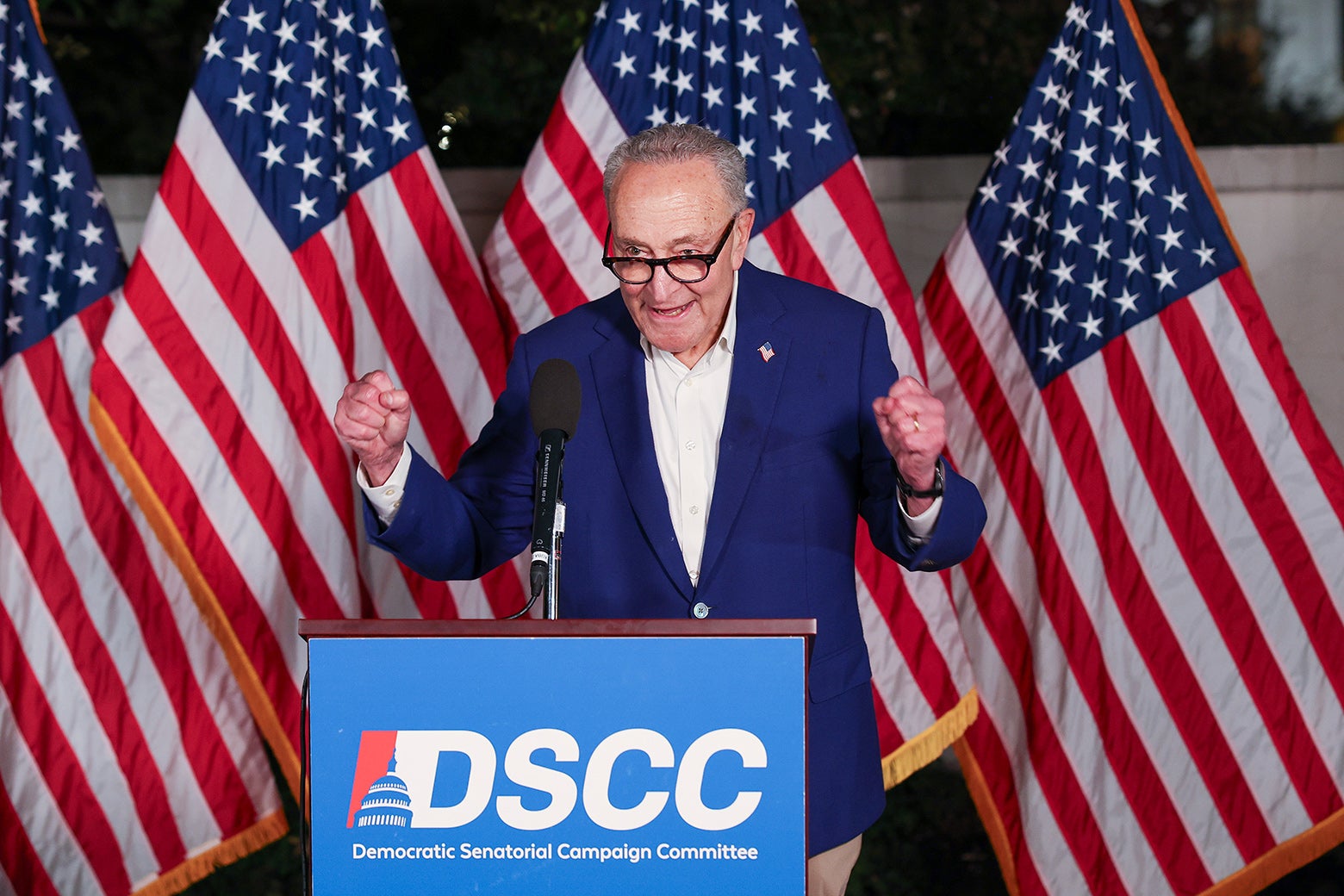
Jurisprudence Senate Minority Leader Chuck Schumer speaking in D.C. on Election Day. Tom Brenner/Getty Images Sign up for Executive Dysfunction, a weekly newsletter that highlights one under-the-radar story about how Trump is changing the law—or how the law is pushing back—and keeps you posted on the latest from Slate’s Jurisprudence team. Some earthquakes are felt with greatest force far from their epicenter. So it may be with Tuesday’s seismic election result. The new House and Senate lack the supermajorities needed to overcome vetoes, let alone impeach anyone. But the Democrats now have firm control over the Senate, and hence the confirmation process for federal judges for at least the next six years, and perhaps more. The vital question now is simple: Will there be any more judges? Only days ago, it looked as if the conservative lock on the federal courts for a lifetime or more was secured beyond any possible doubt. Today, however, that vise grip on the power to set the basic terms of political life seems suddenly tenuous: The prospect of a Supreme Court that takes account of all the nation, and of all its heritage—as opposed to embodying the interests of a largely white, anti-immigrant, Christian nationalism—is suddenly in the cards again. In part, this is a matter of simple numbers. Two members of the Supreme Court’s Republican supermajority—Samuel Alito (76) and Clarence Thomas (78)—will be 82 and 84, respectively, before there is even plausibly a Republican-controlled Senate. Alito had openly contemplated retiring, while Thomas had stoutly resisted the idea. But the choice is not always theirs. My old boss, Ruth Bader Ginsburg, passed just weeks before President Joe Biden won the White House. Her untimely death is a sharp reminder that openings on the court can happen despite the careful planning of the justices and their White House allies. Were an opening to happen on the court after January but before the next presidential election, the Democrats would have powerful reasons to refuse to confirm a new appointee from the Trump White House. For one thing, one or more vacancies would not hobble the court. In its last year of sittings, which ran from October 2025 to July 2026, the court heard argument in just 58 cases and issued only 73 opinions. This is not an overwhelming caseload, and could readily be handled by a smaller bench. A short-handed court, in some works, might well be an improvement on the present state of affairs: It would have a weaker temptation to intervene precipitously in ongoing litigation without hearing arguments or getting briefing. The smaller “shadow docket” that ensues would leave the court less arbitrary and less overtly political. For many people, the core reason for slamming the brakes is to be located in the court’s incendiary forays into the culture war—eviscerating abortion rights and affirmative action, licensing religious discrimination against LGBTQ+ people, callously denying the existence of trans people, and dismantling the Voting Rights Act. I am sympathetic on the merits of these cases, but think that there is a better, more constitutionally grounded, reason to resist new appointments. A central project of the Roberts court has been the sapping of Congress as a co-equal branch of government, and an engorging of executive power. The conservative supermajority has disabled Congress’ efforts to delegate broad power to federal agencies to address fast-moving policy challenges such as pandemics and the climate crisis. Just this year, it issued a constitutional rule against agency independence—stopping Congress from insulating its laws from feckless White House interference. And its fabrication of a sweeping, historically unprecedented immunity for presidents from the criminal laws Congress enacts gave the Oval Office broad license to disregard those laws. The net result is a dramatic tilt of power away from legislators. For Congress to push back now is wholly consistent with the Constitution’s design. At the republic’s dawn, James Madison anticipated that each branch’s “ambition” would counteract others’ inordinate “ambition.” Checking the court, that is, is simply Madison’s logic in action. Nor are Republicans well placed to complain. Having blockaded President Barack Obama’s 2016 nominee to the court, Merrick Garland, and then fast-tracked President Donald Trump’s nominee, Amy Coney Barrett, under the same political conditions just three years later, they have no one to blame but themselves for the turnaround. Even more knotty is the question of how the Senate should approach openings among the 179 judges in the federal courts of appeal and the 677 district court judges. Most of these so-called lower-court appointees diligently work to keep criminal and civil cases moving through the system, rather than deciding blockbuster cases. Yet it is hard to blink away the powerful evidence that Trump appointees have behaved in radical, even lawless, ways. It is no longer safe to assume that lower-court appointments should be viewed as anything other than profoundly risky—and so there is a good reason for the Senate at minimum to presume that a Trump candidate is unqualified absent a powerfully persuasive case on the facts otherwise. Just a sampling of the extraordinary lawless rulings from Trump-appointed lower-court judges should give senators pause today. Last month, for example, a Trump appointee in Missouri issued an extraordinary order foisting on the state a congressional map that had been rejected by the state’s own courts. Two months before that, two Trump appointees in D.C. ruled that federal courts have no power to sanction government lawyers who mislead or defy courts if they claim to be advancing national security or criminal law—a ruling that literally licenses government deceit. And just a few months before that, the whole 5th Circuit cast aside a 1980 Supreme Court precedent to bless the posting of the Ten Commandments in public-school classrooms. Trump appointees again cast the deciding votes. This, moreover, is just the tally from the past few months: It does not account, for example, for the work of the Trump-appointed Florida Judge Aileen Cannon, who single-handedly delayed and then undermined the criminal case against Trump. And then there is former Trump fixer Emil Bove, who was appointed to a circuit court even after being credibly accused of instructing government lawyers to defy federal court instructions. The record, then, is clear: A business-as-usual approach to lower-court Trump nominees would be highly dangerous to the rule of law. It is possible to imagine the Senate simply declining to advance any of Trump’s candidates—especially if we see a return of broader conflict between Congress and the White House. It is also possible that senators will conclude that it is simply too difficult to draw lines between reliable and dangerous nominees. Perhaps they decide that the close scrutiny I’d favor is just too much effort and don’t advance anyone. Yet even if this means a shortfall in judicial appointments in the short term, it may well be that this is the best path back to a federal bench that behaves in a judicious, not a partisan, manner. Congress Democrats Jurisprudence Supreme Court Clarence Thomas Judiciary Samuel Alito
Get Ready for the Great Democratic Judicial Blockade
Full Article
Original Source
Read the full article at Slate →KhanList aggregates and links to publicly available news content. We do not host full articles from third-party sources. Always verify important information with original sources.