
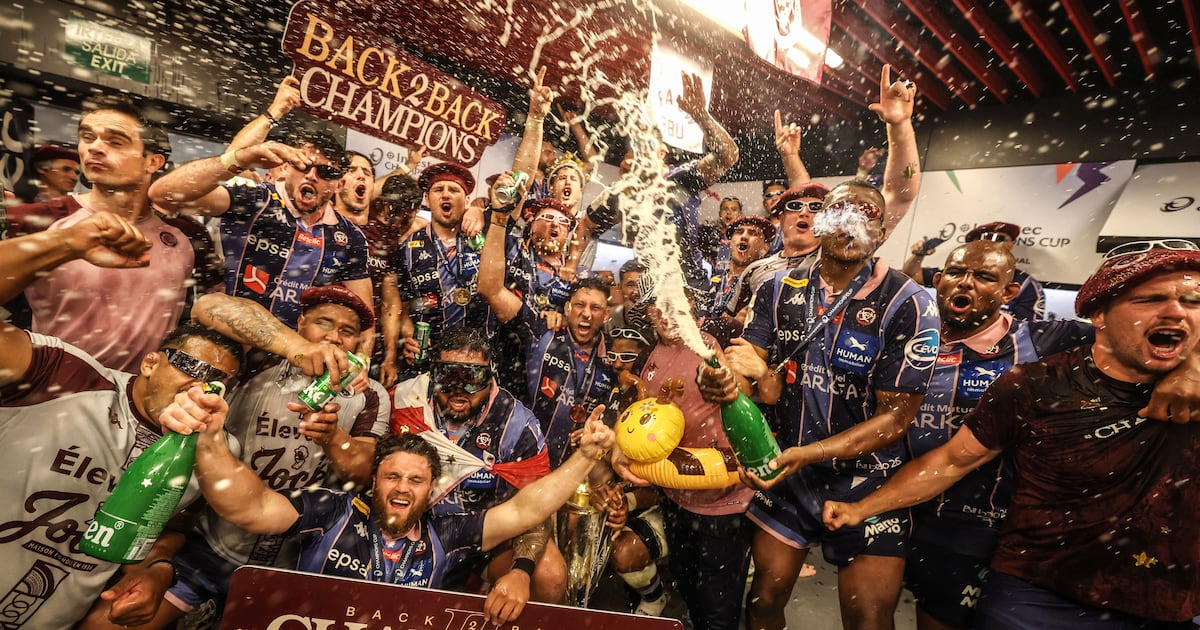
Roll out the bunting and sound the trumpets, the Champions Cup and Challenge Cup return next weekend with the introduction of a one-off first round before the tournaments go back into autumnal hibernation. They will then return with another one-off round in December before, finally, the two competitions are granted back-to-back pool matches for the concluding two rounds in January.This is yet another unconvincing tweak to a format that, once upon a time, was carved in stone. The tweak is seemingly borne of a vain hope that it will increase interest in the Champions Cup by giving it an earlier presence in the season.This is also an acceptance that the December starts of the last five seasons have inflicted further damage on the competitions, which the insular French and English have often used as political footballs while prioritising their domestic leagues. The English, along with the Scots, boycotted the inaugural 1995-96 European Cup, while the English did so again in 1998-99.From the third year of what was then the Heineken Cup in 1997-98 there were pools of four teams and thus six games, played on a home-and-away basis. Even when the number of participants changed from 24 to 20 in 2013-14, pools of four teams and six games remained enshrined until 2019-20. The competitions also started earlier. READ MOREBack in 1997-98, it’s incredible to think that the pool stages were actually run off on six consecutive weekends from early September to mid October. From 1999-2000 onwards, the competition began in October in non-World Cup seasons and November in World Cup seasons. But Covid changed everything, reducing the pool stages to two rounds and delayed December starts in 2019-20 and 2020-21. The tournament organisers deserve huge credit for managing to complete both competitions in those seasons despite the prophets of doom that said tournaments featuring teams from six countries could never be completed in a pandemic. The 2019-20 French championship, by comparison, was cancelled, with no winner.But that was the window of opportunity for the French clubs, who were supported by their English counterparts, in reducing the pool stages in 2021-22 to four games before a two-legged round of 16, with two rounds in December and two in January.Munster players celebrate at the final whistle after beating Toulouse in the 2008 Heineken Cup final. Photograph: Dan Sheridan/Inpho The following season, the round of 16 became a straight knock-out and the Champions Cup was reduced from nine to eight weekends. The shortened and delayed four-game, December/January pool stages have served to further diminish the competitions.During the period of stability and growth from 1997-98 onwards, all participating teams were guaranteed three home games. Now they have only two. For the French clubs, who are also guaranteed 13 home games in the Top 14, this is not an issue.But following the demise of Wasps, Worcester and London Irish, the Premiership clubs are only guaranteed nine home games in their domestic league as well as two in Europe – the same amount as URC sides. You’d think they too would want the additional revenue of more home games, but evidently not.Join our Irish Times Rugby WhatsApp communityGet the best of our writing in the Irish Times rugby community. Photograph: Henry Simpson/Inpho Join our Irish Times Rugby WhatsApp community and get our best rugby writing sent directly to your messages inbox. From provincial news to coverage of Ireland’s inaugural Nations Championship campaign, you won’t miss an update. Join here: https://chat.whatsapp.com/DaV5S7cDxWF0xDDILjarcwPerhaps it’s not surprising that Irish rugby has been the most enthusiastic and pro-European of the participating countries. Tom Kiernan and Vernon Pugh of Wales were the driving forces of the original European Cup. Whereas the French had their own championship since 1892 and the Premiership had been in existence since 1987, in the first six years of the European competition and professional rugby, Ireland did not have a league to play – in save for the interpros – until the creation of the Celtic League in 2001-02.Perhaps, too, Ireland’s biggest mistake was winning five Heineken Cups in seven years between 2006 and 2012. That compounded the resentment surrounding the old ERC offices being based in Dublin and, in part, prompted the very Anglo/French coup of 2014. That saw the creation of EPCR and the setting-up of base in Switzerland.There were also a host of promises about sponsorship and television deals, with accompanying claims that the football equivalent would be emulated. Such promises have largely been unfulfilled.But perhaps Irish rugby’s adoration of European rugby is also a weakness, in that we don’t rate the URC as much as we should do, even with the advent of South African sides participating, who actually have far more buy-in to the competition, be it the franchises themselves or their fans.Leinster successfully defended the URC last season, but the competition deserves greater respect. Photograph: Ben Brady/Inpho Leinster, after all, have just won back-to-back URCs. If a French team won back-to-back championships there’d be open-top bus homecomings, mayoral receptions and widespread media recognition of their greatness. Instead, if Leinster don’t win the Champions Cup outright, their season is regarded as a failure by many.The French and the English never appreciated what the Irish teams brought to European rugby. Granted, they never rated European rugby as highly as we did, and still don’t, all the more so as the Top 14 has grown into a juggernaut and their television deals with Canal+ not only dwarf all other leagues, but leave little left in the kitty for European rugby.For Castres and others, maintaining Top 14 status is imperative or else they could go the way of Biarritz. Save for Toulouse, especially, it’s still hard to compete in both competitions for French clubs, as Bordeaux Bègles were reminded last season.But there’s never been a period of such French dominance in Europe. Toulouse accounted for four of the first five triumphs until a generational Toulon won three in a row from 2013. But Toulouse, La Rochelle and Bordeaux Bègles have each won two of the last six Champions Cups.The reduced, quickfire format evidently suits the French, but it also has become the biggest flaw in the two competitions, because unlike the six-game, home-and-away format of yore, there is simply not enough jeopardy in the pool stages.Sure, every point matters in the jostling for positions, which have ramifications deep into the knock-out stages. But two wins out of four pretty much ensures advancement to the knock-out stages, while a solitary win has been enough for one or two teams in each of the last four seasons.This is plainly ludicrous, and no amount of tweaks will change that.gerry.thornley@irishtimes.com
Gerry Thornley: It’s death by a thousand tweaks for the once-great Champions Cup
Full Article
Original Source
Read the full article at Irishtimes →KhanList aggregates and links to publicly available news content. We do not host full articles from third-party sources. Always verify important information with original sources.