
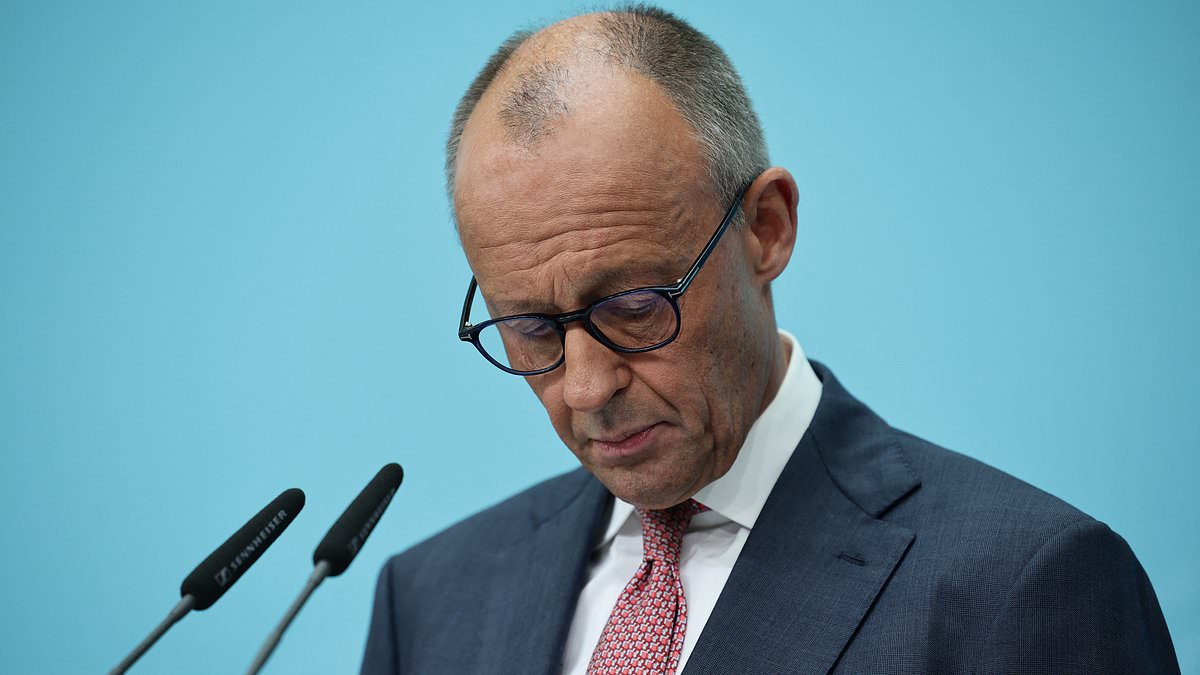
The bruising defeat of Chancellor Friedrich Merz reflects the stalling of what once was Germany’s mighty economic engine.His centre-Right Christian Democratic Union party was crushed in two regional elections over the weekend.Left-wing anti-capitalists triumphed in Berlin. In Mecklenburg-Western Pomerania the far-Right Alternative fur Deutschland (AfD) took more than 38 per cent of the vote, just ahead of the centre-Left Social Democratic Party. Merz’s Christian Democratic Union limped in with less than 5 per cent of the vote.The AfD won 44 per cent of the vote earlier this month in Saxony-Anhalt – a relatively small and not particularly prosperous state – but it was a victory that nonetheless attracted worldwide notice.The Wirtschaftswunder (the economic miracle of West Germany’s rapid reconstruction following the Second World War) was based on industrial prowess.The manufacturing boom was enabled by cheap energy, much of it from Russia, open markets and high demand from China for German imports. Chancellor Friedrich Merz's centre right Christian Democratic Union party was quashed in two regional elections over the weekendEven the high costs of reunification after the fall of the Berlin Wall seemed to have been taken in Germany’s stride, though it has since become clear that stark divisions remain. Now the country is struggling with rising energy prices after the war in Ukraine and conflict in the Middle East.Former chancellor Angela Merkel’s decision to shun nuclear energy after the Fukushima catastrophe has not helped.China, once an avid customer, has become a competitor. The car industry is deep in crisis. Volkswagen cut its profit forecast a few days ago and tens of thousands of workers were protesting yesterday over proposed job losses and changes to working conditions.German manufacturers were late to invest in electric vehicles, leaving themselves open to rivalry from Chinese EV producers.Donald Trump’s tariffs are costing the German economy billions. Germany’s population is ageing. Welfare and pension spending is at a record high, as a shrinking working-age population has to support more of its elders. Merz was bringing in incentives to invest along with moves to cut taxes and energy costs, but not quickly enough to satisfy business leaders or voters.The Bundesbank has been making emollient suggestions over the summer that the economy is on the mend. However, Joachim Nagel, its president, expressed fears after Saxony-Anhalt that political developments will scare off investors and nip any nascent recovery in the bud.There are echoes of Germany’s situation across Europe. In France, concerns are mounting over its public finances ahead of next year’s presidential election. Marine Le Pen’s National Rally has had chequered fortunes recently, but she is doing well in opinion polls.Here, Prime Minister Andy Burnham is heading for a difficult Budget and a well-funded Reform party is proving resilient in the face of scandal.Disaffected voters are attracted to politicians who seem to have straightforward answers. In a world of complex, entrenched and long-denied problems, that is rarely the case.Troubled watersUnlike the Norwegians, who have, by and large, been wise stewards of their North Sea wealth, politicians here have made a poor fist with ours. Chancellor John Healey should heed calls from industry leaders calling for the windfall tax, introduced by the Tories and hiked by Labour, to be phased out more quickly than the current timetable.Some 25,000 jobs in the sector have been lost since Labour came to power and if the tax remains in place, more will go, leaving the country without the skills needed to move to green energy.It is not possible to wave a wand and simply magic up skilled workers when new green energy projects require them. There needs to be a smooth segue. We could have set up a sovereign wealth fund as was the case in Oslo. It could now be cushioning our economic woes and funding growth. Instead, Labour seems intent on blowing what remains of the North Sea bounty.Scale upWho says the UK can’t produce AI companies? British-based data centre business Nscale, which is backed by Nvidia, has just filed for an IPO.The HQ is in London and former deputy prime minister Nick Clegg, who went on to make his fortune at Meta, graces the board. Its youthful founder, Josh Payne, an Aussie, stands to make millions if things go well, according to reports.The catch: The float, like so many, is not in London, but New York.DIY INVESTING PLATFORMSAJ BellAJ BellEasy investing and ready-made portfoliosHargreaves LansdownHargreaves LansdownFree fund dealing and investment ideasinteractive investorinteractive investorFlat-fee investing from £4.99 per monthFreetradeFreetradeInvesting Isa now free on basic planTrading 212Trading 212Free share dealing and no account feeAffiliate links: If you take out a product This is Money may earn a commission. These deals are chosen by our editorial team, as we think they are worth highlighting. This does not affect our editorial independence.Compare the best investing account for you
Germany's political and economic problems are sounding a warning for the UK: RUTH SUNDERLAND
Full Article
Original Source
Read the full article at Dailymail →KhanList aggregates and links to publicly available news content. We do not host full articles from third-party sources. Always verify important information with original sources.