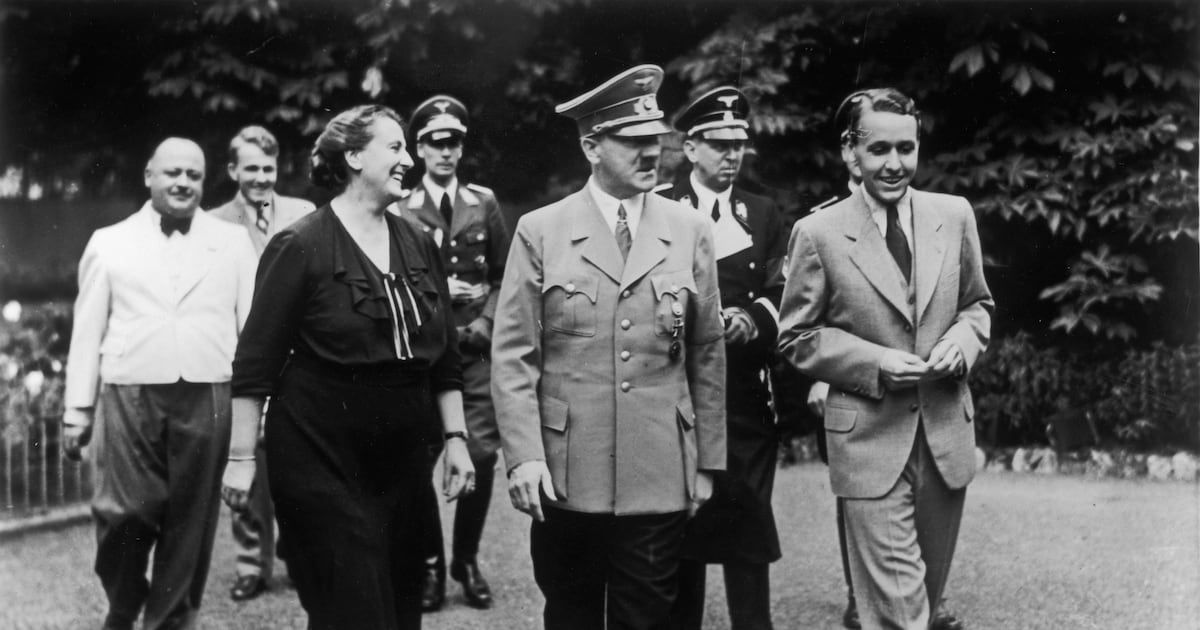
Richard Wagner was a musical genius and world-class anti-Semite – with an unerring talent for monetising scandal. He would have nodded approvingly – then checked box office receipts – after outraged headlines marked the 150th anniversary of the festival he founded in Bayreuth.The headlines were thanks to festival director Katharina Wagner, the composer’s great-granddaughter, who invited - then uninvited - Michel Friedman, a German-Jewish journalist, to lecture on the burdened Wagner inheritance.Bayreuth is as legendary for its feuds as its music and Wagner, with an eye on the press, changed her mind again at the last minute and reinvited Friedman, who lost 50 relatives in the Holocaust.READ MOREOnstage, he placed front and centre what the Wagner family prefers to forget: their intimate ties with opera obsessive and Nazi leader Adolf Hitler.Katharina Wagner - Richard Wagner's great granddaughter - with Andreas Zippel and Luca Maass at the Bayreuth Festival 2026 opening. Photograph: Tristar Media/Getty Images In his early days in office, the Nazi dictator liked to say it was Wagner’s opera Rienzi – staged this year for the first time at the festival – that inspired him to enter politics.Later, Hitler said: “It was in Bayreuth that the sword was forged with which we fight today.”Wagner was half a century dead when Hitler took power, but the composer’s soaring music was as much Nazi soundtrack as metaphorical sword: at party rallies, in newsreels and wartime radio announcements – even in concentration camps.That all ensures the Bayreuth festival theatre stands on “contaminated ground”, Friedman said, and “stinks of Hitler, despite postwar efforts”.After Hitler’s suicide and Nazi Germany’s capitulation, the Wagner family, caught up in the national amnesia epidemic, restarted the festival in 1951 with a polite programme request: “In the interest of a smooth staging of the festival, we ask politely to desist from conversations and debates of a political nature ... here is for art.”The Nazi dictator liked to say it was Wagner’s opera Rienzi – staged this year for the first time at the festival – that inspired him to enter politics. Photograph: Corbis via Getty Images It is the long tail of this postwar self-exculpation that Friedman blames for modern Germany’s growing political worries.With the far-right political party, Alternative for Germany (AfD), posed to take power in its first federal state in September, Friedman said the main problem – then and now – was not Germans who wanted to remember the past, but those who would rather forget.“We are the eyewitnesses of our time, today,” he said, “and hopefully people won’t ask us in 20 years why we gave away democracy so easily to those who want to destroy it.”Friedman praised Wagner, hoping her efforts to address the past would help secure the festival’s future as it struggles with money troubles, artistic rows and ageing audiences. Katharina Wagner has been praised for her efforts to address the past as a means to help secure the festival’s future. Photograph: David Zorrakino/Europa Press via Getty Images With her guest, the festival director visited an open-air exhibition in Bayreuth about Jewish artists with festival links who were murdered by what her grandmother called “blessed Hitler”.This year’s festival gave fresh momentum to the long-running row over whether it is possible to separate Wagner’s music and politics. Defenders of Wagner say, for all of his many character flaws, his music lives in its own sphere as great art for the ages.Critics dismiss these arguments with the composer’s own logic, as laid out in his notorious 1869 pamphlet Judaism in Music, that it is impossible to salvage ideologically compromised music: for him, it was the music of “outsider” Jewish composers; for his modern critics, it is the sweeping melodies of an anti-Semitic misanthrope.For all the offstage drama, the Wagner family’s belated reflections on the real cost of human stupidity attracted more praise in Bayreuth than the onstage AI-generated backdrops of this year’s new Ring tetralogy.Bayreuth’s ‘Das Rheingold’. The Wagner family’s belated reflections on the real cost of human stupidity attracted more praise in Bayreuth than the onstage AI-generated backdrops of this year’s new Ring tetralogy. Photograph: Bayreuther Festspiele / Enrico Nawrath The AI software was fed Wagner scores, recordings and other historical material then, during live performances. Photograph: Bayreuther Festspiele / Enrico Nawrath The AI software was fed Wagner scores, recordings and other historical material then, during live performances, projected hallucinatory backdrop collages: historic Bayreuth production photos, images of writer Thomas Mann and, of course, the inescapable Adolf Hitler.
Germany’s most famous opera festival confronts its Nazi-era inheritance
Full Article
Original Source
Read the full article at Irishtimes →KhanList aggregates and links to publicly available news content. We do not host full articles from third-party sources. Always verify important information with original sources.