
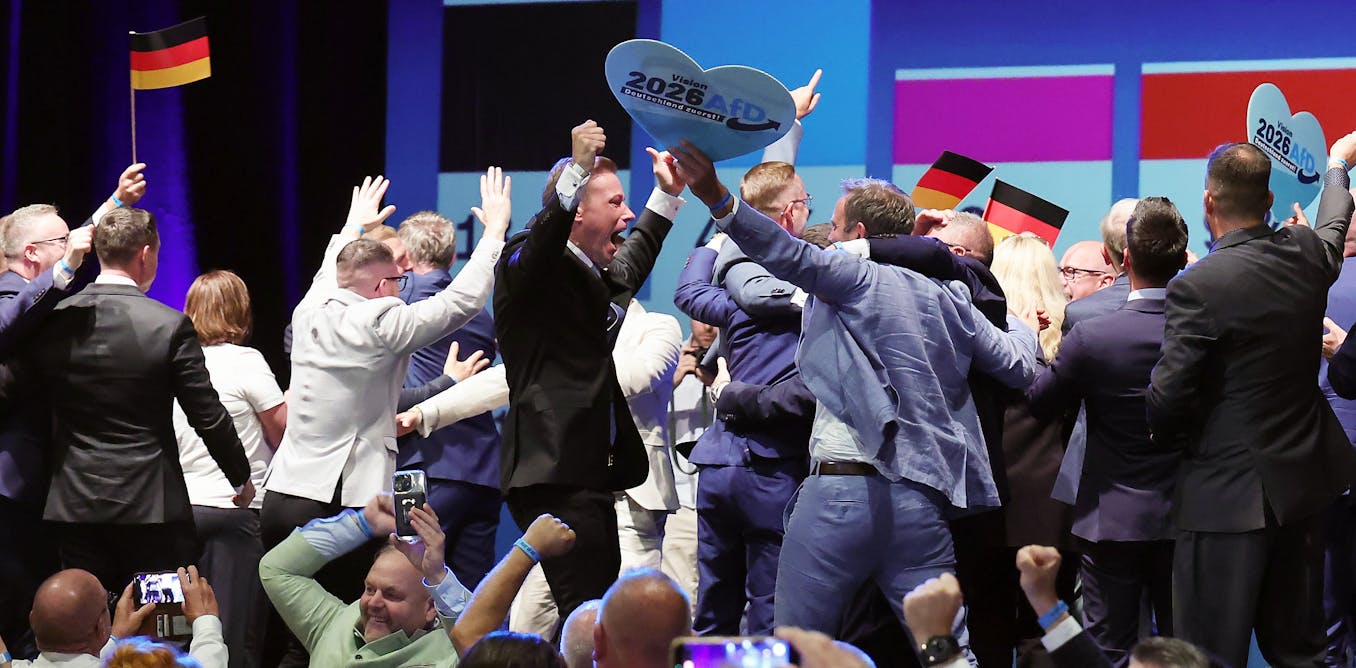
The results of Germany’s Saxony-Anhalt state election on September 6 were far worse than feared for the country’s mainstream political parties. The far-right Alternative für Deutschland (AfD) came close to winning a majority of votes, with 43.8%. This was about 4% higher than polls had suggested. Support for the centre-right Christian Democratic Union of Germany (CDU), on the other hand, imploded. It won 17.2% of the vote, down from 37.1% in 2021, performing substantially worse than predicted. At nearly 78%, turnout was up substantially compared with 2021 – in a way that helped the AfD. Analysis suggests the growth in its support came mostly from former non-voters, joined by a substantial number of erstwhile CDU supporters. The polarised nature of the election, with 41% of voters surveyed beforehand wanting an AfD-led government but 46% favouring one led by the CDU, had some surprising effects. One was that it flattered the social democratic SPD and the Greens. Both the SPD and Greens received tactical support from CDU and Left Party voters to make sure they reached the 5% of votes required to win seats in the state parliament. Saxony-Anhalt’s current minister president, Sven Schulze, reacts to the AfD’s win during a speech in Magdeburg on September 6. Clemens Bilan / EPA The AfD, which had said it would only seek to govern if it had a majority, now has several paths to seeing its candidate, Ulrich Siegmund, elected as Saxony-Anhalt’s minister president. Most likely is a deal with the Bündnis Sahra Wagenknecht (BSW), a party that combines left-wing economic policies with conservative ones on topics such as migration. On election night, the BSW made clear it had “overlaps” with AfD positions in some areas and that it would be “completely undemocratic” for the AfD to be excluded entirely from government. If this failed, some support from the CDU would be a further route. The election of minister president is a secret ballot, and several CDU MPs reelected on Sunday have a long history of suggesting there should be more openness to working with the AfD. Support across society The AfD did best in Saxony-Anhalt among working-class voters (59%), as well as those with a lower level of education (57%) and those who perceived their economic situation as bad (65%). But even among graduates (30%) and voters who saw themselves in a good economic situation (37%), the AfD performed respectably. It also secured over 40% of support among all age groups apart from the over 70s (31%). So the AfD can really claim to be a Volkspartei or “people’s party”, with support from across society, across the state. By no means was this a single-issue election. Exit polls revealed immigration was one motivating factor for AfD voters, with 91% of them agreeing with the statement that they “were very worried too many foreign people live in Germany”. But so too was concern with security and the economy. There was also real dissatisfaction (66% of all voters) at the state government, which had been led by the CDU since 2002. But the standing of Friedrich Merz’ government in Berlin was worse, with 83% taking the view it was insufficiently concerned with the problems of ordinary people. Just 20% of voters in Saxony-Anhalt trust it to improve the country substantially in the coming years. Accompanying these sentiments, which can be found across Germany albeit more strongly in Saxony-Anhalt and other eastern states, there is a strand of dissatisfaction particular to the east. Seventy-three percent of all voters in Saxony-Anhalt believed easterners were still second-class citizens in many situations. This view is taken by 83% of AfD voters. The AfD has been rather successful in mobilising grievances about reunification and some nostalgia about the days of the communist East Germany. Ulrich Siegmund leaves on a Simson Schwalbe motorcycle, a bike common in former East Germany, after casting his vote on September 6. Clemens Bilan / EPA Assuming the AfD does form a government, there will be close scrutiny of the extent to which it can implement its hard-right manifesto – and, indeed, whether it confirms the view of German intelligence that the party is demonstrably “right wing extremist” in the state. In fields such as education, culture, law and order and public broadcasting it will go on the front foot, though there may well be persistent legal challenges to more radical measures. These include attempts to force teachers to represent particular ideological positions in schools. The AfD will also use its position for further publicity, and of course each time it is blocked from realising its aims by courts or other parties, it can claim to be a victim of establishment stitch-ups. This is a common populist tactic. Wider political consequences The results make Merz’s position even harder. Already as unpopular as any German chancellor has ever been, he stands no prospect of any boost from the state election in Mecklenburg West Pomerania on September 21. That election is set to be a clear battle between the AfD and SPD. On the same day, the state of Berlin, with its highly fragmented politics, might offer the chance of a first-place finish for Merz’s CDU on a low vote-share. But that would not be a game-changer. Crucially, many of his MPs will demand changes. Most will push for a rightward shift to close down an open flank the AfD can exploit. But that can hardly be achieved in coalition with its current coalition partner, the SPD. Others will push to reopen major reform packages, such as pensions, slated for decision in the Autumn, noting the loss of ground among working-class voters. However, that would rub up against Merz’s analysis of what Germany needs to do to get its faltering economy back on track. Saxony-Anhalt may be asking a very hard question not just of Merz, but of German society: is the country now so fragmented politically that it is becoming almost ungovernable? Coalitions of easy bedfellows (Christian Democrats with Liberals or Social Democrats with Greens) would barely get 25% of the vote at a federal election. So mainstream parties are forced to form governments with parties with whom they fundamentally disagree simply in order to keep the AfD out. These governments quarrel, they put off decisions as they cannot agree, and they collapse. And from this negative dynamic, the AfD is able to profit.
Germany: why the AfD won in Saxony-Anhalt – and what happens next
Full Article
Original Source
Read the full article at Theconversation →KhanList aggregates and links to publicly available news content. We do not host full articles from third-party sources. Always verify important information with original sources.