
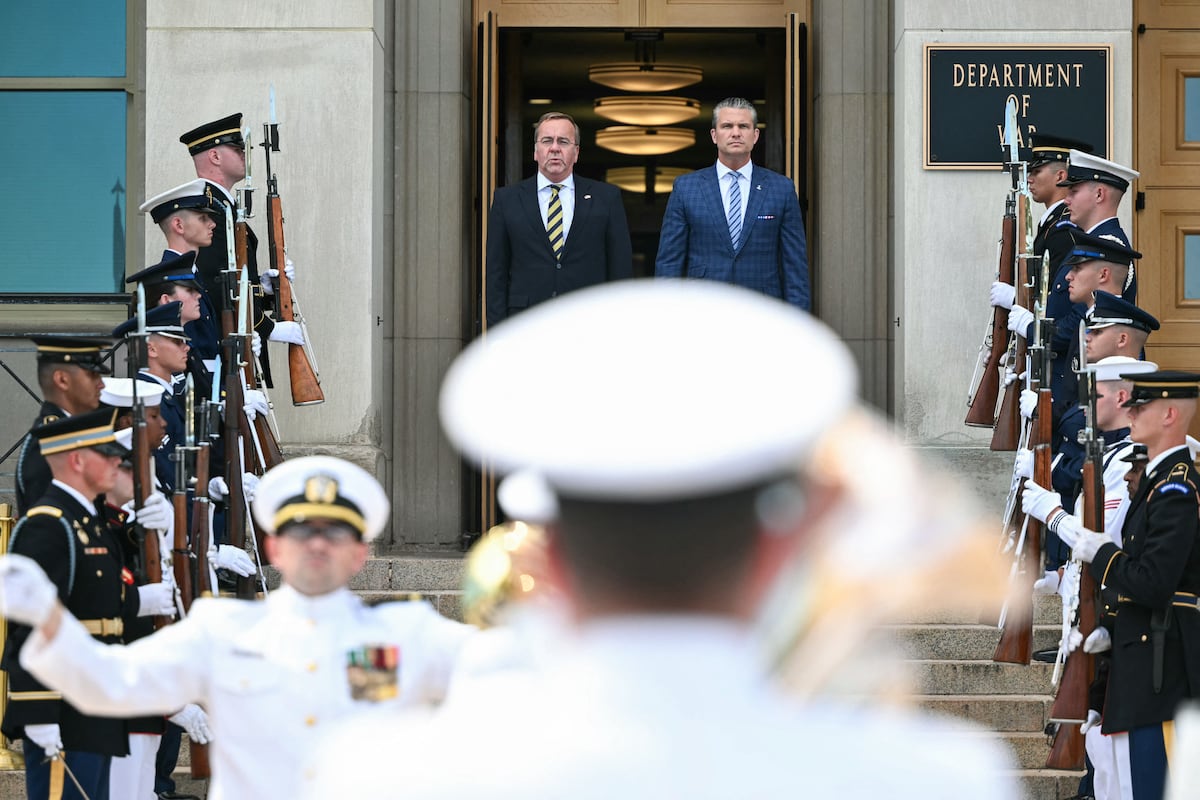
COLOGNE, Germany — The defense leaders of Germany and the United States have signed an agreement positioning Germany as an additional production hub where workers can make scarce munitions for American weapons if stateside U.S. firms are overwhelmed by demand.German Defense Minister Boris Pistorius and U.S. Defense Secretary Pete Hegseth announced the pact on Tuesday during a visit by Pistorius to the Pentagon. It comes as German officials, in particular, are looking to secure practical touchpoints in the trans-Atlantic defense relationship, dinged by U.S. President Trump’s on-again, off-again disdain for NATO and Europe.Hegseth portrayed the agreement as combining defense-acquisition reform initiatives in both nations. “When we align the two, you expand opportunities for joint development, production, licensed manufacturing and expanded maintenance and sustainment capacities — exactly what allied countries should be doing,” he said.Germany’s arm of pan-European missile maker MBDA is already making Patriot air-defense interceptors of the older PAC-2 generation. Production of the latest PAC-3 MSE interceptor is set to begin at the company’s plant in Schrobenhausen later this year, Pistorius told reporters.In addition, officials from both countries will consider which components of the Tomahawk cruise missile Germany could supply, he told reporters. Berlin wants to buy the missiles, along with Typhon launchers, as part of Germany’s emerging “deep precision strike” complex. While there is agreement on a political level on selling the weapons, manufacturing them will take longer than defense leaders in Berlin want to wait.Patriot interceptors and Tomahawk cruise missiles have become prime examples of scarce weaponry in recent years.European nations have funneled much of their Patriot inventories to Ukraine to help Kyiv defend against barrages of Russian missiles and attack drones, and they are now scrambling to rebuild their own arsenals. Meanwhile, U.S. forces have reportedly drawn down the Pentagon’s Tomahawk stock considerably during the war against Iran. That has made the cruise missiles, prized for their precision at a range of 1,000 miles, hard to obtain for European countries, like Germany, looking to build a long-range strike capability from scratch.Berlin is keeping its options open for more readily available medium- and long-range weapons while developing an upgraded version of its own German-Swedish Taurus missile. For example, Germany is part of a European group of nations looking for a homegrown alternative, known as ELSA.In addition, officials are eyeing the Anthem cruise missile by U.S.-based firm Covenant, as well as a cooperation with Ukraine, Pistorius said in Washington.Germany’s new defense-industry overture with the U.S. may ruffle some feathers among European autonomy purists, especially in France. Paris has already seen Berlin walk away from joint weapons development programs in recent years in favor of quicker purchases from the U.S. Those include P-8 maritime surveillance aircraft made by Boeing and F-35 fighter jets by Lockheed Martin. The acquisitions were perceived by some French officials as sucking the air out of bilateral efforts to develop next-generation aircraft for each of the two mission types.France has repeatedly criticized the use of European money to produce U.S. weapons under license, with then-Armed Forces Minister Sebastien Lecornu, the current prime minister, saying in February 2025 that doing so would be a “historic mistake.”The French government has argued that EU funds should build up European defense-industrial capacity, rather than subsidizing systems whose design authority remains outside of Europe, citing German production of interceptors for the Patriot air-defense system rather than investing in the French-Italian SAMP/T.During their public remarks at the Pentagon on Tuesday, Hegseth focused on the mechanics of the new defense-cooperation agreement, as Pistorius painted a geopolitical context for the pact.“We need to realize once more … that we are currently experiencing what might be the greatest threat to the alliance, the West, and our way of life since the height of the Cold War,” Pistorius said. “Russia has been waging a brutal war against Ukraine for almost five years now. Russia is modernizing its nuclear arsenal, increasing its presence in the Arctic and militarizing space.” “Russia will remain the biggest threat to Euro-Atlantic security in the foreseeable future,” he added.The German defense minister was scheduled to meet with U.S. lawmakers and local defense company executives after meeting Hegseth in Washington, per the German Ministry of Defense. His trip will be capped on Friday by a handover ceremony of the first German F-35 coming off the production line at Lockheed Martin’s plant in Fort Worth, Texas. Germany has ordered 35 of the planes so far, but defense officials in Berlin are eyeing more.Rudy Ruitenberg in Paris and Linus Höller in Vienna contributed to this report.Sebastian Sprenger is associate editor for Europe at Defense News, reporting on the state of the defense market in the region, and on U.S.-Europe cooperation and multi-national investments in defense and global security. Previously he served as managing editor for Defense News. He is based in Cologne, Germany.
Germany, US to expand shared production of Patriot interceptors, strike missiles
Full Article
Original Source
Read the full article at Militarytimes →KhanList aggregates and links to publicly available news content. We do not host full articles from third-party sources. Always verify important information with original sources.