
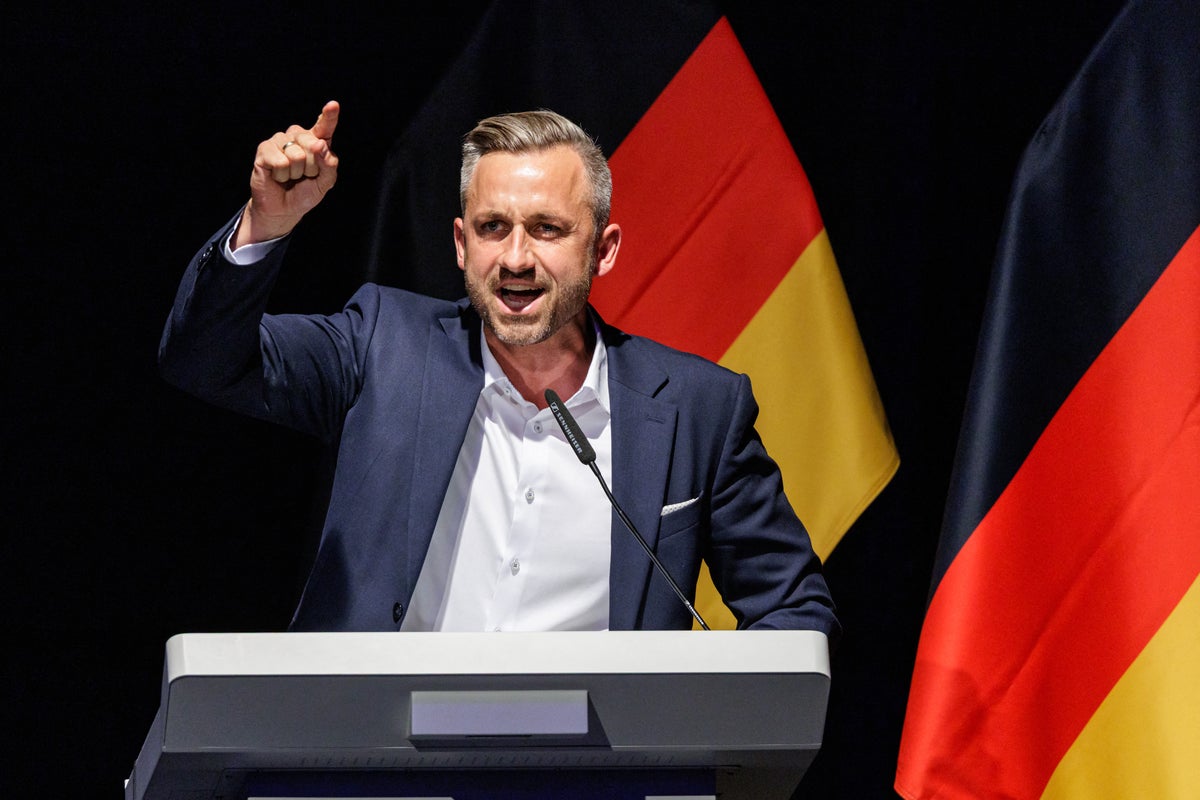
The far-right will be vying to seizea dirst tatse of power in Germany since the Second World war on Sunday, as voters head to the polls in the eastern state of Saxony-Anhalt.A win for the Alternative for Germany (AfD) party - which was polling at 40 per cent in the build up to Sunday’s vote – could spell an historic shift in German politics after years of cooperation between the other parties to keep the hard right out of power.The AfD seeks to restrict immigration, quit the Euro and restore ties with Russia as most of Europe rallies around Ukraine. Germany’s own intelligence service has designated the party as ‘extremist right wing’.But the party has gone from strength to strength in recent years, buoyed by popular disillusion with successive governments in Berlin and drawing support from formerly communist states in the east.Ulrich Siegmund, pictured on 29 August, is the main candidate for the AfD in the Saxony-Anhalt state election (AFP/Getty)Ahead of the 2029 national elections, a victory in Saxony-Anhalt could offer a glimpse of a hardline path ahead for the EU’s biggest economy, marked by a deportation offensive, an overhaul of the education system, and the promotion of “traditional” relationships.The Independent looks at what a win for the AfD could mean for the state and the future of Germany.Can the AfD win the election in Saxony-Anhalt?The AfD is expected to decisively win Sunday’s election with 40 per cent of the vote, twice the support it saw there just five years ago.Polls have routinely put the AfD 10 to 15 points ahead of the centre-right Christian Democrats (CDU), which currently leads a coalition with the centre-left Social Democrats (SPD) and the free-market Free Democrats (FDP).Winning enough votes to secure an outright majority and govern the state alone would be especially humiliating for Chancellor Friedrich Merz, upsetting decades of alignment across the mainstream parties to keep the hard right out of power.Nationwide, the AfD has swollen to become the most popular party, polling at 29 per cent, while Merz has become the most unpopular chancellor since the founding of the Federal Republic, with 85 per cent of voters dissatisfied.In Saxony-Anhalt, all the parties except the small far-left BSW party have ruled out joining a coalition with the AfD, which has also said it aims to govern alone. But there is no guarantee that the other parties will be able to form a viable coalition.Ulrich Siegmund greets supporters as he arrives for a debate on MDR regional TV in Magdeburg, eastern Germany on August 26 (AFP/Getty)If both the SPD (polling at 8.5 per cent) and the Greens (6 per cent) reach the minimum 5 per cent threshold, their votes – together with the CDU (23 per cent) and the far-left Left party (11.5 per cent) – could be enough to stop the AfD from forming a government in the state. But the CDU has ruled out a coalition with the Left Party and combining with the SPD and Greens may not be enough for a majority.The Brookings Institution, an American think-tank that describes itself as nonpartisan, concluded that an absolute majority for AfD candidate Ulrich Siegmund “is within reach”.They acknowledged that Siegmund - described as “a glib salesman with a degree in business psychology who once cofounded a company for room fragrances” - had organised a “remarkably successful campaign”, despite failing to disavow the AfD’s links to extremist movements, and despite the clumsy shortcomings of his deputy.And even if the AfD does fail to achieve an outright majority, they said, “the task of organizing a CDU-led governing majority faces almost insurmountable difficulties”, exacerbated by the CDU’s ruling out of any coalition with the Left party.The Left party has indicated it would be open to an arrangement formalising support for a CDU-led government over the AfD. But the CDU faces internal divisions over a possible alliance with the ideologically remote far-left.Merz said ahead of the election last Sunday that they would “assess the situation in light of the election results” and “do everything we can to prevent Saxony-Anhalt from falling into the hands of the radicals”.What would an AfD win mean for Saxony-Anhalt?Based on the party’s “Vision 2026” election manifesto, victory in Saxony-Anhalt could invite sweeping reforms around state policy on migration, education, culture and the family.Under Germany's federal system, state governments sit in the upper house of parliament, the Bundesrat, and also have wide powers in education, domestic security and culture.Friedrich Merz, 70, has maintained Germany’s position as the biggest donor to Ukraine, having contributed more than 800 million euro to date, while the AfD promises to slash support at a crucial time in the war (AFP/Getty)An AfD-led state would launch a crackdown on migration with a task force set up to coordinate quicker deportations.The children of refugees would be placed in separate classes at school to prevent what the party claims are “stresses” on the other children from being around different cultures.Meanwhile children with disabilities would no longer be taught in the same classroom as those without, instead being sent to special schools.Schools would also be banned from flying rainbow flags, and the government would exhaust “all legal avenues” to limit Islamic expression.The party has claimed greater acceptance of what it offensively labels as"sexual deviations and non-reproductive lifestyles" has contributed to sinking birth rates and promises to aggressively promote "traditional" family structures consisting of a mother, father and children.Saxony-Anhalt's State Premier and Christian Democratic Union's (CDU) main candidate Sven Schulze on Friday (AFP/Getty)An AfD government would see major changes to the school curriculum around a “patriotic cultural policy”, extended to raising the German national flag daily and singing the national anthem at school celebrations.It would also advocate for removing war refugee status for Ukrainians in Germany as long as the conflict remains concentrated in eastern Ukraine, arguing they should seek refuge in western Ukraine.The current structure of the public broadcasting system would be dismantled and funding withdrawn for some cultural institutions.
Germany braced for political earthquake as far-right AfD eyes first taste of power
Full Article
Original Source
Read the full article at Independent →KhanList aggregates and links to publicly available news content. We do not host full articles from third-party sources. Always verify important information with original sources.