
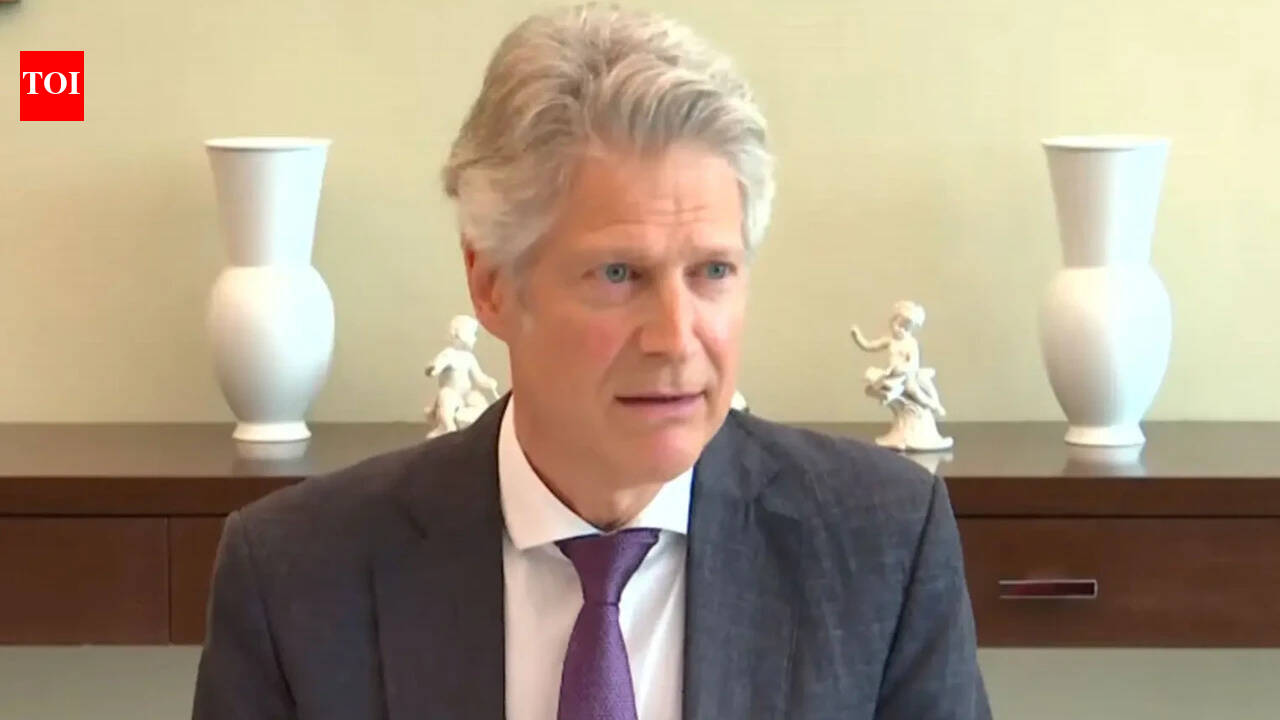
Wieck said the project will see extensive transfer of technology in the underwater domain, not just limited to the submarines, as he highlighted overarching policy frameworks established by Berlin to guarantee reliability.With the India-Germany Project-75 India (P-75I) conventional submarine deal in CCS for final approval, Germany has reiterated its commitment to delivering comprehensive technology transfer under the long-term industrial partnership with India. German ambassador to India Jasper Wieck told TOI in an interview mutual trust regarding protection of sensitive technologies will be key to this partnership.Pegged at $ 8-9 billion, the proposed P-75I deal involving Germany’s TKMS and India’s Mazagon Dock Shipbuilders Limited (MDL) to build 6 submarines equipped with the vital Air-Independent Propulsion (AIP) technology—which allows vessels to remain submerged for weeks without surfacing—will be one of the largest-ever defence contracts signed by India.Wieck said the project will see extensive transfer of technology in the underwater domain, not just limited to the submarines, as he highlighted overarching policy frameworks established by Berlin to guarantee reliability."Germany has committed to becoming a reliable defence-industrial partner of India. The bilateral defense industrial cooperation roadmap, which was signed in April this year, explicitly includes defense technology transfer," said Wieck.Asked about compartmentalisation and protection of sensitive submarine technology transferred to India, Wieck said technologies related to P-75I will only be shared with related Indian companies and government bodies. "Now, ultimately sharing technology with partners is always a question of trust and reliability, but here I can confirm India and Germany are definitely trusted partners in both directions," Wieck said.Speaking alongside Wieck about the technical execution of the project, TKMS global CEO Oliver Burkhard said P-75I is built around the transfer of the design of the submarine which will belong to the Indian Navy."You can't run a submarine if you haven't understood it. A few core technologies are protected in every partnership but India will get full access to that what they need to run, maintain, sustain those boats over the next 40 years," said Burkhard.Addressing India's concerns regarding TKMS' historical submarine contracts with Turkey, Burkhard clarified that each international program is strictly isolated and governed by German sovereign oversight."India does not have to worry because every program is ring-fenced. The technology, data, and intellectual property stay in that country and is protected by agreements between the two governments. The design India will receive is a highly advanced, unique-to-India boat and that has nothing to do with Turkey anymore," Burkhard said.Ambassador Wieck highlighted how the submarine agreement fits into Germany’s broader Indo-Pacific strategy, considering particularly regional security challenges and efforts to maintain rules-based maritime order."India plays a central role in the Indo-Pacific and India and Germany have a shared interest in upholding and defending the rules-based international order. And in the Indo-Pacific, that means the freedom of navigation and the security of lifelines of communication across the oceans. P75I is a long-term engagement with the potential of becoming a catalyst for deepening security and safety in the Indian Ocean," noted Wieck.Asked if India's ties with Russia might limit Germany's willingness to transfer sensitive naval technology, Wieck stressed mutual respect for sovereign choices."Each and every country around the world has its own network of partners and friends across the globe...instead of dwelling on India's partnerships with other countries, I'd rather focus on broadening and deepening the Indo-German partnership. Mutual trust, also regarding the protection of sensitive defense technology, is of course the key to that partnership," said Wieck.According to Burkhard, the submarine partnership might offer an opportunity for turning India a hub for Southeast Asian nations or others who want to join the submarine programme. "Submarines of the future can be built for other nations with, for example, a German design on one side, and on the other Indian competencies when it comes to assembly and manufacturing. A number of countries are approaching us. We are the global leaders in conventional submarines...so, if you can offer, for example, a country which is interested and it goes along with the political interests of India and Germany also to be part of a submarine building programme...it can be steered from a new hub in Asia, which will then be India for us," he said.On the need to adhere to strict delivery schedules, Burkhard emphasised TKMS’ delivery track record - citing four submarines and one frigate delivered this year - and noted that execution is a shared responsibility with MDL, with indigenous content reaching 70% on the final boat. While acknowledging past delays, he stressed confidence in meeting timelines, stating, "we are also in a delivery mode which shows hopefully some confidence that, of course, we will meet the timelines".Addressing concerns over integrating the AIP system into a new design for India’s P75I submarines, Burkhard called AIP a proven technology operated by the German Navy for over 20 years and across more than 50 submarines in service or under contract. He noted that India will own the design for P75I, making future modifications easier without having to depend on the foreign original equipment manufacturer.
Germany assures India of sensitive tech transfer in $9bn submarine deal
Full Article
Original Source
Read the full article at Timesofindia →KhanList aggregates and links to publicly available news content. We do not host full articles from third-party sources. Always verify important information with original sources.