
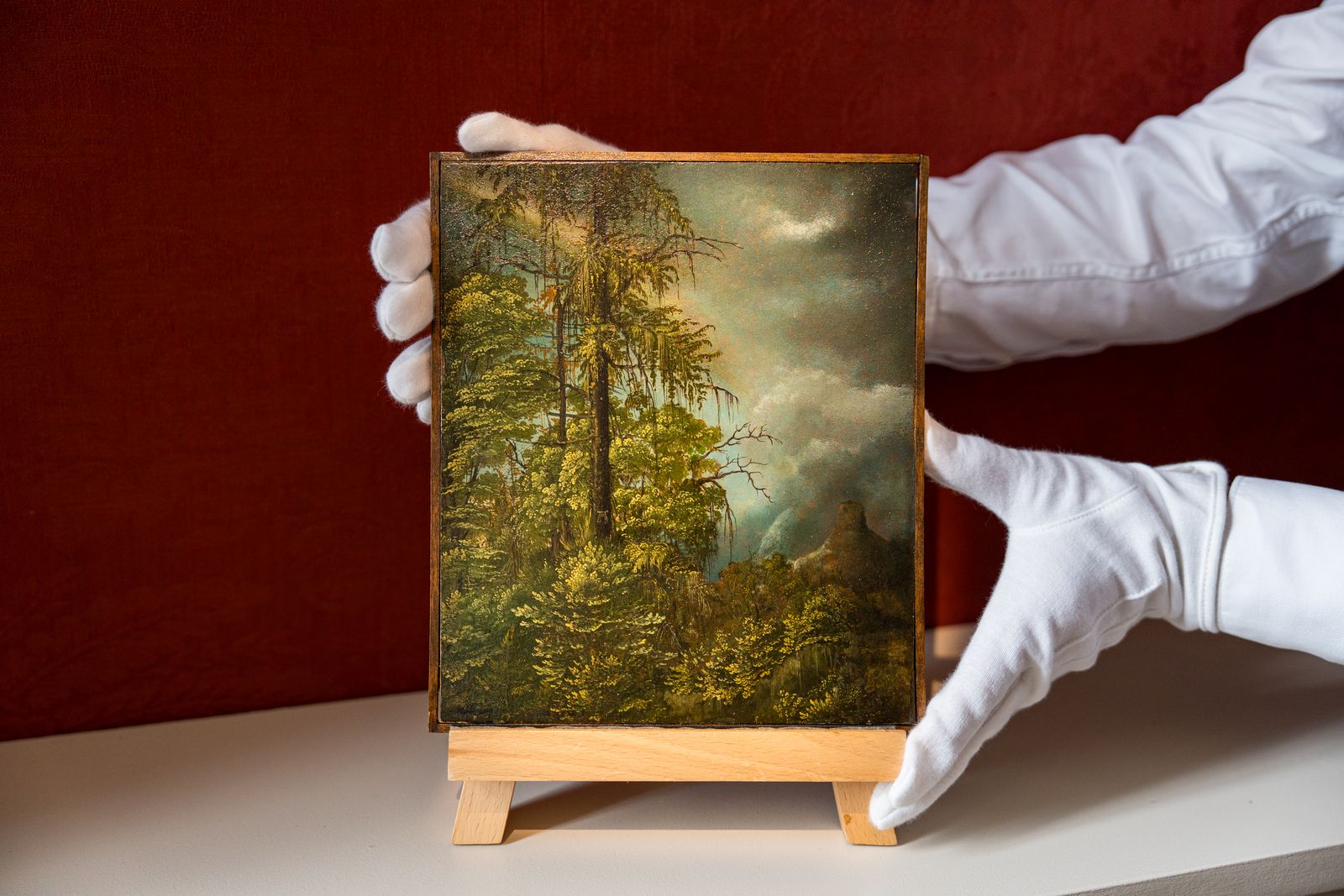
Painted around 1520, the newly identified painting is one of only three pure landscapes painted in oil by the artist. It depicts a lush forest scene with castle ruins and a rainbow emerging from stormy skies November 13, 2026 10:02 a.m. The painting does not appear in Altdorfer’s catalogue raisonné and was only identified earlier this year. Sotheby’s / Rayan Bamhayan For nearly seven decades, a small 16th-century painting of a forest hung in a private collection in Switzerland, unbeknownst to art historians. Now, the 500-year-old work has emerged into the limelight, newly attributed to Albrecht Altdorfer, a German Renaissance artist who pioneered landscape painting. Measuring roughly nine inches long by eight inches wide and dating from around 1520, A Thickly Wooded Landscape With a Rainbow Behind the Trees and a Distant Outcrop to the Right Beneath a Cloud-Laden Sky will head to auction at Sotheby’s in London on December 9. “Every inch of this intimate picture is imbued with an intense mood that transcends its scale … It somehow still feels as modern and immediate as it would have appeared to those seeing it when it was first painted,” George Gordon, co-chair of Sotheby’s Old Masters department, says in a statement. “To add to the known body of work of one of the great masters of the Northern Renaissance is one of the most exciting discoveries imaginable in our field.” The painting, which does not appear in Altdorfer’s catalogue raisonné and was only identified earlier this year, is expected to sell for up to $6.6 million. “We don’t really know what it’s worth because it’s many decades since an Altdorfer last came to the market,” Gordon tells the Art Newspaper’s Catherine Hickley. “It could fetch more than our estimate.” Until its discovery, scholars knew of just two oil landscapes by Altdorfer, both held in major European museums: Landscape With a Footbridge at London’s National Gallery and Landscape of the Danube Near Regensburg at Munich’s Alte Pinakothek. No Altdorfer painting has appeared on the market since 1980, when the National Gallery acquired Christ Taking Leave of His Mother. Painted in oil on vellum, A Thickly Wooded Landscape is the smallest and most densely forested of Altdorfer’s surviving landscapes in any medium, including engravings, etchings and drawings. In the foreground, tangled evergreens and mossy undergrowth rise without a single human figure in sight, while a distant castle perches atop a rocky outcrop on the right. Overhead, heavy clouds part just enough to reveal a faint glow from the sun, whose light catches a delicate rainbow arching behind the trees. Albrecht Altdorfer, A Thickly Wooded Landscape With a Rainbow Behind the Trees and a Distant Outcrop to the Right Beneath a Cloud-Laden Sky, c. 1520 Sotheby’s / Rayan Bamhayan Together, Altdorfer’s three known oil landscapes form a study in shifting weather and light. While Landscape With a Footbridge unfolds in blue daylight and the Landscape of the Danube canvas glows in warm evening light, the newly surfaced work captures the hushed atmosphere immediately after a rainstorm. “There is a sun, but the sun is really struggling to make its presence felt, and then you have a rainbow which has caught light from the sun,” Gordon tells the Guardian’s Miatta Mbriwa. Before Altdorfer, European painters tended to treat nature as decorative scenery behind biblical or mythological narratives. “The first independent landscapes in the history of European art were painted by Albrecht Altdorfer,” art historian Christopher S. Wood writes in Albrecht Altdorfer and the Origins of Landscape. “These pictures tell no stories. They are physically detached from any possible explanatory context … They are complete pictures, finished and framed, which nevertheless make a powerful impression of incompleteness and silence.” As art historian Simon Schama observes in Landscape and Memory, “it was the outstanding achievement of Albrecht Altdorfer, in particular, to make the forest itself the natural protagonist.” Did you know? Landscapes and beyond Altdorfer may have pioneered landscape painting, but his legacy extends beyond this world. In 1960, astronomers named 8121 Altdorfer, an asteroid orbiting the sun between Mars and Jupiter, in the painter’s honor. Born around 1480 in Regensburg, Bavaria, Altdorfer spent most of his life in the city on the Danube, balancing painting, engraving and printmaking with work as an architect and local politician before his death in 1538. Around 1511, a journey south into the Alps sparked Altdorfer’s fascination with sweeping natural vistas, while the mixed deciduous and evergreen woodlands along the Danube downstream from Regensburg inspired his dense forest scenes. He later served Emperor Maximilian I in Innsbruck and painted his most famous work, The Battle of Alexander at Issus, for Duke Wilhelm IV of Bavaria in 1529. The current owner of A Thickly Wooded Landscape inherited the painting from his father, who purchased it in 1957 from the collection of an aristocratic Austrian family, the House of Harrach. Following public previews at Sotheby’s in New York from November 7 to 19 and in London from December 4 to 9, the work will go in front of bidders. Given its rarity, Gordon tells the Art Newspaper, “I think it’s quite likely that museums will be interested.” You Might Also Like Get the latest stories in your inbox every weekday. More about: Art Art History Auctions Germany Money Painters Painting Renaissance
German Renaissance Master Albrecht Altdorfer Pioneered Landscape Painting. A Work Previously Unknown to Scholars Just Emerged After 70 Years in a Private Collection
Full Article
Original Source
Read the full article at Smithsonianmag →KhanList aggregates and links to publicly available news content. We do not host full articles from third-party sources. Always verify important information with original sources.