
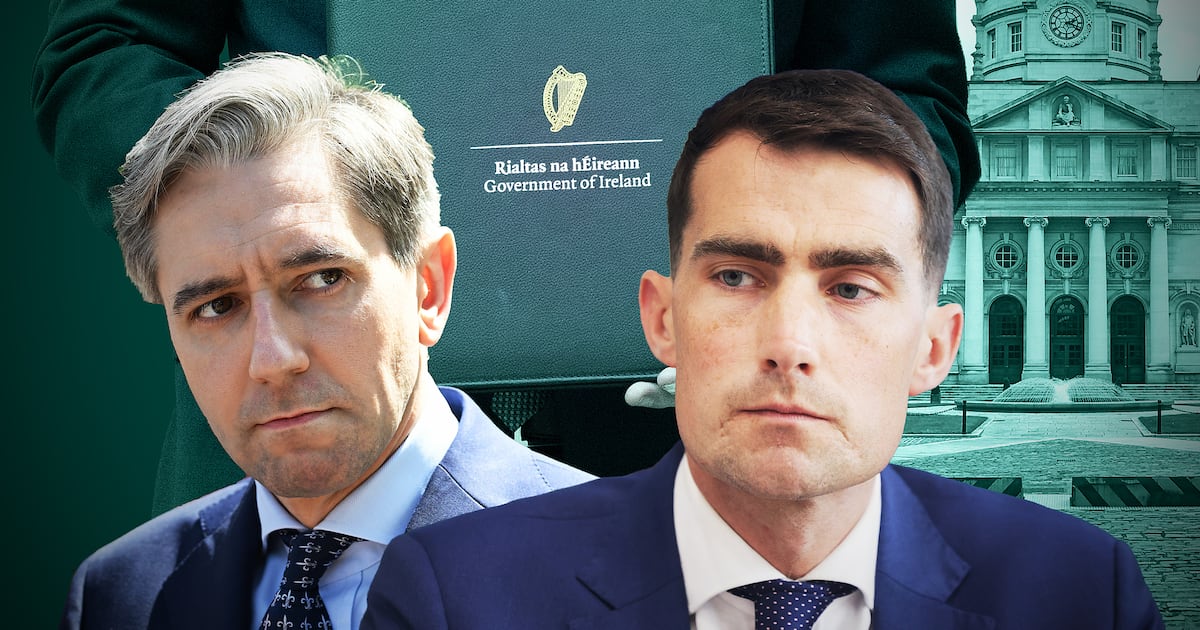
The thing to know about tomorrow’s budget is that, like it or loathe it, you don’t have a choice. The Opposition cannot credibly outspend this Government and can’t afford to underbid it. In the absence of any broader vision, what we are getting is a great frittering of money for ever-less return. We are heading into a winter of loadsa money and a lot of discontent. This budget will rival Gene Fitzgerald’s in January 1981 in its purposelessness – and that budget was until now a nadir of Irish budgets. Fitzgerald was finance minister in the throes of rising public debt, unemployment and inflation. Under then taoiseach Charles Haughey’s direction he ignored reality and kept spending in advance of an imminent general election, but it didn’t work. The circumstances now are very different but eerily similar. Modest but firm control of public spending, under a government with clear priorities and a willingness to articulate them, could be transformative. But it is not to be. What we have in its place are bitty promises, a chaotic budgetary process that feels made up as it goes along, and fragmented politics. Much of the Cabinet and civil service are left to follow developments through the media. Inside the Government – insofar as there is any inside – there is a lot of feral scrapping for a share of a diminishing political centre. It is all short term and tactical. But even on the purely tactical front, it doesn’t work.Because despite all the promises, the day after tomorrow will be one of disappointment. Expectations have been raised across multiple fronts for months – not least by Minister for Finance Simon Harris. No one has been prepared to face down any of the demands. READ MOREThe chutzpah of the hospitality industry in hitting the Government for an expected €681 million in 2027 in the form of a reduced VAT rate was an omen of what was to come. We are now spending €100 million a month on cutting excise duty on fossil fuels as farmers face a severe shortage of winter fodder after a summer drought linked to global warming. Presumably the fodder shortage will require another subsidy. Like the water charge protests of more than a decade ago, the fuel protests were about far more than the ostensible issue. Both resulted in not just a U-turn on the issue, but a real political setback more generally. The momentum for structural reform in the State stalled with the abandonment of water charges. Likewise, the pretence of fiscal discipline ended with the hauliers’ blockade after Easter – and this budget is part of that. It is now a political truism across much of Government that appeasement is the only possible policy.An exception, for now, are the trade unions which have set down preconditions for pay talks to replace the public pay agreement that has expired. A standoff with Minister for Public Expenditure Jack Chambers has escalated into work-to-rule across parts of the public service and planned one-day strikes on October 14th and 21st. There would be a strategic prize for the Government if it could negotiate an agreement that would take them to the other side of a general election at the end of 2029. But it is unclear if this Government can do strategy. Meanwhile, Government backbenchers are being assailed by fuel protesters and by public servants seeking better pay and conditions. As belated attempts are made to contain the rate of growth in public expenditure, public services will be affected by industrial action. All of this feeds into a general mood of dissatisfaction. Ireland is awash with money, yet there is not enough to get younger people who are paying high rents on to the housing ladder, or for modestly paid people to do a weekly shop and pay their fuel bills without feeling the pinch. Critically, there is no persuasive political narrative to convince voters that the Government has a plan for how to tackle any of this. [ Budget talks enter ‘banging fists on the table’ phase – metaphorically at leastOpens in new window ]Budget 2012 was the first after Fine Gael and Labour took power in 2011 and split the Department of Finance in two, creating a new Department of Public Expenditure. That was a political decision about sharing economic power within the Government. It worked well for a time.Until last year, when Paschal Donohoe and Chambers presented Budget 2026, there was largely a unity of purpose between the two ministers concerned. But for the first time since 2011, there is now a split team in the Government trying to manage the economy. Feeding into that dynamic is increasing dysfunction in what, 15 years later, are separate but siloed economic departments, neither of which has or feels responsibility for the big picture. The senior cadre in each department lacks experience in the other – institutionally, this is a step backwards and means the collective powerhouse that took charge in the post-crash period has been diminished.Compounding all this is the rotation of the office of Taoiseach, which started in 2020, and by the next election will be a decade-old phenomenon. This has profoundly altered the dynamic of government to its detriment. It means that a new taoiseach has hardly arrived, but people are looking over their shoulder towards their successor.If there is any consolation to be gleaned from all of this, it is that we have few problems that don’t have solutions – and many can be solved far more easily than in 1981. All that is lacking is the political will and courage to get on with it.
Gerard Howlin: Tomorrow’s budget may be the worst since the days of Charles Haughey’s wild spending
Full Article
Original Source
Read the full article at Irishtimes →KhanList aggregates and links to publicly available news content. We do not host full articles from third-party sources. Always verify important information with original sources.