
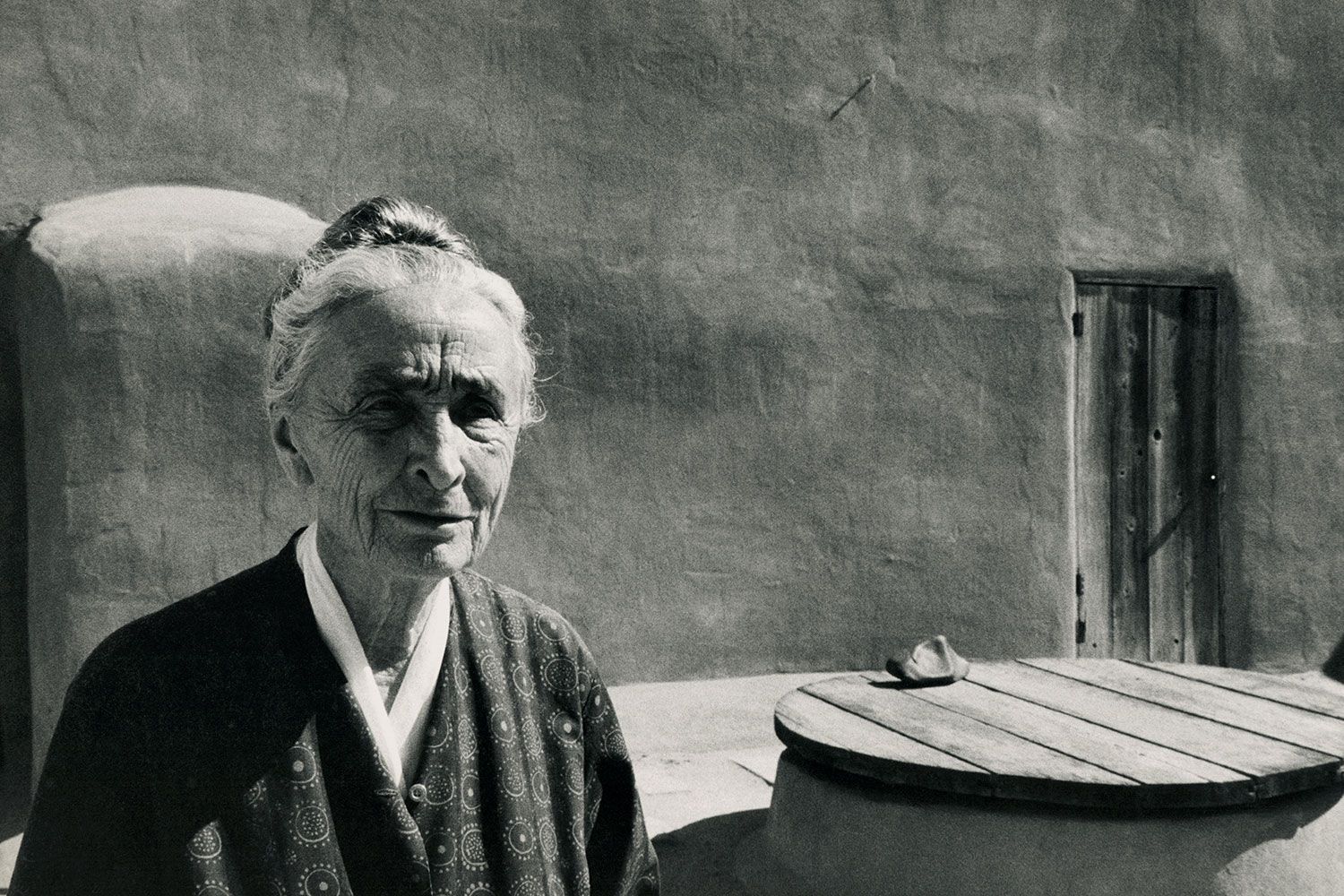
Featuring nearly 40 artworks, a new exhibition at the Detroit Institute of Arts spotlights the artist’s mesmerizing portrayals of the built environment, from rural farmhouses to city skyscrapers November 20, 2026 7:00 a.m. Georgia O'Keeffe at her home in New Mexico in 1971 Basil Langton / Photo Researchers History / Getty Images Georgia O’Keeffe started visiting New Mexico in 1929, immersing herself in the state’s austere desert landscapes for months at a time. She captured her surroundings in hundreds of paintings, which are now some of her best-known works. But while she found the scenery striking, nature was only part of the American Southwest’s aesthetic appeal. In the 1930s, the artist stumbled across an abandoned house in Abiquiú, which she later purchased. O’Keeffe was particularly fascinated by a large wooden door leading to the central patio, a feature she painted at least 20 times. “I bought the place because it had that door in the patio, the one I’ve painted so often,” she said in a 1962 interview. “I’m always trying to paint that door—I never quite get it. It’s a curse—the way I feel I must continually go on with that door.” Black Door With Red, Georgia O'Keeffe, 1954 © 2026 The Georgia O'Keeffe Foundation / Artists Rights Society (ARS), New York O’Keeffe is considered one of America’s greatest artists, and general audiences are familiar with her desert landscapes and large-scale flower portraits. But now, an exhibition at the Detroit Institute of Arts spotlights a lesser-known part of her oeuvre: her enduring fascination with the built environment. “This is the first exhibit that takes a comprehensive view of architecture as a lifelong fascination for O’Keeffe,” Ben Colman, the exhibition’s curator, tells the New York Times’ Leslie Wayne. “Barns and fields and buildings are not the O’Keeffe that people think about. It’s a bit of a surprise.” Quick facts: Georgia O’Keeffe’s flowers The artist created more than 2,000 works during her lifetime, but only 10 percent of them—around 200 paintings—feature her famous flowers. In 2014, one of her flower paintings, Jimson Weed (1932), sold for $44.4 million, becoming the most expensive artwork by a woman ever auctioned. Frida Kahlo’s The Dream (The Bed) (1940) broke that record when it sold for $54.7 million last year. “Georgia O’Keeffe: Architecture” features nearly 40 works created between the 1920s and 1960s. The artist’s paintings are grouped into three sections, each exploring a central setting from her life: rural barns and farmhouses, New York City skyscrapers, and New Mexico homes. Stables, a painting of a white barn that the artist noticed during a 1932 road trip through Quebec, served as the inspiration for the exhibition. It’s the only O’Keeffe in the Detroit Institute of Arts’ collections. When Colman joined the institute in 2015, he was fascinated by its simple geometric shapes and large blocks of color. He found himself thinking about it often. “I had such a strong pull to this picture and wanted to know more,” Colman says in an interview posted on the institute’s website. “In asking questions about Stables, I started to sketch out a broader story about O’Keeffe’s life and her engagement with architecture across her career. What began as a set of questions about the summer of 1932 turned into a larger story about the role architecture played as a recurring source of inspiration throughout the artist’s life.” Stables, Georgia O'Keeffe, 1932 © 2026 The Georgia O'Keeffe Foundation / Artists Rights Society (ARS), New York Stables is on display in the exhibition’s first section, which reflects O’Keeffe’s childhood on a Wisconsin dairy farm, as well as her sojourns to Lake George in upstate New York with her husband, photographer Alfred Stieglitz. Another highlight of this section is My Shanty, Lake George (1922). Colman describes it as “a challenge to her critics,” who struggled to evaluate O’Keeffe’s art without considering her gender. “One day as I looked at the brown burned wood of the Shanty, I thought, ‘I can paint one of those dismal-colored paintings like the men. I think just for fun I will try—all low-toned and dreary,’” O’Keeffe wrote in her 1976 autobiography. When My Shanty, Lake George went on display, “the men seemed to approve of it,” she added. “They seemed to think that maybe I was beginning to paint.” My Shanty, Lake George, Georgia O'Keeffe, 1922 © 2026 The Georgia O'Keeffe Foundation / Artists Rights Society (ARS), New York The second section showcases paintings of high-rises in New York City, where the artist lived for three decades. One of the pieces on view is Brooklyn Bridge (1949), the final city artwork that O’Keeffe created before moving away. She painted it from the perspective of someone passing through the bridge’s famous archways. “It captures a view that you only see when you’re crossing the river, when you’re in the midst of making a change yourself,” Colman says. “The artist created this painting the year that she relocated her life and home to New Mexico permanently.” The final section displays O’Keeffe’s paintings of New Mexico, where she lived until her death at age 98 in 1986. These paintings capture the region’s unique adobe architecture—including ten depictions of that inscrutable patio door. “Georgia O’Keeffe: Architecture” is on view at the Detroit Institute of Arts through January 3, 2027. You Might Also Like Get the latest stories in your inbox every weekday. More about: Art Artists Arts Cities Deserts Exhibitions Exhibits Flowers Modern Art New Mexico New York City Painters Painting
Georgia O'Keeffe Is Famous for Painting Flowers and Deserts. Why Have We Forgotten Her Obsession With American Architecture?
Full Article
Original Source
Read the full article at Smithsonianmag →KhanList aggregates and links to publicly available news content. We do not host full articles from third-party sources. Always verify important information with original sources.