
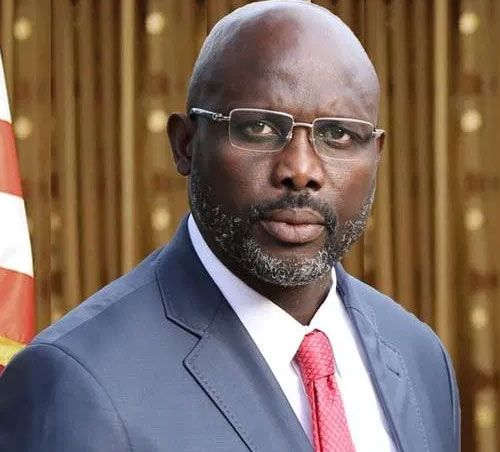
By Mobolaji Sanusi “…Government of the people, by the people, for the people, shall not perish from the earth.”— Abraham Lincoln (1809-1865), the 16th US President, in his November 19, 1863 Gettysburg Address. The 66th Annual Conference of the Nigerian Bar Association (NBA) has come and gone, but the substance of the presentation by the Guest Speaker has left an indelible imprint on my mind. That Guest Speaker, former President of Liberia from 2018 to 2024, is George Weah. He spoke on the theme, “Beyond Limits: The Bar, The Bench and The Building of Africa.” Without pretending to be a lawyer, Weah, the only African ever to be named World Footballer of the Year, delivered a compelling address before an audience comprising mostly members of the legal profession. He wove together his humble beginnings and the life lessons learned under his poor grandmother’s guidance in a remote village in Liberia, his illustrious football career in Europe, and the rich experience he garnered as a politician and former president into a beautiful and instructive presentation. Weah is indeed the pride of Africa who, by sheer providence, rose from the dusty, uneven, open football fields in his village to the world-class pitches of Europe, becoming an accomplished professional footballer who brought glory and acclaim to his ancestral continent. His astronomical fame and fortune spread across continents, and millions of people, especially youths in his home country, yearned for his political leadership. He subsequently delved into the murky waters of politics in Liberia. In 2005, George Weah lost his first bid for the presidency of Liberia to Ellen Johnson Sirleaf, a former Liberian Finance Minister and top World Bank official. Her victory made her Africa’s first elected female president. That election was not without controversy. For instance, during the first round of elections held on October 11, 2005, neither Weah nor Johnson Sirleaf secured an outright majority, paving the way for a runoff. In the first ballot, Weah led with 28.3% of the vote, while Johnson Sirleaf trailed with 19.8%. In the runoff held on November 8, 2005, Johnson Sirleaf, with support from then-President Olusegun Obasanjo of Nigeria and other African leaders, “won” with 59.4% against Weah’s 40.6%. Obasanjo and other leaders, against the democratic wishes of Liberians, reportedly argued at the time that Weah lacked the requisite education and political experience and that it would be unwise to hand over a war-ravaged country to a former football superstar.Despite this blatant partisanship by continental leaders, Weah displayed admirable statesmanship by dropping his intended legal challenge and allowing Johnson Sirleaf to govern from January 16, 2006. This determined and illustrious footballer immediately went abroad to pursue his university education, earned a degree in Political Science, and later returned to contest and win the presidency in 2017. He served from 2018 to 2024. When he was not re-elected, Weah made the instructive decision to congratulate his victorious opponent even before the official results were announced. This is a rare trait among leaders on the African continent. Our political leaders are bad losers who challenge even the unchallengeable in court. Weah is not part of this group of unworthy leaders. Former President Goodluck Jonathan of Nigeria is also a worthy example of what a leader’s disposition to power should be after losing an election. He called Muhammadu Buhari when it was obvious he had lost his re-election bid to him in 2015, and the rest is now history. With this antecedent, Weah’s choice as Guest Speaker by the NBA leadership could not have been more apt. He might not have been perfect as a leader of Liberia, but where on earth is there a leadership without blemish? With his experience in leading his country, the attendant mistakes he made and the lessons he learnt, coupled with his inspiring resolve to hand over power without any fuss, Weah is eminently qualified to talk about democracy and the rule of law, not only before an audience of lawyers but also before any gathering anywhere in Africa and the world. Consequent upon the foregoing, his unqualified admonition to serving elected leaders, especially on the continent, who erroneously believe that once an election is won, the electorate can go to blazes and that everything else will fall into place, should not be waved aside. To reinforce this, he pointed out that “once elections do not follow democratic precepts, it is very dangerous for the peace and security of a country.” Unfortunately, most elections on the continent do not follow democratic tenets. Weah’s lecture did not fail to mention that although elections, as a democratic component, might be necessary for the periodic change or retention of government, he was quick to add that “democracy does not survive on the strength of elections alone. Elections are the doorway into democracy, not the house itself.” No wonder that under a democracy, eternal vigilance is considered a prerequisite for the attainment of true freedom. Weah equally called on the people to be wary of the type of candidates of political parties to whom they give their mandates, since clothing a leader in democratic garb does not reveal such a leader’s innate character. Hence his declaration that “a tyrant with a certificate of return is still a tyrant…” He continued by stating that “democracy, properly understood, does not end on election night. It is tested every single day afterward, in how power treats the courts and the parliament that exist to restrain it.” In realistic terms, most countries on the continent have turned the judiciary and the legislature into ‘echo chambers’ for executive power play and impunity. This has made these two important arms of government a laughingstock in the court of public opinion across the continent. No wonder he called on African leaders to henceforth ensure that “a court’s decision must mean what it says, without anyone’s political permission…” He further reminded these selfish leaders and their cronies in countries across the continent that unfettered court decisions are “what protects a nation from sliding, gradually but progressively, into the very conditions we condemn when soldiers do it with guns.” The question is: How can we as a collective get out of this shambolic situation that has made the judiciary and the legislature dependent on the tyrannical executive branch of government despite Baron de Montesquieu’s clearly espoused and globally embraced principle of separation of powers and the doctrine of checks and balance. While reflecting on how to resolve this question, Weah was quick to remind members of the NBA that it is not enough for it to remain merely a professional association negotiating welfare for its members but, more importantly, to be the “standing sentinel of our republic’s democracy.” He further pointed out to the assemblage of lawyers and other distinguished personalities in attendance that “when the Bar is silent, courts are easier to capture. When the Bar speaks with one voice, as guardians of the Bench, the executive branch thinks twice before even dreaming of interference.” Unfortunately, the Bar as it is currently constituted is, attitude-wise, more concerned with individual survival than with embracing collective vigilance against executive impunity toward institutions, courts of justice and the state in general. A salvo to governments across Africa was inherent in Weah’s drawing attention to their much-overlooked conduct that constitutes a serious peril to constitutional democracy. The actual peril to democracy, according to Weah, “does not come only from the coup-makers who seize power in the night. It also comes from governments that call themselves democratic through budget manipulation, wrong appointments, pressure on judges, and deciding that courts should be a convenience rather than a check.” What a pity! But the clincher that calls for reflection by members of the Bar and other truly democratically minded people anywhere is Weah’s suggestion on how to solidify democratic tenets when he stated that “the independence of courts and the rights of the ordinary Nigerian citizen are in themselves protection for democracy, here in Nigeria and across our region.” Good governance anchored on the rule of law, truly independent institutions, and an unwavering adherence to democratic tenets is a sine qua non for Nigeria’s and the entire continent’s greatness. I hereby rest my case for this week. •Sanusi, former MD/CEO of Lagos State Signage and Advertisement Agency, is currently Managing Partner at AMS RELIABLE SOLICITORS. (WhatsApp only: 07011117777)
George Weah’s Homily On Democracy
Full Article
Original Source
Read the full article at Thisdaylive →KhanList aggregates and links to publicly available news content. We do not host full articles from third-party sources. Always verify important information with original sources.