
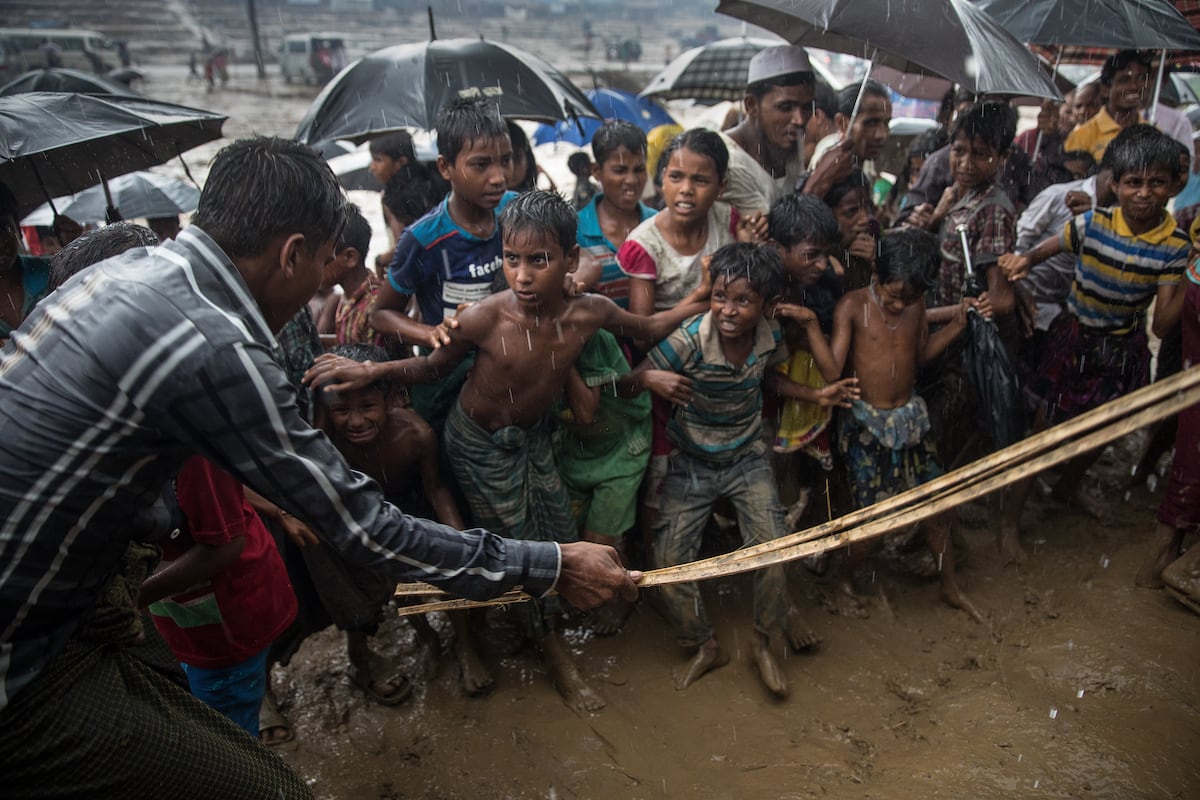
Genocide is considered the crime of crimes. However, its path through international justice has been tortuous. Under the 1948 Convention on the Prevention and Punishment of the Crime of Genocide, ratified by 153 states — including Israel — the crime is defined as the “intent to destroy, in whole or in part, a national, ethnical, racial or religious group.”The Convention’s definition, which emerged from lengthy negotiations among countries after World War II, is stricter and harder to apply than the one coined by the word’s inventor, Polish jurist Raphael Lemkin, who sought a new concept to define Nazi crimes. The jurisprudence developed by international justice since then has made a conviction even more difficult.So far no state has ever been convicted of genocide, although dozens of individuals have been found guilty by international tribunals — such as those for Rwanda and the former Yugoslavia — and by national courts in universal jurisdiction cases, for example in Belgium. It took 50 years after the Convention’s adoption for a person to be legally deemed a génocidaire: Rwandan Jean-Paul Akayesu, mayor of Taba, tried by the International Criminal Tribunal for Rwanda and convicted in 1998. Of all the massacres during the wars in the former Yugoslavia, only Srebrenica — where 8,000 Bosnian Muslim men and boys were killed by Serbian ultranationalists in the summer of 1995 — was judged to be genocide.That is why the ruling the International Court of Justice (ICJ) in The Hague plans to announce on November 19 regarding Gambia’s complaint against Myanmar for the ethnic cleansing of the Rohingya — a Muslim minority — is so important. If this UN court, which hears disputes between states, finds that the acts amount to genocide, it would create jurisprudence that could affect the next case the ICJ must rule on, as yet not scheduled: South Africa’s complaint accusing Israel of genocide in Gaza.A jurist and international law expert familiar with the process described himself as “moderately optimistic” and, above all, acknowledged the influence this case could have on what happens with Israel. The ICJ ordered Israel in 2024 to halt its offensive in Gaza because of the territory’s “catastrophic humanitarian situation” and to allow investigation of the genocide allegation. The government of Benjamin Netanyahu has done neither.Lemkin (1900–1959), of Jewish origin, coined a new word to try to define the Nazi horrors of World War II, blending the Greek genos — tribe or people — with the Latin -cidium — killing. Around the same time, as Philippe Sands recounts in East West Street, Hersch Lauterpacht, another jurist who studied in the same city as Lemkin, Lviv (now in Ukraine), coined the concept of crimes against humanity, which punishes the murder of individuals, as opposed to genocide, which punishes the destruction of a collectivity.Lemkin spent his life pushing for the concept to be incorporated into international justice, without fully succeeding: at the Nuremberg trials, genocide appeared in the indictments but not in the verdicts, so technically the top Nazi leaders were never convicted of genocide, even though their crimes — and the mass killings of Armenians by the Ottoman Empire — forced the search for a new concept to define the abysses of horror into which humanity had fallen.When Lemkin first used the term in his book Axis Rule in Occupied Europe, written in 1943 and published in 1944, Auschwitz was still an occupied Polish town, not yet a synonym for the industrial extermination of human beings. In his book the jurist writes about Jews but also about other peoples deported and persecuted by the Nazis, such as Slovenes. His concern was not only physical murder but “the destruction of the economic foundations of a national group,” as he explains in the chapter devoted to the term in his essay.After World War II, Lemkin campaigned for the international community to adopt the concept, hoping humanity would learn the lesson of the Holocaust and Nazism. Thus the Convention on the Prevention and Punishment of the Crime of Genocide was born, and it was far more restrictive than his ideas. Because the USSR took part in the negotiations, it pushed especially for the inclusion of the notion of an ethnic group so that it could not be accused over Stalin’s crimes. Franco’s dictatorship, for example, signed the convention in 1968, at a time when the fascist regime was seeking to win a place in the international community.The convention text defines genocide as: “any of the following acts committed with intent to destroy, in whole or in part, a national, ethnical, racial or religious group, as such: (a) Killing members of the group; (b) Causing serious bodily or mental harm to members of the group; (c) Deliberately inflicting on the group conditions of life calculated to bring about its physical destruction in whole or in part; (d) Imposing measures intended to prevent births within the group; (e) Forcibly transferring children of the group to another group.” Proving intent has never been easy, and international jurisprudence has made it even harder.Philippe Sands explained those difficulties in an article in the magazine Le Grand Continent. Under the title On the Concept of Genocide, the jurist and writer noted that in the precedent involving Serbia — accused by Croatia and Bosnia of genocide — the ICJ leaned toward finding genocide only when mass killings were not accompanied by other military operations. If mass killings occur during an offensive, they would be treated as war crimes and crimes against humanity, not genocide. Another question is whether degrees of horror should be ranked: Sands insists there is no scale of barbarism and that genocide is not worse than crimes against humanity.Serbia, therefore, was not convicted of genocide, but of failing to prevent it in Srebrenica. “If there are two possible motives for committing an offense, it is not easy to qualify it as a crime of genocide,” Sands explained. Even intent alone is not always sufficient to secure a conviction.So far, various tribunals have found genocide in crimes committed in Rwanda and in Cambodia under the Khmer Rouge regime — during which nearly a third of the country’s population was exterminated — as well as in Srebrenica, in Bosnia and Herzegovina. For many jurists it is highly significant that the International Criminal Court — also based in The Hague but different from the ICJ, because it tries individuals, not states — ordered the arrest of Netanyahu for war crimes and crimes against humanity, but not for genocide, at least to date.Historians and jurists — and even states such as Germany in the case of the Herero and Namaqua peoples in early 20th-century Namibia — expand the list of 20th-century genocides considerably, starting, of course, with the Jewish Holocaust and the extermination of the Armenians (which Turkey does not recognize). But the authority of a ruling by an international court is undeniable.Sign up for our weekly newsletter to get more English-language news coverage from EL PAÍS USA Edition
Genocide: The difficulty of proving the crime of crimes
Full Article
Original Source
Read the full article at English →KhanList aggregates and links to publicly available news content. We do not host full articles from third-party sources. Always verify important information with original sources.