
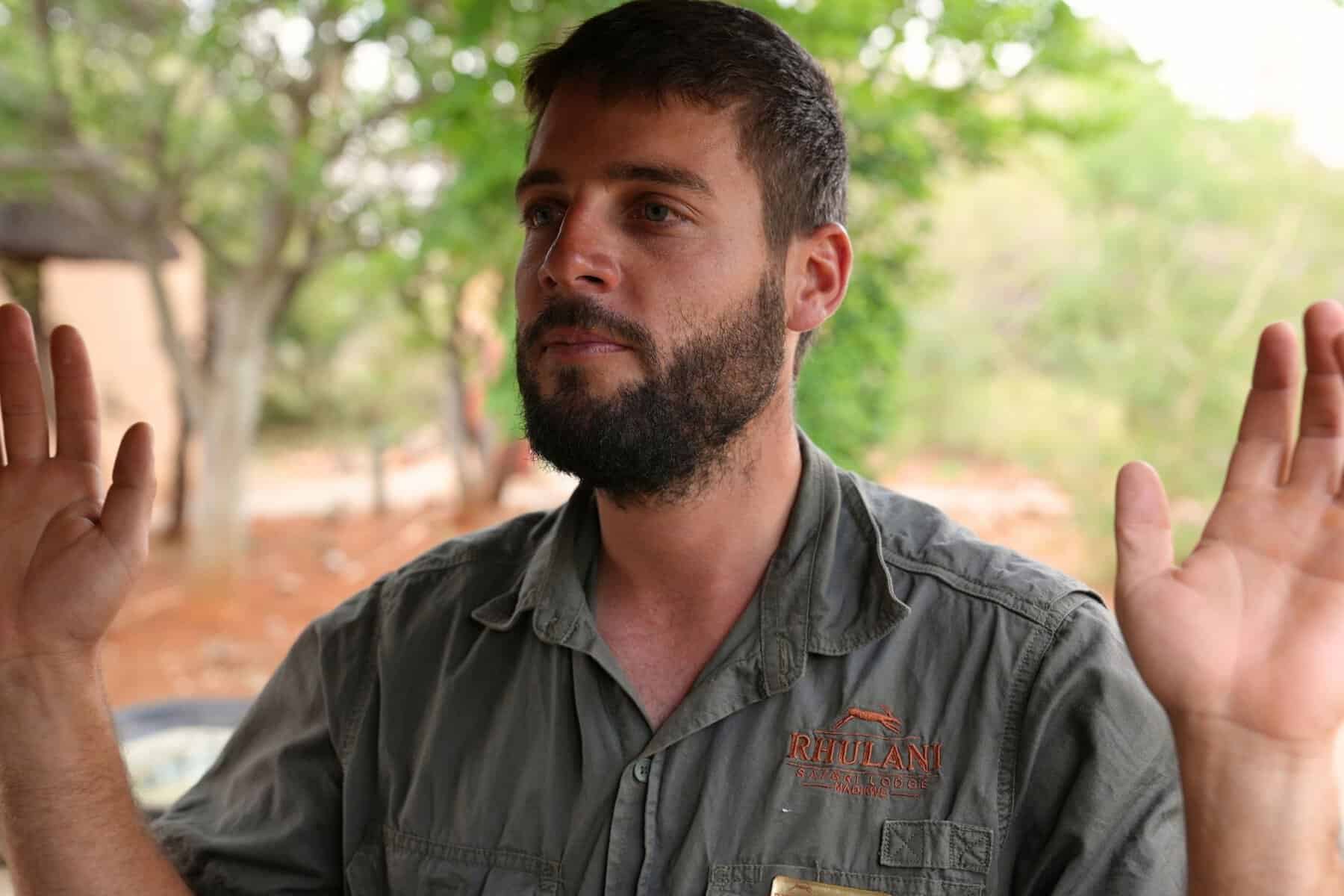
Nel knew from an early age that he wanted to become a guide. Doomscrolling, endless hours on social media and screen time are not part of 28-year-old Gen Z safari guide Willem Nel’s daily vocabulary. His generation is often labelled as digitally obsessed and even dependent. Nel said he would rather watch a cheetah, listen to birds or see what the bush has to offer. “The moment you sit in front of a screen, you lose time out in the bush,” said Nel. He’s a guide at Rhulani Safari Lodge in Madikwe Game Reserve. And there is plenty to keep him occupied. “During the daytime and during the nighttime, the bush in Madikwe takes a complete turn. The animals that get active, the type of animals that call, the smells that come out, different birds that are being active.” The world Nel lives and breathes is vastly different from what we know in the city. It’s idyllic until, of course, an elephant walks through the camp, plays and drinks up half the swimming pool. Or when a pack of wild dogs take down an impala at the solar plant, or when a hyena comes to trash the trash for scraps. But it’s all in a day’s adventure. Elephants that empty the pool Nel knew from an early age that he wanted to become a guide. He was born near the Kruger National Park before his family moved to Pretoria and later to a farm in North West. He was about five when his dad took the family to the Kruger. There, they would self-drive during the day and join guided safaris at night. “My dad would go and sit in the back of the vehicle, and then I’d pretend as if I’m the guide on the vehicle,” he said. He fell in love with the bush, and it stayed with him. On the day Nel received his matric results, he went directly into field-guide training. He qualified at 18 but had to wait until he was 21 before he could start guiding. He began working full-time in 2019 and eventually moved to Madikwe, where he has spent almost five years. All in a day’s work for Rhulani Lodge guide Willem Nel. Picture Hein Kaiser During his half-decade, Nel said, he’s gotten to know many of the animals in the reserve. Sometimes on a first-name basis, so to speak. Madikwe has about 65 lions, and Nel said knowing their histories adds another dimension to guiding. “It’s about more than just facts and figures,” he said. “Sharing stories with visitors about an animal, a herd, a pack of wild animals is so much more enriching. They all have different characters, and each has a story to tell.” It also means that guests who return to the reserve can pick up where they left off on a previous visit. Some of our regulars follow the stories. “To be able to tell the story of the animals, you need to be part of those animals,” he said. “You get attached to the animals, especially when they start to get sick or when they pass away. You get a little bit sad because you’ve bonded that relationship with that animal for a few years. Then that animal gets taken away by nature.” Cheetahs are his favourite cat Cheetahs are Nel’s favourite, but he also pays attention to the smaller animals. He is on a mission to see as many of South Africa’s mongoose species as possible. He said what excites him on any particular day can be anything from a kudu bull to a herd of impala with young. Guiding is also more than taking guests out on safari. Nel said guides become cooks, bartenders, mechanics and maintenance people, with much of the work behind the experience unseen by visitors. Communication between guides is important too. They use Setswana over the radio when talking about sightings. They do this so guests don’t always know what they are heading towards. “It’s one way to try and keep the animals, not let the guests know what animals we might be responding to,” he said. “Nothing is ever guaranteed. Even if you’re three seconds away.” Guides share information throughout a drive, and the arrangement works both ways. Someone who receives help finding an animal one day may be the person calling in the sighting the next. The people part of the job can be just as fulfilling, said Nel. “Some guests have waited decades for a real bush experience. I have met people who dreamed about visiting Africa for 40 or 45 years and only managed to do so when they were around 60. “The bush is a place that leaves people with emotion,” he said. “I like to see the joy in people, and when they get excited, I get excited with them.”
Gen Z safari guide swaps doomscrolling for life in the wild
Full Article
Original Source
Read the full article at Citizen →KhanList aggregates and links to publicly available news content. We do not host full articles from third-party sources. Always verify important information with original sources.