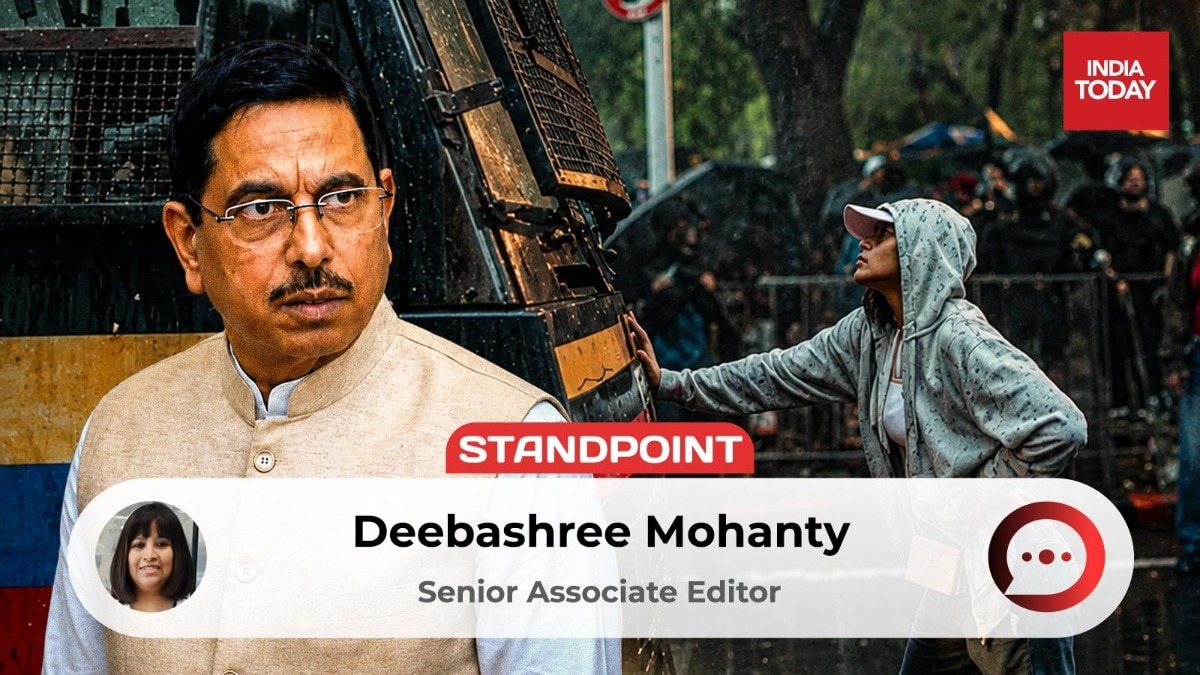
The protests opened a rare window for change, and India's foremost educationists have identified reforms that cannot wait; better teachers, stronger schools, fairer exams and greater institutional autonomy. Can the new Education Minister deliver?The ministry must now choose reform over pet peeves (Photo credit: Arun Prakash/ITGD)There are moments in public life when governments receive an unexpected gift. For the Union Education Ministry, this is one of them.Months of protests by students, led overwhelmingly by Gen Z, did more than demand accountability after the examination crisis. They forced education, perhaps for the first time in years, to become the country’s biggest national conversation.The government responded. A new Education Minister has taken charge, a high-powered committee under Nandan Nilekani has been tasked with reforming examinations, and the National Testing Agency is being restructured.But this is only the beginning. If there is one lesson from the past few months, it is that students were not only asking for a minister’s resignation or another committee. They were demanding a better education system. That is why the ministry (under Pralhad Joshi) must resist the temptation to return to its familiar political battles and ideological pet projects.Whether it is revisiting history textbooks, expanding the role of Indian knowledge systems and mythology in curricula, pushing language policy changes such as the three-language formula, or other curriculum debates, these are conversations that can continue on the sidelines. We are not saying that these are unimportant. But they cannot become the ministry’s defining agenda at a time when students are demanding solutions to far more fundamental problems such as broken examinations, poor learning outcomes, teacher shortages, the coaching culture, weak public schools and declining trust in the overall education system.The Education Ministry now has something far more valuable; a rare public mandate to pursue meaningful reforms that could shape an entire generation.SO WHAT SHOULD THESE REFORMS LOOK LIKEWe asked some of India’s leading educationists, directors of premier institutions and policy experts one simple question.If you had the Education Minister’s ear today, what would you tell him to fix first?Interestingly, despite coming from very different backgrounds, their answers converged around a few clear priorities.1. Fix classrooms before fixing rankings“The biggest problem is the lack of teachers trained adequately in modern pedagogical techniques,” says Prof Shreepad Karmalkar, Director of IIT Bhubaneswar. His prescription is strikingly practical. Make it a mandatory 50-hour annual teacher-training programme focused on modern teaching methods.Education reforms often begin with changing syllabi, but they rarely begin by changing how teachers teach. "Perhaps that needs to change," he tells India Today.in.2. Public schools must become good enough that coaching becomes optionalFor Dr Pushpendra P. Singh of IIT Ropar’s ANNAM.AI Centre of Excellence, India’s greatest challenge isn’t simply examinations. It is the growing loss of confidence in public schooling.With learning outcomes varying sharply across states, millions of families increasingly see private schools and coaching institutes as necessities rather than choices. He argues that the new minister "should prioritise measurable learning outcomes, teacher capacity and transparent standards in government schools."His reasoning is simple. "Countries like Finland, Estonia and Singapore don’t eliminate coaching through regulation, they make it unnecessary by making public education reliable."3. Reform NEET instead of merely defending itIndependent education counsellor Jayaprakash Gandhi believes the conversation must move beyond paper leaks.He suggests conducting NEET online immediately after the Class XII board examinations to minimise opportunities for leaks. "If JEE Advance can be held before the Class 12 Board exams with Physics, Chemistry, and Maths, why can't we have an examination in Physics, Chemistry, and Biology held right after the Boards?"He also proposes "a separate entrance examination for nursing and paramedical courses, arguing that forcing every healthcare aspirant through one examination unnecessarily increases pressure on students and families."Perhaps his most important suggestion has little to do with NEET itself.“No major education reform should be introduced without consulting stakeholders and giving at least 12 to 15 months’ notice,” he says. In recent years, consultation has often appeared to follow policy. Maybe it should precede it.4. Stop treating universities like government departmentsOne of the strongest responses came from Prof. Debashis Chatterjee, Director of IIM Kozhikode.He warns that excellence cannot be created through excessive centralisation. India’s IITs and IIMs, he argues, "became globally respected because they enjoyed academic freedom, attracted exceptional faculty and retained institutional autonomy."His advice to the new minister is blunt. Provide direction, not prescription. And perhaps his most provocative suggestion is this. Why shouldn’t India one day have an accomplished academic as its Education Minister?5. Degrees alone won’t build India’s futureFor Meenakshi Roy, District Employment Officer, Bihar, the problem begins much earlier. India’s education system, she argues, still produces degrees rather than employability.She wants "universities to prepare students for emerging industries, diversify careers beyond the doctor-engineer binary and produce graduates who are emotionally intelligent, socially responsible and equipped for jobs that do not yet exist."In one sentence, she captures what many employers have said for years. “The biggest problem is the chasm between what is needed and what is being produced.”6. Build on reforms, but first restore faithDr Manujata Gupta of BIMTECH believes the ministry should continue implementing the National Education Policy 2020 while focusing on infrastructure, public-private partnerships, transparency in examinations and affordable access.Her emphasis is not merely on policy. It is on restoring young people’s faith in the education system.THE OPPORTUNITY GEN Z CREATEDIronically, none of these suggestions revolves around textbook controversies, language politics or symbolic debates that often dominate headlines. Instead, they focus on classrooms, teachers, on learning, autonomy, assessment, and also trust.That is perhaps the biggest message emerging from this exercise. The students who occupied the streets these past months did more than protest an examination crisis. They handed the Education Ministry something governments rarely receive — a second chance.The temptation will be to return to familiar ideological battles that generate headlines but leave classrooms unchanged. The wiser choice would be to use this moment to fix what students have been asking for all along.If the ministry truly wants to honour the generation that forced this national conversation, it already knows where to begin. The roadmap isn’t hidden in another committee report, it’s written in classrooms across India, and echoed by the country’s own education leaders.- EndsPublished By: Deebashree MohantyPublished On: Jul 27, 2026 15:31 IST
Gen Z forced an education reset. The ministry must now choose reform over pet peeves
Full Article
Original Source
Read the full article at Indiatoday →KhanList aggregates and links to publicly available news content. We do not host full articles from third-party sources. Always verify important information with original sources.