
Published Jul 24, 2026, 10:30 AM EDT Abhinav pivoted from a career in banking to pursue his first love in writing. Even while working full-time, he continued contributing as an editor-at-large, a role he has held for more than 7 years. A lifelong tech enthusiast who has built three gaming and productivity powerhouse PCs since 2018, his passion for technology keeps him closely following the semiconductor industry, from NVIDIA and AMD to ARM. His MSc dissertation explored how artificial intelligence will reshape the future of work, reflecting his curiosity about the wider social impact of emerging technologies. Back when ChatGPT first launched in late 2022, it was fascinating, and it nearly broke the internet for the months after. It was a model that could handle queries, write for you, hold a conversation and aid your decision-making, none of which had been available at that scale before. The competitors that followed only pushed the value further, and within a couple of years, AI stopped feeling futuristic and became a part of the new normal. So naturally, there's something revolutionary about running a model with similar reasoning capabilities on a laptop with no internet connection at all, thirty thousand feet in an eight-hour flight, running on 16GB of RAM. Gemma 4 has arguably become the most popular local model today, in part because it doesn't discriminate between the devices it's running on. You could have a flagship workstation, or a budget gaming laptop, and its use cases end up limited only by imagination. Here's why I can't stop using it. 16GB of memory, and almost no compromises in the AI experience Gemma 4 gets right that no other model does, and there's a clever trick behind it Now, I'm not a total stranger to the local AI marketplace, as over time, I've tested basically every model that doesn't require data center-grade compute. When you've tested a lot of models, you'll come to realize that at compact sizes, there are always compromises made. It could be factual depth, prompt adherence, or coherence over longer conversations. Gemma 4's E4B variant feels like a rare departure from this pattern, in that, the model somehow doesn't feel like its coming with the usual set of trade-offs, and the reason for that is an architectural decision by Google. To understand this, you'd have to delve further into the nomenclature. The "E" in the model's name stands for "effective", and that means something when it comes to LLMs. The E4B variant actually stores 8 billion total parameters, but only 4.5 billion of them activate at a time. The rest live in what Google refers to as "Per-Layer Embeddings", where every decoder layer gets its own small per-token embedding table. These are bulky in storage, but cheap at inference, which tend to work as fast lookups rather than continuous computation. This means that the model runs with the memory footprint and speed of a 4B model while drawing on nearly twice the stored "knowledge". On the other hand, competing models at this size spend their entire parameter budget on dense weights and have nothing in reserve. The use cases keep finding me, not the other way around Vision for my notes, memory for my archive, and tools that I've only started exploring I categorically hold the view that anyone who hasn't used Gemma 4 offline can't accurately estimate its raw capabilities and usability fairly. It comes across as a small model with modest specs, and every instinct of a user who is accustomed to using cloud AI will tell them that a 4B model will be like an unintelligent chatbot. Then, you realize you can hand it a photograph of your own terrible handwriting and watch it come back transcribed, structured, and ready to be tucked away in a knowledge base, and that moment challenges every notion about capability there is. That is, of course, just one example out of many that make use of the model's native vision capabilities. You can point it at labels, instruction manuals, prescriptions, legal documentation, and just watch it make sense of all of it for you. If that didn't sell you on the idea of running the model yourself, then there are use cases that I haven't got to. Gemma 4 E4B supports native function calling, and perhaps it's one feature that has the most headroom of anything here. You can describe small tools to the model, ask it to "search the vault" or "read this file", and instead of replying in text, Gemma decides when a job calls for one, fills in the arguments, and hands the execution to the software on your machine. One of the popular use cases of it is through Obsidian, which becomes a fully private, offline second brain using Ollama as the local runtime and community plugins like AI Providers or Local GPT to connect the two. If you point the setup at your vault, the model can summarize, rewrite, and answer questions with your own notes as context. The model handles the decision-making, the machine handles the execution, and your own archive starts talking to you. No meter, no tier, no usage limits, and no bills When it comes to AI, the consumer market is in a place where it is accessible to nearly everyone with an internet connection, and yet the most advanced capabilities are gate-kept behind a premium subscription tier. Additionally, every cloud AI service, no matter how generous, is metered somewhere, at some point. Tokens, message caps, priority queues, "advanced" models held one tier above... the pattern is all too familiar. During the initial days, the allure of local AI was the fact that it's free. Now, the allure for me is the fact that it's limitless, accessible from anywhere, and does not come with a pop-up warning that says that I've exceeded my usage quotas. Once the weights are on the SSD, a prompt only costs a few seconds of time, and nothing else. That mere fact changes how I behave and interact with AI tools. I get to iterate on drafts ten times instead of twice, generate the same code several times until it's satisfactory, and query my knowledge base as many times as it takes to develop a working understanding. The best AI tool on my laptop is the one no one bills me for There are a lot of open-weight models out there, but Gemma 4 E4B's capabilities makes every single one of these tasks easier, because it's exactly the sweet spot between efficiency and capability, if there has ever been one. It asks for nothing beyond 16GB and a little disk space, and gives back a solid working assistant with no strings (or tiers) attached. Three months from now, it'll cost me exactly what it did on day one, and that makes it as dependable as dependable gets.
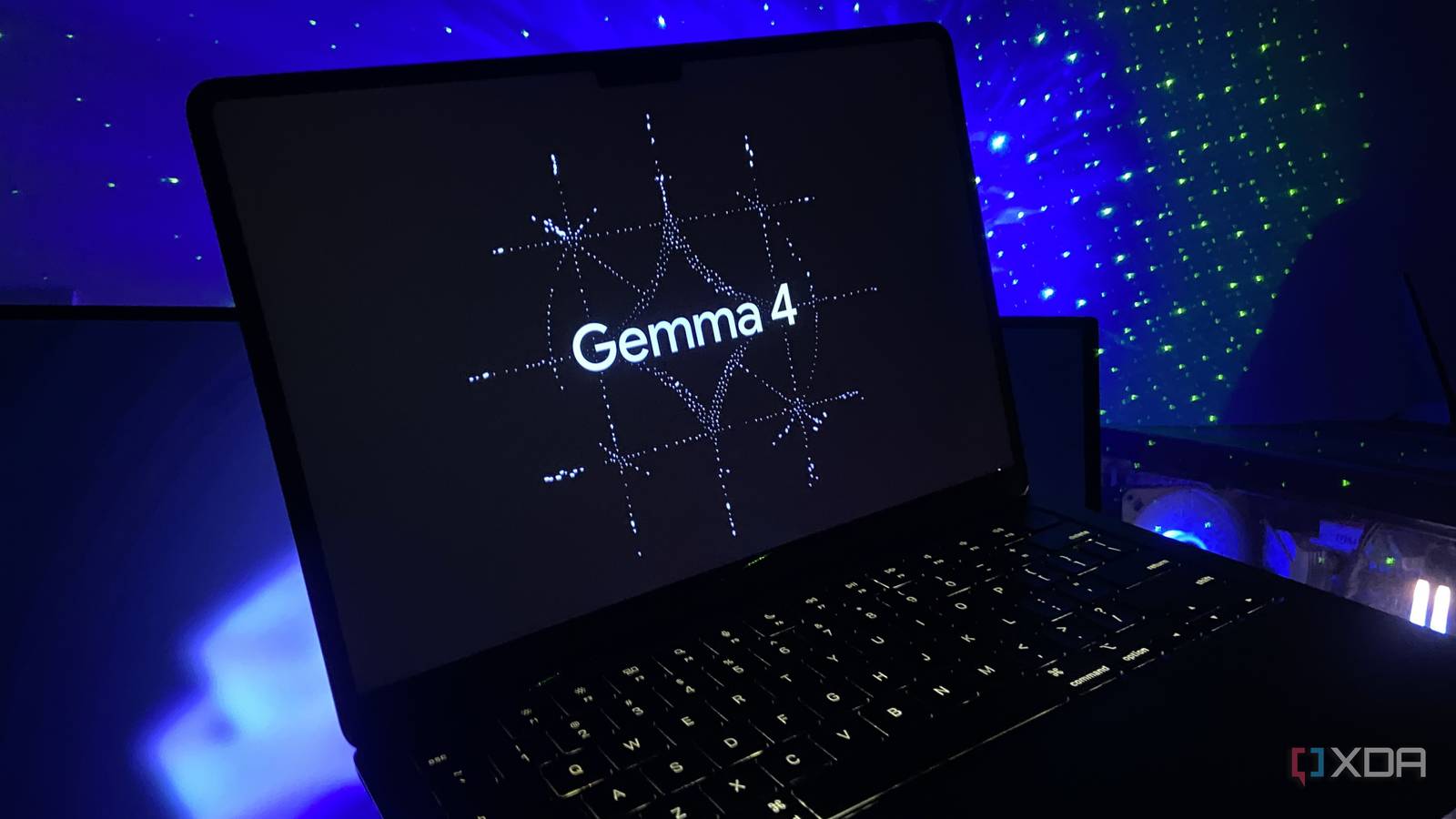
Gemma 4 is lightweight, runs on my 16GB laptop, and costs 0$ to keep me productive offline
Full Article
Original Source
Read the full article at Xda-developers →KhanList aggregates and links to publicly available news content. We do not host full articles from third-party sources. Always verify important information with original sources.