
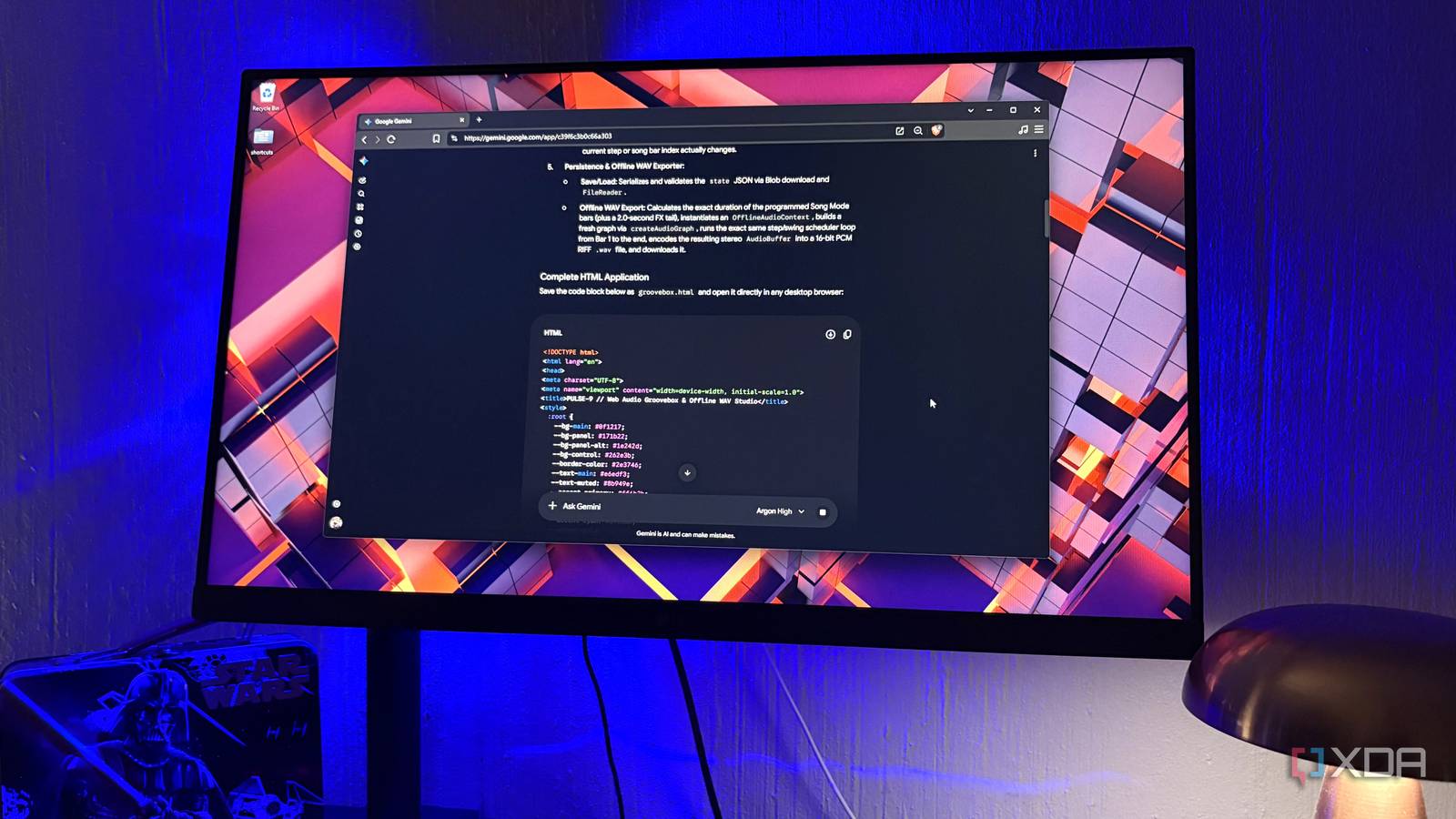
Published Nov 14, 2026, 4:00 PM EST Nolen began their writing career in 2019, with three years dedicated to editing the Creative section at MakeUseOf. Their expertise lies at the crossroads of technology and creativity, covering areas like photography, video editing, and graphic design. Outside of work, you'll often find Nolen diving into a good book, writing their own stories, or playing video games. Paying for multiple AI subscriptions is something that creeps up on you fast, which is exactly why I was so hesitant to get Claude Pro in the first place, never mind getting more than one. But here I am, a couple of months into my Google AI and ChatGPT plans, still trying to figure out which one is worth keeping and which ones should be dropped. New flagships keep promising to be the one model that covers everything, and I can't think of many that survived much past their first week after the hype simmered down. Gemini 4 Argon came with the same promise, and its first impression on me wasn't great. Some of that was down to how I tested it, to be fair, so I wanted to tune my queries to its strengths this time. And it turns out that Claude and ChatGPT have some real competition after all. What is Gemini 4 Argon? And why my first test went wrong Gemini 4 Argon is the first model in Google's Gemini 4 family. Google announced it on September 30 and gave it to a group of vetted cybersecurity teams first, before opening it up in the Gemini app on October 13 for Google AI Pro and Ultra subscribers. I started out on Google AI Plus but have since moved to Pro, and so I got early access to Argon. My first proper go with it was a drum machine test against Claude Fable 5.1 and GPT-6 Astra, where all three got the same prompt for a step sequencer that runs from a single HTML file. Argon's had the most personality, so I'll give it that - it named itself TR-86 and copied the wood side panels off old Roland units. But resizing the window or screen completely threw off the layout, and as for the sound, the kick barely had any low end. Long story short, Argon ended up last on my comparison. Looking back, the test was a bad match from the start. A drum machine like that is a one-prompt job the other two finished in minutes, and I was judging Argon on how fast it could knock out something small. But that's not actually what it's best for, so I wanted to play more to its strengths. What Gemini 4 Argon is built for How you're going to get the most out of this model Google's own wording is pretty clear on this, and I admittedly ignored it at first. When it launched Gemini 4 Hydrogen in November, Google described Argon and Carbon as built for deep, long-horizon reasoning, which basically means jobs with lots of steps where the model keeps working for a long stretch without anyone checking in. Hydrogen is meant for fast everyday work. Google says it narrowly edges Argon on the Artificial Analysis Intelligence Index, an independent ranking that combines a bunch of benchmarks, with rounded scores of 51 to Argon's 50 at default settings. Meaning that small one-shot tools are more Hydrogen's territory, and it would have been a better pick for my first go at Gemini's new models. Argon is what makes sense for bigger tasks, with coding as the main one. Google built it for long, multi-step coding jobs, where the model plans out a whole project and keeps working through it without someone nudging it every few minutes. Through the API, one response can run up to a million tokens once long responses are switched on, up from 64,000 on older Gemini models, and that million is shared with your prompt and the model's thinking. That basically means it can write all the code for an entire app in one go. The developer guide also suggests sharing your goal and asking Argon to raise clarifying questions about edge cases and what success looks like before it starts. Once you've agreed on the target, Google says to let it run the whole plan instead of prompting it turn by turn. Thinking is another factor. The Gemini app gives Argon Low, Medium, and High settings, and Google's advice is to try a job at all three and stick with the lowest one that still does it well, instead of leaving everything on High. Another cool tip from Google is recording your screen while you click through something it built and talk through what bugs you, then handing that video to Argon to find the problems. I think this is pretty brilliant, and it definitely gives the Gemini interface points over Claude. How I use Gemini 4 Argon now It was about improving my brief Going back to Argon, the thing I changed most was the prompt. Now I write it as a proper spec split into sections, similar to how you'd write a brief for a person, with the goal at the top, a section spelling out what done looks like, and a request for an honest self-check at the end - as you can see, it's really long and detailed. The project shown here was much bigger than my previous drum machine one. I asked for a full groovebox, which is basically a drum machine and a synth rolled into one, with a way to arrange patterns into a whole song and export it. I must say it did take its time, but it came back with a plan before the code and laid out how every part connects. I don't write code, and I could still follow where all the stuff I asked for was going to live. The bigger difference was that it seemed to understand what the tool was for, so it made decisions that someone who actually uses these types of audio tools would make. I did also mention my audio engineering background, so it explained its choices in terms that I would use myself. It even loaded a demo track with an actual arrangement, so this really gave me something to react to straight away. This project ended up with Argon listing what was certain worked and what it only assumed, since it couldn't actually open the file and test it like I could. But it did end up working the first try anyway, including exporting the song as an audio file. It did still fumble a few tiny things. For example, there was an option to start playback from a chosen bar that just goes back to the top. It also made a call on the low end that sounds full on my headphones but gets very thin on speakers. I also had to pull the master down quite a lot, and I think there could have been more variation in the size of the button labels. It's hard to defend paying for multiple chatbots If most of your AI use is quick questions or bug checks, or even making small utilities, then Argon probably isn't going to be for you. Bigger projects are where it shines. So if you regularly hand an AI a whole app to build or a massive document to work through, then I think the Google AI Pro plan is the better option over Claude and ChatGPT's plans. But it's still quite a specific use case, so even though it was a close call, I will be keeping my other subs for now. Google Gemini
Gemini 4 Argon is the first model that made me seriously consider cutting my Claude and ChatGPT subscriptions
Full Article
Original Source
Read the full article at Xda-developers →KhanList aggregates and links to publicly available news content. We do not host full articles from third-party sources. Always verify important information with original sources.