
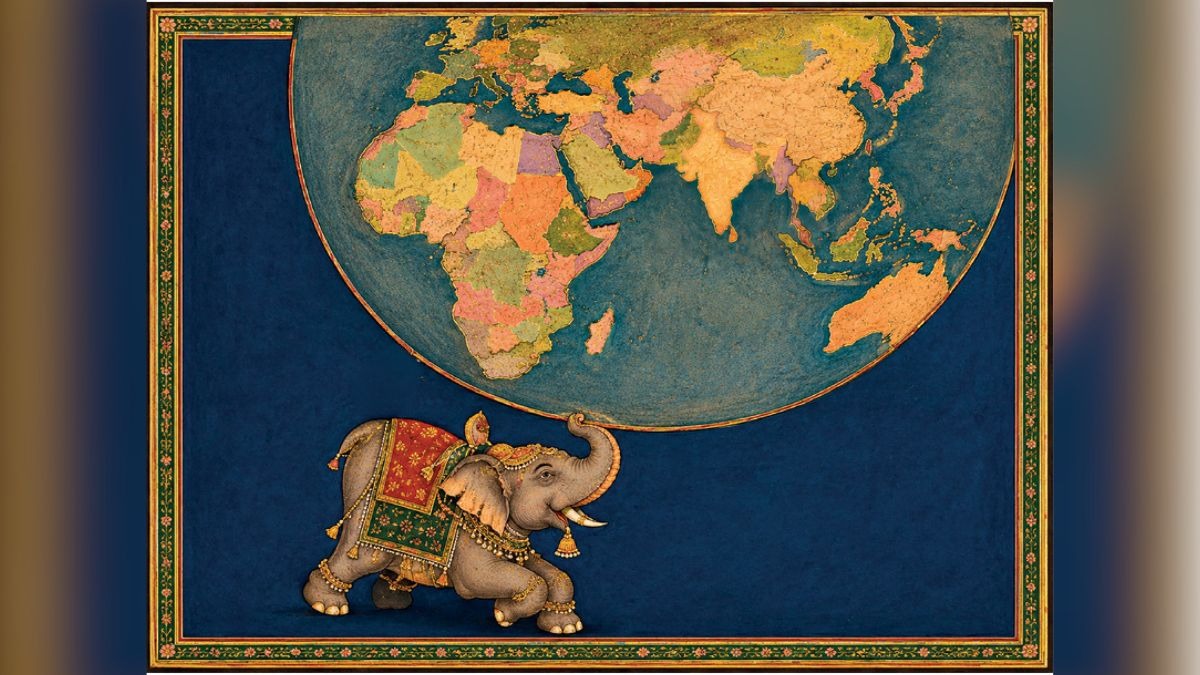
India's GDP growth in Q1 of FY27 showed surprising resilience despite geopolitical headwinds. But some experts have questioned the high numbersIllustration by Nilanjan Das(NOTE: This article was originally published in the India Today issue dated September 14, 2026)India’s economy has delivered a stronger performance than many expected, with the latest data offering a reassuring picture of its resilience in a turbulent global environment. Gross Domestic Product (GDP)—the standard measure of the size and growth of an economy—expanded 7.8 per cent year-on-year (y-o-y) in the April-June quarter (Q1FY27), compared with 6.9 per cent in the same quarter a year earlier (Q1FY26). The figure, released by the ministry of statistics and programme implementation (MoSPI) on August 31, is well ahead of analysts’ forecasts and the Reserve Bank of India’s own projection of 7 per cent.The growth is particularly significant because it came in the first full quarter since the Iran war, as the global economy absorbed the shock of higher energy prices and continuing tensions in West Asia. Meanwhile, nominal GDP, measured at current market prices without adjusting for inflation, grew 10.3 per cent, compared with nearly 8 per cent a year earlier.But some experts—former Union finance secretary Subhash Chandra Garg foremost among them—have questioned the GDP data, arguing that a downward revision of the previous year’s figures had artificially inflated the latest growth rate. According to Garg, without the revision, the “real growth” would have been only 2.6 per cent, rather than the reported 7.8 per cent (see Questions Over the High GDP Numbers). The Centre, however, maintains that it has followed an updated globally accepted methodology for calculating GDP and rejects the allegation that the changes have artificially inflated growth. PILLARS OF GROWTHCrisil, a global analytics company, identifies three principal engines behind the economy’s resilience. The first was domestic consumption. “Household spending was supported by the rationalisation of the Goods and Services Tax (GST) regime and income tax relief announced last fiscal,” says Dharmakirti Joshi, Crisil’s chief economist. The automobile market offered a striking illustration. Passenger vehicle sales surged 25.6 per cent y-o-y, while two-wheeler sales rose 20.6 per cent, “reflecting a broad-based demand across income segments”. “State-level cash transfer programmes, complementing existing food security schemes, also helped cushion household finances and sustain spending momentum,” he adds.The second engine was public investment. Capital expenditure by the Centre increased 23.7 per cent y-o-y in Q1FY27, reinforcing the government’s role in supporting growth. The states added to the momentum, with combined capex across 17 major states rising 6.8 per cent from a year earlier. “The government’s continued thrust on capex-led growth has translated into sustained double-digit investment growth for two consecutive quarters,” notes Rajani Sinha, chief economist at CareEdge Ratings. Investment also strengthened more broadly. Gross fixed capital formation (GFCF), which captures both government and private investment, grew nearly 12 per cent, its highest rate in 13 quarters. It stood at 6.7 per cent a year earlier and 10.5 per cent in the previous quarter (Q4FY26).Exports provided the third leg of support, holding up well even in the face of a challenging global backdrop. “Overall exports expanded 12 per cent in real terms,” says Joshi, “demonstrating the agility of Indian exports amid uneven external demand.”Services remained the strongest broad sector, growing 10 per cent. Financial, real estate, IT and professional services expanded 12.1 per cent, as compared to 8.8 per cent in Q1FY26. Industry grew 8.6 per cent, led by manufacturing and electricity. Manufacturing itself accelerated to 9.2 per cent from 8.3 per cent. Gross value added (GVA), considered a better gauge of the economy’s underlying performance because it captures the value created by producers after the cost of intermediate inputs and raw materials is deducted, grew 8.2 per cent.THE DEMAND DIVIDENDNilesh Shah, MD of Kotak Mahindra Asset Management Company, sees an opportunity to build on that momentum. “In 2010, we were the tenth largest economy; today we are the fifth largest,” he says. “That’s a slope worth accelerating and staying on. We should focus on overtaking Japan and Germany over the next couple of years.” (India slipped to the sixth place in FY26, according to the IMF’s April 2026 World Economic Outlook.)Corporate performance has also remained robust, with Indian companies recording double-digit earnings growth in the past two quarters. Shah notes that this has come despite oil price uncertainty, supply-chain disruptions, a depreciating rupee and monsoon-related shortages.Industrial data, too, point to firm demand. Consumer durables growth accelerated to 8 per cent from 2 per cent in the previous quarter and exceeded the past fiscal’s average of 3.2 per cent. Motor vehicle output rose 15.3 per cent, while other transport equipment expanded 19.7 per cent. Both benefited from sustained discretionary demand and GST rationalisation.HEADWINDS AHEADYet some of the economy’s softer spots are already visible. Agriculture and allied GVA eased to 3.6 per cent from 3.9 per cent, partly because kharif sowing was delayed. The southwest monsoon had been weak in June, with rainfall at just 60 per cent of the long-period average by the end of the month, compared with 109 per cent a year earlier. Kharif sowing was consequently 22.7 per cent lower y-o-y as of June 25.Crisil has raised its GDP growth forecast for FY27 to 7 per cent from 6.6 per cent following the stronger-than-expected first quarter. Pranjul Bhandari, chief India economist at HSBC, nevertheless expects some moderation ahead. “Even as GDP growth has held up well thus far, some softening could be in order, led by a high base over the remaining quarters of the year, some softening in public capex (to meet fiscal deficit targets), the impact of weak sowing (and deficient rains), the petering out of the GST rate-cut impact, and the ending of manufacturing frontloading (that has led to a 10-year high in the stock of finished goods),” she says.The first-quarter numbers offer a measure of confidence, but the months ahead will test how much of the economy’s momentum can be sustained as some of its current supports begin to gradually fade.Questions over the high GDP NumbersCritics say revisions to past GDP data have made the latest growth rate look stronger than it is; Centre denies any manipulationThe Q1 GDP numbers have sparked a fierce debate among economists, with some questioning the methodology used to arrive at the figures and whether they adequately reflect economic realities, particularly when it comes to jobs and incomes. The Congress has also alleged that the GDP numbers are “fudged”.To understand the dispute, it helps to distinguish between nominal GDP and real GDP. Nominal GDP measures the value of goods and services at current prices, including the effect of price changes. Real GDP strips out these price changes to show how much the economy has actually grown in terms of output. The government arrives at real GDP using a ‘GDP deflator’, or implicit price deflator, which measures the overall change in prices by comparing GDP at current prices with GDP at base-year prices. It helps distinguish how much of the increase in the value of output is due to higher prices rather than increased production. For Q1FY27, this put nominal GDP growth at 10.3 per cent; real GDP growth at 7.8 per cent.Subhash Chandra Garg, former Union finance secretary, has questioned the figures, arguing that the government revised the previous year’s GDP numbers downward to artificially inflate this year’s growth rate. If this had not been done, “real growth” would have been only 2.6 per cent, he said. “The government said on August 30 that the GDP at current prices for the first quarter of the past fiscal (Q1FY26) was Rs 86 lakh crore (in absolute terms). That GDP has been reduced to Rs 80 lakh crore. That gives the current increase of 10.3 per cent,” he said. If the government had retained the earlier Rs 86 lakh crore figure, he argued, growth would have been only 2.6 per cent. “The question we are all raising is, how come Rs 86 lakh crore became Rs 80 lakh crore?” he said, adding that a Rs 6 lakh crore difference in a GDP estimate was large and unprecedented.Gourav Vallabh, a part-time member of the PM’s Economic Advisory Council, countered this, pointing to the change in the base year used to calculate GDP from 2011-12 to 2022-23. Effected this February to reflect structural shifts in the economy, it also brought changes to the underlying data and methodology.“The GDP data that was released in August was the first advance estimate. In November 2026, for the same quarter, there will be a second advance estimatethis is the process,” he said. “How can we measure the denominator in a different base year, and then say India’s nominal growth rate is some 2 per cent or the real growth rate is zero per cent? That is not factually correct.”The Centre, too, maintained that there was no deliberate downward revision of Q1FY26 GDP to “mechanically increase” the Q1FY27 growth rate to 7.8 per cent.Garg, however, argued that the issue was not simply the change in the base year. “The enormity of that change in value was the key issue, and it needs to be explained why what counted as production value earlier did not count so now. This is a very serious matter.” He also questioned the negative deflator for manufacturing in Q1FY27 despite an increase in both manufacturing output and input prices.The Centre has defended the negative implicit price deflator for manufacturing, saying it reflects the fact that input prices increased faster than output prices. It also clarified that it had used the ‘double-deflation approach’, an internationally accepted method in which the prices of manufacturing output and the intermediate inputs used to produce it are adjusted separately. Real gross value added (GVA) is then calculated by subtracting the inflation-adjusted value of intermediate consumption from the inflation-adjusted value of output.Subscribe to India Today Magazine- EndsPublished By: Akshita JollyPublished On: Sep 4, 2026 20:36 IST
GDP growth: So far, so good
Full Article
Original Source
Read the full article at Indiatoday →KhanList aggregates and links to publicly available news content. We do not host full articles from third-party sources. Always verify important information with original sources.