
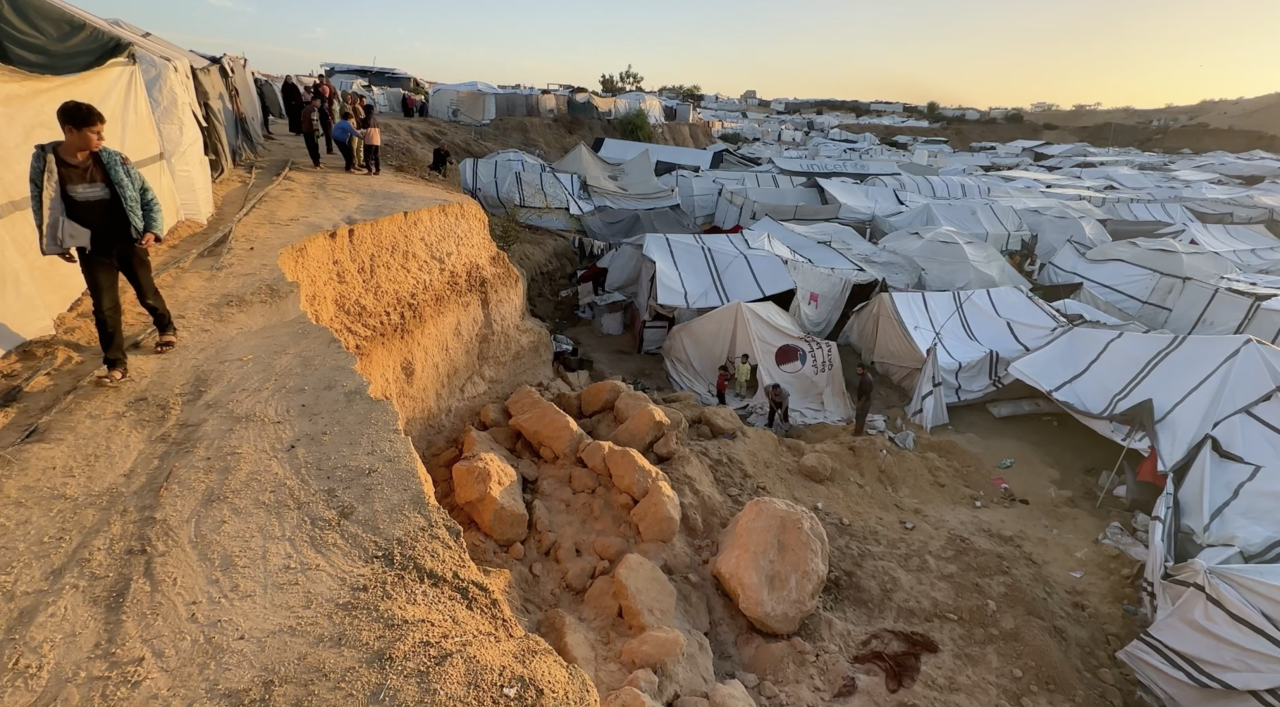
When Tahrir Nabhan, her sister, and their three children went to sleep in a tent carefully pitched beneath a sandy hill in Deir al-Balah, they thought the hill would serve as a natural barrier, shielding them from the heavy rain and torrents that accompany winter storms. But an unexpected landslide happened, and the sand embankment collapsed onto the tents below, killing Tahrir Nabhan and the three children, injuring others. Neighbors rushed to the scene only to be confronted by a horrifying sight: enormous sand mounds covering the tents with people still sleeping underneath. Witnesses said they were initially frozen in shock, unable to react to the scale of the disaster. Eventually, they began digging with their bare hands, pulling out the bodies of relatives who had suffocated, buried under the sand. As soon as other displaced neighbors realized what had happened, they rushed toward the buried tents to help, with no tools at their disposal. “We dug with our bare hands and pulled them out,” said Mustafa al-Masri. “When we reached them, we found an entire family asleep, covered by their blankets. Suddenly, these massive blocks of sand fell on top of them, suffocating them while they were sleeping.” The Civil Defense reported that the deaths of four Palestinians after a mass of sand collapsed onto displaced families’ tents, constituted a tragic incident that reflected the dangers facing thousands of displaced people forced to seek shelter in tents that do not offer the most basic standards of protection and safety. Mahmoud al-Jamal, 45, a relative of the Nabhan Family, said the victims had gathered on a cold, rainy night to keep warm together and share some sweets. Al-Jamal says the family had been displaced from northern Gaza and had remained in the South because they did not want to endure another displacement and feared that the war might resume. “This tragedy will happen again,” al-Jamal said. “We will see it in many displacement camps. A tent does not protect people. It is not a home, nor is it a safe refuge for displaced families.” On Friday evening, the first of many winter storms reached Palestine, bringing heavy rainfall to the Gaza Strip. According to information released by the Government Media Office, 70,000 tents were completely flooded within the first 12 hours of the storm. Dozens of walls also collapsed, causing injuries, some of them serious. Across displacement camps in different parts of the Gaza Strip, the rainfall flooded entire camps which currently house hundreds of families. Floodwaters swept tents away, soaking everything inside. Children were caught in the floods while sleeping, while men were seen walking through the camps with water reaching halfway up their bodies. Ahmed Siyam, spokesperson for the Civil Defense in Khan Younis, describes the efforts being made by the relevant authorities in Gaza to mitigate the impact of winter storms and rainfall on residents, particularly those living in tents. But he speaks against a backdrop of severe incapacity. These challenges existed even before the genocidal war, although on a far smaller scale. After the war, he said, the situation has become entirely different. In Khan Younis, for example, the Civil Defense is operating with only two firefighting vehicles to cover more than one million displaced people in the area. “Following the genocidal war launched by the Israeli occupation against the Gaza Strip, approximately 80% of Civil Defense centers, vehicles, equipment, and machinery were destroyed. We are now working with extremely deteriorated equipment, and much of what remains is no longer fit for service,” Siyam said. Al-Mawasi, Siyam explained, lacks the necessary infrastructure and was primarily an agricultural area before the war.“We are talking about entire camps being submerged, tents being completely blown away by the rain, and water accumulating inside tents to heights exceeding 50 centimeters,” he said. “This means complete flooding.” ‘We no longer know where we can go‘ At the site of the collapse, Umm Abdullah al-Sahhar, 51, recalls that less than ten minutes after the rain began, the sand collapsed, killing their neighbors. Inside her tent, the sand had reached up to her neck. “What does it feel like to look to death face-to-face? Those moments were unbearable. We would not wish anyone to experience them,” al-Sahhar said. She recounts how her son tried to pull his family out from beneath the falling sand, but was unable to free them before others arrived to help. Together, they managed to pull al-Sahhar, her daughter, and her grandson, all of whom had been buried beneath the sand following the collapse of the embankment. Umm Abdullah al-Sahhar, 51, recalling the moment when the sand covered her up to her neck inside her tent. “At this time of the day, my children and the kids who buried under the sand last night would usually gather and play in front of our tents,” she said. “We fled from everywhere, seeking shelter from the rain and from the Israeli army, which forced us into displacement and took away our homes. We no longer know where we can go to protect ourselves from all this death.” She says what happened was equivalent to the war they had endured for three years. “We have witnessed horrific things, including facing death over and over again.” Back to square one: A recurring tragedy Naji Imran, a displaced Palestinian living in al-Mawasi, Khan Younis, saw the floodwater fill his tent during the storm. He says the disaster was not limited to his family, as dozens of neighboring tents were also submerged. It was a widespread catastrophe. He points out that every winter storm brings another ordeal for displaced families, destroying their tents, flooding their belongings, and leaving them with almost nothing. It is another setback that they are forced to endure repeatedly throughout the winter. “We go back to square one every time,” Imran said. “Our tent, which is our home and our shelter, is destroyed. Our mattresses take weeks to dry completely, and we cannot use them again. Our food, clothes, bedding, and everything we have stored inside the tent is suddenly swept away by flooding caused by rainfall that may have only lasted an hour, something no one can prepare for.” Waiting for the next storm In tents and other displacement centers, everyone is working frantically. Mothers retrieve their belongings that have been soaked by the rain and spread them out in sunny places to dry. Fathers and children move around their tents, hammering in additional nails to reinforce the structures in preparation for the next storm. Dina Abdul Rahman, 35, lives in a tent in al-Zawayda, in central Gaza, with her four children. Her husband was killed during the war. She spent the entire night watching over her children, afraid that they would drown in the rain. She said her tent floods every winter, so she spends the rainy season staying awake through the night to make sure her children do not drown, and gathering whatever belongings remain after each storm. “When the rain suddenly pours down over our heads, I focus on protecting my children and leave everything else behind. Once the rain stops, I look to see what has survived and what has been destroyed,” she said. “Winter has not even properly begun. We are still in November. The real winter comes later. What are we going to do then? Will we remain in our tents, freezing and dying from the cold and floods?” When Abdul Rahman hears that children have drowned while sleeping, she cannot stop wondering: “What if this happens to my children? It is entirely possible. What if it happens while we are asleep? How would I ever forgive myself for failing to protect them?” she said. She explains that this is what life inside a tent has become, and that there is little she can do to change it. As long as they continue living in tents, she says, they remain exposed to every danger. Rainfall, which they once hoped would arrive, has become a source of tragedy. Before the war, she recalls, people used to look forward to the rain because they were safe inside their homes, watching it fall through their windows. They did not have to endure it falling directly on their heads, or sleep under the rain day and night. Now, she says, a growing number of people are hoping that the rain will not come.
Gaza’s displacement camps face deadly winter storms, flooding, and landslides
Full Article
Original Source
Read the full article at Mondoweiss →KhanList aggregates and links to publicly available news content. We do not host full articles from third-party sources. Always verify important information with original sources.