
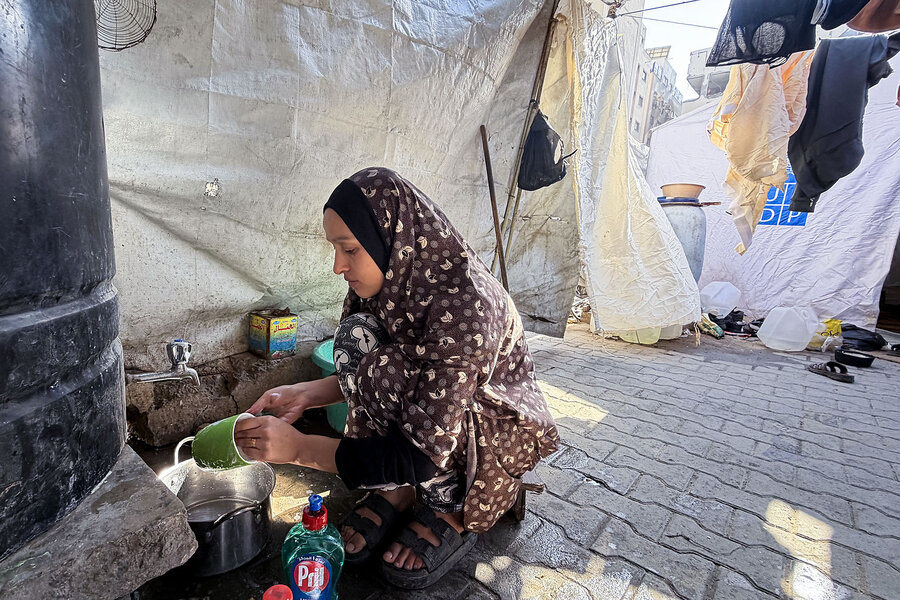
Gaza City, Gaza Strip | Oct. 30, 2026, 2:17 p.m. ET | 3 min read While Israelis await the coalition negotiations that will determine the shape of their next government, Palestinians in Gaza also find themselves deeply invested in the outcome.More than a year since a ceasefire was reached between Hamas and Israel in October 2025, the political process to end the war is stalled, leaving no clear roadmap for Gaza’s future. Meanwhile, Palestinian elections originally slated for November were recently moved to September 2027.Those circumstances are compelling Gazans to look across the border to an Israeli elections process they cannot participate in, clinging to the prospect that a change in leadership there might lead to change – however small – in their lives as well. “I keep asking myself whether a different administration or different party might ... bring the war to an end,” says Islam Abed, a displaced mother of four from the neighborhood of Shuja’iyya who lives with her family on the streets of Gaza City.She doesn’t have an answer to that question. But of something else she is certain.“Whether the right or the left [governs], the consequences will fall on us: on our health, our lives, our future, and the future of our children,” she says.Rejecting the status quoPalestinians following Israeli elections is not new. Certain groups – particularly laborers who used to work in Israel and speak Hebrew – have long taken a keen interest in politics there. However, the current vote has generated an exceptional level of attention in Gaza, where Israeli airstrikes and blockades continue a year after the ceasefire, and the population of more than two million people is being confined to an ever-shrinking slice of the Gaza Strip. Ghada AbdulfattahExtensive destruction is seen along a street in Gaza, where damaged buildings and piles of rubble continue to impact the daily lives of residents. Given those conditions, Gazans want, above all, to see key figures of the current government ousted, foremost among them Prime Minister Benjamin Netanyahu.It is that rejection of the current Likud-led government – rather than support for the platforms of opposition parties – that drives Gazans’ views on the election, says political analyst Mustafa Ibrahim.Indeed, none of the leading Jewish parties offers a clear commitment to Palestinian self-determination or the establishment of an independent Palestinian state. Still, many here see the Israeli opposition, led by Gadi Eisenkot and his Yashar party, as the best of a slate of bad options.Mr. Ibrahim says Mr. Eisenkot might prove more responsive to the international community’s concerns and criticisms of Israeli policy in the region. A desire to reduce Israeli isolation could also make a new government more invested in pushing the stalled Gaza ceasefire negotiations further.“We cannot rely on any election or political party to alleviate our suffering,” Ms. Abed says frankly. “But perhaps a change might bring ... less airstrikes. We see no safety here.”Small shiftsHer view reflects a wider reality. Gazans know what they can reasonably hope for out of new Israeli leadership is limited, because it is not a particular government’s policy, but rather the Israeli state that “they regard as an occupying power, one they accuse of seizing their land and displacing them,” Mr. Ibrahim says. “A change in the Israeli government does not necessarily imply a fundamental shift in policies toward the Palestinians.” Ghada AbdulfattahRuaa sits with her three children inside their tent, which serves as their family's temporary shelter. She and her husband, Mus’ab Jihad Al-Buhaity, follow the Israeli elections closely. In the run-up to the election, political parties in Israel focused largely on on domestic issues. Even debates about Gaza’s future are driven by how the war and continued occupation affect Israel’s future, he says, rather than improving “the conditions of Palestinians in the West Bank and the Gaza Strip.” Mus’ab Jihad Al-Buhaity, a displaced Palestinian in eastern Gaza, and his wife, Ruaa, aren’t convinced that Mr. Netanyahu’s departure would bring an end to the threats facing Palestinians.Still, they follow election news closely from their tent, using a radio app installed on their phone. The couple sees it as a way to “find out what might happen to us,” Mr. Al-Buhaity explains. And he refuses to let go of a small hope that what might happen could be better than what is happening now. Deepen your worldviewwith Monitor Highlights.Politics with respectGet political stories with respectful analysis.There‘s a world of new ideas in everyBooks newsletter.There‘s more to life, enrich yours withCulture & Learning weekly.Follow humanity‘s discoveries withScience & Nature stories in your inbox.Gain a spiritual perspectivefrom the stories in your inbox.Want to understand the deeper impact of critical events? Learn the Monitor‘s insight.Already a subscriber? Log in to hide ads. “We are optimistic, God willing, that life will get better,” he says, “that they will rebuild, that something will happen.”While Mr. Al-Buhaity remains hopeful, Ms. Abed says the significance of Israel’s elections is not ultimately about which party wins. It is about whether anything might change enough for her family to have a home again. “They may make promises to their own people, but they also make promises to threaten us with further punishment,” she says. ALREADY A SUBSCRIBER? LoginReal news can be honest, hopeful, credible, constructive.The Christian Science Monitor was founded in 1908 to lift the standard of journalism and uplift humanity. We aim to “speak the truth in love.” Our goal is not to tell you what to think, but to give you the essential knowledge and understanding to come to your own intelligent conclusions. Join us in this mission by subscribing.
Gazans couldn’t vote in Israel’s election. But many say it will determine their future.
Full Article
Original Source
Read the full article at Csmonitor →KhanList aggregates and links to publicly available news content. We do not host full articles from third-party sources. Always verify important information with original sources.