
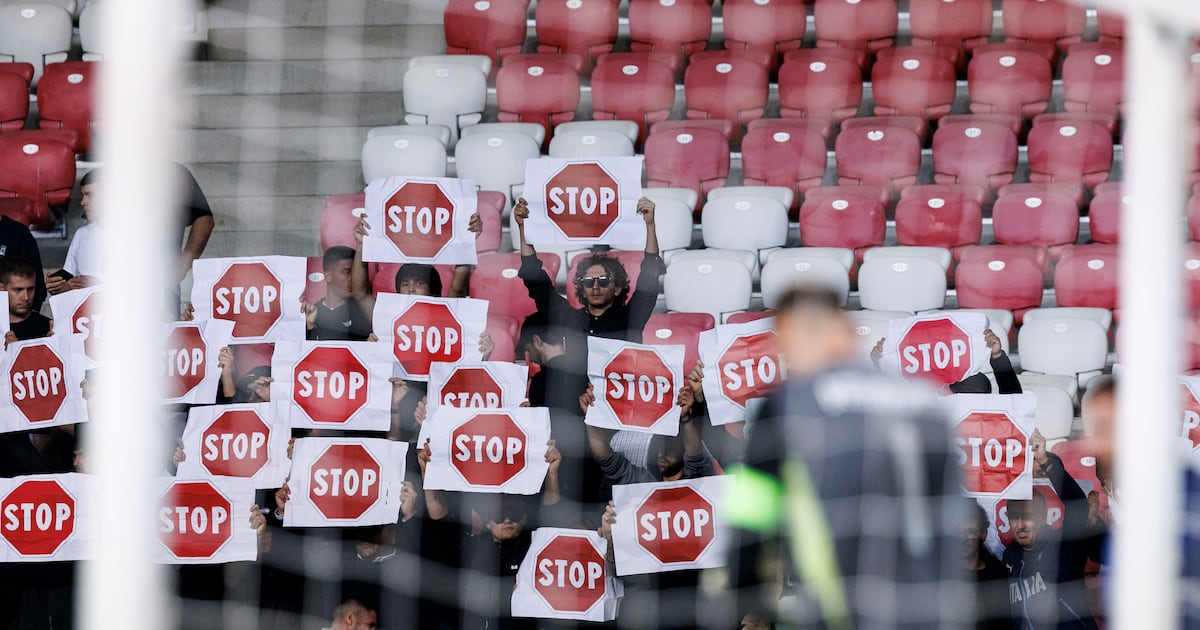
Searching for similarly contentious counterparts to the forthcoming Nations League games with Israel led us to a new book by Tony Shaw and Alan McDougall, Cold War Football: A History in Ten Matches. It chronicles Ireland’s 1955 friendly against Yugoslavia in Dalymount Park, with which the FAI pressed ahead despite the firm condemnation of Archbishop John Charles McQuaid. McQuaid was a staunch critic of all communist regimes but particularly Tito’s, owing to the imprisonment of Croatian cardinal Aloysius Stepinac. He had every priest in the country declare from their pulpit that attendance at the match would be a mortal sin, but the FAI went ahead anyway, with Ireland losing 4-1. Shaw and McDougall’s book illustrates how some of the media grappled with their coverage of the game, and Radio Éireann did not broadcast live commentary because commentator Philip Greene told his employers he did not wish to cover it (his boycott led to a memorable headline in Dublin Opinion that read “Reds Turn Greene Yellow”). Seventy-one years on, RTÉ and the rest of the Irish sports media are again wrestling with how to cover an Irish international. RTÉ is set to strip back its coverage of both Israel games to its barest essentials, allowing it to fulfil its obligations as rights holder while involving as few RTÉ employees as possible. It is not going to have any studio coverage around the match, and the commentary will be provided not by a familiar Irish voice but by the Uefa-appointed commentators on the generic world feed. Tony O’Donoghue will be at the games to cover them as a news story. READ MORENewstalk’s Off the Ball holds the live radio rights for the games, but it is choosing not to do live commentary of either Israel game. Like RTÉ, it is sending a reporter to both games for news purposes, and does not intend to provide on-air updates during the match. Some of the writers among the press pack, meanwhile, are choosing to boycott the Israel fixtures entirely, and they set out their reasons for doing so in a letter to Soccer Writers Ireland. Their respective outlets’ plans to cover the games are unclear. While the fact of their boycott is likely to emerge closer to the games, we won’t name them here, as they have the right to explain their stance on their own terms if they wish to do so. Their reasoning for boycotting is principled, earnest, deserving of respect and difficult to disagree with on a personal level. But this is ultimately a professional question, and is therefore not something with which this column or newspaper agrees, which is why we are travelling to Hungary and Serbia to cover both games. They will not be covered as normal football matches, but they will be covered. We are doing our best not to sound pious or mighty here, but it is the media’s job to bear witness and report accurately and fairly, and it is not possible to do this from home. The story here is not simply football, and all you’ll see on TV is simply football. Some Irish fans, for instance, are planning to attend the Israel game held in Debrecen, for which tickets are being sold to the public. Should they stage a protest, you won’t be shown it on TV, given the chief principle of Uefa’s broadcast direction is to avoid anything remotely controversial or non-sporting. This is a small instance of why news gathering must happen in person, and these games are guaranteed to throw up additional, unexpected news stories. Plus, media outlets cannot refuse to cover events or stories with which their journalists personally disagree. The facts of the news are often morally unconscionable and sports departments should not hold themselves to a different standard. Boycotting events with which media outlets don’t agree also leaves them open to the accusation that they are therefore endorsing whatever they attend. If you boycott this, do you approve of Donald Trump by covering the LA Olympics? Do you give the thumbs-up to the Saudis by attending the 2034 World Cup? [ Séamus Coleman out while Liam Kitching earns call-up to Ireland squad for matches including Israel double headerOpens in new window ]These Israel games should not be happening. The Israeli FA is in clear breach of Fifa and Uefa statutes by organising matches on occupied territory in the West Bank, and Fifa has ruled that the Israeli FA has repeatedly failed to adequately punish incidents of racism and anti-Arab discrimination. These are clear grounds to suspend Israel from competition, but the game’s governing bodies have failed to implement their own rules. The inaction of Uefa and Fifa has placed the FAI in a deeply invidious position. Nonetheless, the FAI’s warnings as to the financial costs of boycotting the games are based on opaque figures and its concerns around the sporting ramifications are at best vague and at worst dubious, given Ireland are co-hosting Euro 2028 and can finish bottom of this group and still avoid relegation via a new play-off. The FAI doesn’t know the full cost of a potential boycott, but it sure as hell doesn’t want to find out the answer to that question. Israel’s participation in these games is a more significant win than anything they will achieve on the field against Ireland, as it sends a message that global organisations of the importance and visibility of Uefa and Fifa will continue to tolerate all that is done in the country’s name, which in this instance is, in the opinion of an independent UN panel, a genocide in Gaza.The staging of these games is wrong but there is nothing additional to be gained by the media refusing to cover them. It is the media’s obligation to remind everyone that sport and politics mix all of the time, and that this is a particularly wretched example.
Gavin Cooney: Why I won’t be joining media boycott of Ireland’s games against Israel
Full Article
Original Source
Read the full article at Irishtimes →KhanList aggregates and links to publicly available news content. We do not host full articles from third-party sources. Always verify important information with original sources.