
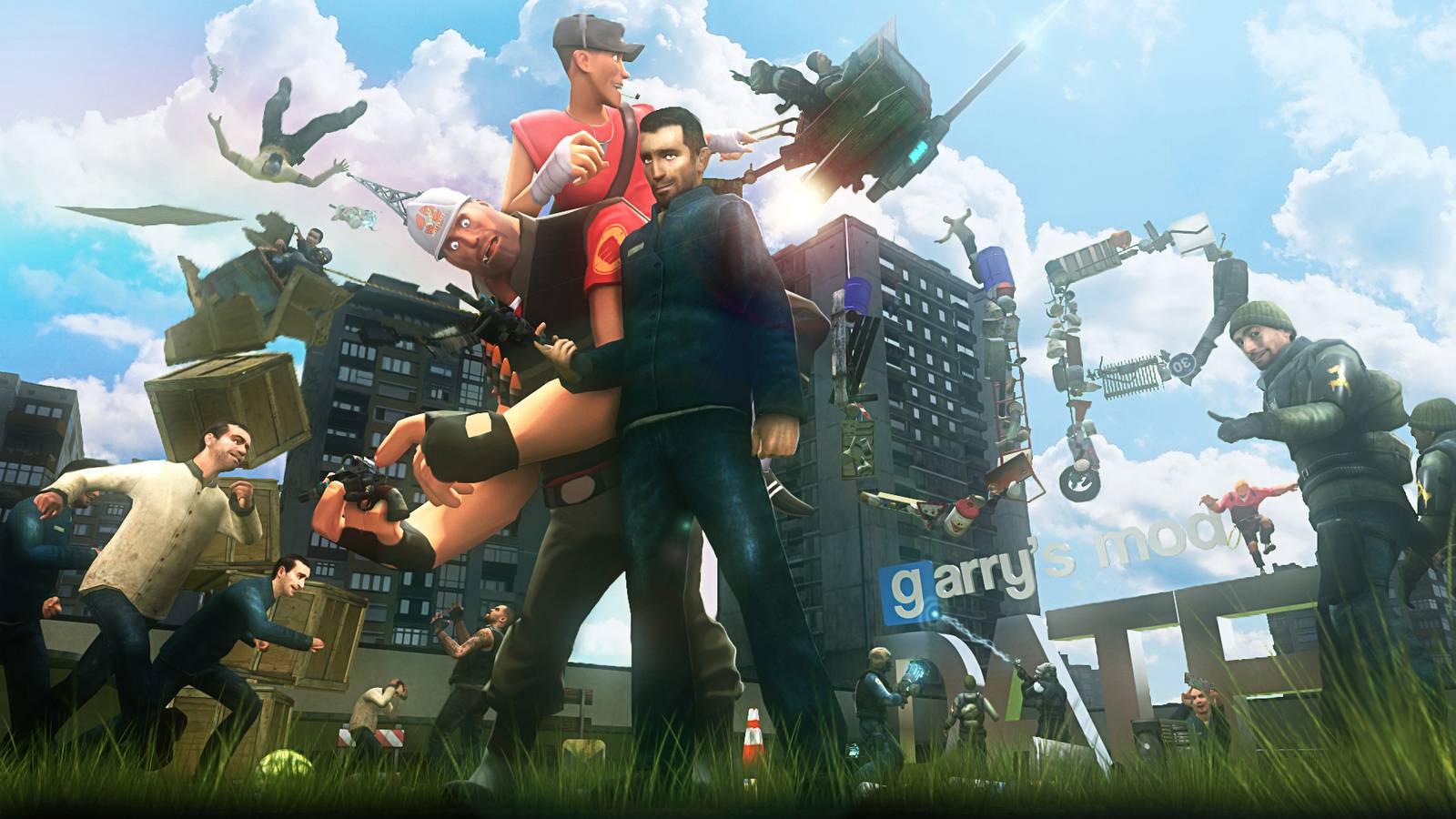
What if you took G-Man, sat him down in a bathtub, attached wheels, and carefully glued a lampshade thruster to the back? You'd get Garry's Mod, the bizarre Source engine sandbox that took Valve's entire library, from Half-Life 2 to Counter-Strike, and threw it onto a giant flat field. Developed by Garry Newman out of his parents' house in the early naughties, Garry's Mod began life in 2004 as a sandbox for him to play around in. He only discovered its sheer popularity after setting up an online forum, and things quickly spiraled from there. Valve contacted Newman in 2006 to suggest launching Garry's Mod on its new digital storefront, Steam, the first of its kind. Newman was hesitant and rejected the idea, but eventually the two would strike a deal and the game would launch on the platform on November 29. Before long, Garry's Mod became one of the best-selling PC games of all-time — thanks in part to Newman offering complete freedom to the community to run their own servers and build entire games, like Trouble in Terrorist Town, Prop Hunt, and DarkRP. To commemorate two decades of G-Men in bathtubs, I chatted with Newman all about Garry's Mod and its history, how it grew from a mod developed in a West Midlands bedroom to a PC gaming staple with over 25 million copies sold. Where It All Began: Facewound And JBMod TG: You were originally working on Facewound when Garry's Mod began as a side project. What did GMod give you as a developer that Facewound didn't? Garry: Players and feedback. I'd worked on Facewound privately for something like a year. I grafted on it in secret and only a couple of people had played it and given feedback. When I released Garry's Mod, I got my first taste of people actually playing something I'd made. It was out in the wild and people were downloading it. It was very motivating and spurred me on to iterate and impress them more. Facewound was a 2D side scroller shoot 'em up. TG: Were you deliberately designing a sandbox from the beginning, or were you discovering one feature at a time that Source could expose to players? Garry: I didn't know what I was doing. I had played Half-Life 2, I wanted to explore more of the engine. Valve do a thing where they made this tech, and they use it really sparingly. I wanted to play with ragdolls and physics more. I wanted to see the refraction effects more. So really I was doing it so I could play with these things more.. Which I guess is what everyone else wanted to do too. TG: What was the first feature you remember adding specifically because players wanted it, rather than because you personally wanted it? Garry: Man, that's a good question. I'm not sure if there would have been any feature in the actual sandbox game mode that I would have added by request, even though I didn't want it. There may have been APIs and stuff like that, but I'm pretty extreme about things having to have their own purpose for me to want to add them. TG: What do you remember about the first person who showed you something they'd made in Garry's Mod that you hadn't anticipated? Garry: I think it would have been the addons and game modes people made more than the contraptions. Like, comic books, contraptions, you know they're possible, it's just a matter of time and patience. But when people coded stuff like helicopters, I never saw that stuff coming really. I am more impressed when people code stuff that I don't think I could code. TG: What did you misunderstand about Garry's Mod and its players in those early days? Garry: Players generally underestimate how much work some stuff is, and overestimate how much work other stuff is. Sometimes I'd work on something for a month and I would think it was a work of art, and they wouldn't be impressed at all. Then sometimes I'd tweak a single variable, and they'd lose their mind about this new amazing feature. Players generally underestimate how much work some stuff is, and overestimate how much work other stuff is. TG: Garry's Mod and JBMod both started at around the same time. Looking back 20 years later, how much did the existence of another project like JBMod influence the way you developed GMod, either technically or culturally? Garry: It's funny, because JBMod was nothing. They just used the leaked source code and put it back in. I don't think it had any original features, nothing new coded. But after GMod surpassed it, I was scared that it would come back and surpass GMod again. This spurred me on to keep working and make sure I was always ten miles in front, so they couldn't catch me. I think for the most part the hl2world community were just trolling me. I don't think they really ever had anything that would match or beat GMod, but at the time I didn't know. It was like a Cold War situation. JBMod was an early sandbox game based on Half-Life 2, released in 2004 by developer jb55. TG: When Lua was introduced, how did you expect people to use it? Did you realise you were effectively handing them the keys to the game? Garry: I knew Lua would make my job easier. I hated coding in c++. I hated waiting for three minutes of compiling between every run. I hated closing the game and opening it again. So as soon as I got it working, I knew I could turn it into something that I would enjoy, personally. When I did it, I knew it would enable people to do stuff. I'm consciously implementing it in a way and making decisions that mean more freedom for the modder, you know. Instead of going from A to B to C, I'm gonna go straight to D so they can implement all those letters themselves. TG: When Valve first started taking Garry's Mod seriously, did it change how you thought about what you'd made? Garry: I didn't really take it seriously. I didn't think anyone would pay for it. When I eventually said yes, I thought to myself... But I'll have to really improve it to make people want to buy it on Steam. TG: You'd spent years making Garry's Mod as a free experiment before people suddenly started paying for it. What do you remember about that first month, both commercially and personally? Garry: It was scary as fu**. On the one hand, you've got the sales charts. Watching that every day. It sold about 5,000 copies the first day. That was higher than I expected. That was good. On the next day it sold 2,800 copies. Then 2,100. By day 7 it's selling about 1,000 a day. So I'm thinking okay this is just going to keep going. Where's the floor going to be. Is this going to be feasible to keep working on, what's my next move? But then it's a new release, so I have a million bug reports. A bunch of stuff is on fire. I am in heaven, fixing all these problems and feeling productive and cleaning the code. Garry's Mod 13: The Big Shake-Up TG: Garry's Mod 13 was a major overhaul of the game, and it was a pretty disruptive moment for the community. Looking back, what did you learn from that transition about how difficult it is to change a platform that other people have built their own games and communities on top of? Garry: Disruption is always the price of progress. I don't think it was a term at the time, but any 'live service' game has a level of resistance to changes. The community complains and celebrates every change made. That is part of the experience for them. When I tell everyone that CS 1.4 was the peak of Counter-Strike, I'm not really saying that, I'm just bragging that I was there for CS 1.4. The updates, the lows, the highs, they're part of the experience. It's a live moving thing that the community is experiencing together. It's what they're there for. TG: You've said before that you didn't really have a grand plan for Garry's Mod. 20 years later, do you think that lack of a plan helped make it what it became? Garry: That's just how I operate. There's always a vague idea of 2-3 years down the line, but planning is guessing, so I think it's wasting everyone's time to speak about this. By committing to a hard plan you're ignoring the opportunities that are on the way. And a lot of the time that's where the pleasure comes from. I am a tinkerer. I take a lot of delight in discovering things. I have a lot of faith in that process of tinkering until something emerges, following your delight in that way, instead of sitting down and trying to plan everything out before you've even started. Facepunch, Machinima, And S&Box: Where Garry's Mod Ended Up TG: Garry's Mod became much more than a game. It became a film-making tool and a major part of early internet machinima, from Civil Protection and Idiot Box to hundreds of smaller YouTube productions. You can even draw a line from the game to Source Filmmaker and later to Skibidi Toilet, whose creator has cited GMod filmmakers as an influence. When did you realize people were using GMod to create entirely new forms of internet media? Garry: A lot of GMod's history was really before internet video was a real thing, so it really started with the comic books. Concerned by Christopher Livingston became a real staple of the Source engine community. I find it hard to take any kind of credit for any of this. That would be like the guy who makes paintbrush handles taking credit for the Mona Lisa.. but it is nice to think I may have played a small role in it all, from my bedroom in my parent's house in Walsall. TG: Selfishly, I have to ask: would you ever consider making older branches, such as Garry's Mod 9.0, available on Steam? Garry: Does it even work? Why would you want it? Editor's note: I don't really have a better answer than nostalgia. TG: Garry's Mod ultimately gave you the foundation to build Facepunch into a studio and eventually led to Rust. What did GMod teach you that directly shaped Rust, and what lessons did you deliberately leave behind? Garry: Garry's Mod really taught me how to program. It taught us the importance of sandboxes and emergent gameplay. It taught us that if you can get out of the way, then the players will make their own stories and their own entertainment, and it's more rewarding and real than any story you can try to drag them through. TG: Garry's Mod grew from an experiment into a platform where people could make games, films, communities and even careers. Now that s&box is here, what do you hope it achieves that GMod couldn't, and how have twenty years of watching the GMod community shaped your approach to building it? Garry: My one big regret with Garry's Mod is that for the developers it created, for the careers that it started, it didn't allow those people to capitalize on it. It was a dead end for them. I really feel like I let those developers down in that way. What I mean is that the people that created successful games in Garry's Mod were stuck there. They couldn't make a good living from it. If they wanted to do that, they had to leave the community. They had to use Unity or UE, which sucks for the community. With s&box, my dream is that people make a successful game on the platform, which is free, then at some point choose to make a jump to a standalone release on Steam without paying any engine royalties or anything. Systems Released November 29, 2006 ESRB m Developer(s) Facepunch Studios Publisher(s) Valve Engine Source
Garry's Mod Creator Garry Newman Looks Back on 20 Years of GMod
Full Article
Original Source
Read the full article at Thegamer →KhanList aggregates and links to publicly available news content. We do not host full articles from third-party sources. Always verify important information with original sources.