
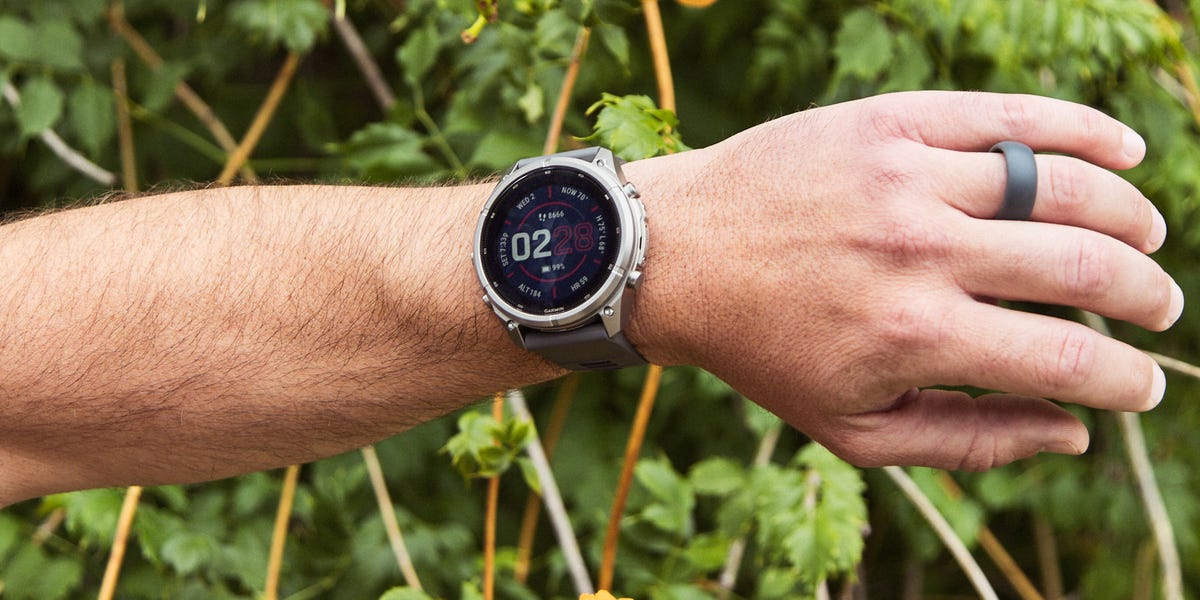
The Garmin Fenix 9 Pro Solar is the best Fenix for trail runners, multisport athletes, and ultra runners who want extraordinary battery life, built-in inReach safety features, and a highly readable display. I tested it for 180 miles over three weeks and charged it once.Three weeks, 180 miles, one charge. That’s not something I ever thought I’d say about a Fenix running watch. A Garmin Enduro? Sure, but the multisport baddie Garmin? Never. But because of that memory-in-pixel screen that I can read in the blinding sun, and the solar ring that charges as I go, I’m never hurting for battery or worrying if I’m going to max out my day. And when you take that killer spec and combine it with the InReach satellite that allows you to leave your phone at home or in your car (if you’re braver than I am), this watch is freaking impressive. But there’s obviously so much more, so let’s dig into it.ProsScreen readable no matter the lightBattery life is completely wildHuge, but light and comfyTons of inbuilt features that are actually usefulConsLags on start and stop/between activitiesThe app connectivity is still mehKey SpecsDisplayMiP for Solar, AMOLED for all othersSizes Available43, 47, 51 mmWeight3.5 ouncesBattery LifeOstensibly weeksBluetoothMultipointGPSMultiband satellite GNSS, with inReachCall/TextYesGarmin PayYesSolar Ring and Memory in Pixel DisplayThe Solar model uses a memory-in-pixel (MiP) display, not the AMOLED you get on the other Pro models. That not only gives you increased readability, but enhances the battery life on the watch like I mentioned above. The solar ring around the perimeter of the titanium bezel supercharges your battery life, even in fairly cloudy conditions, which means the battery life is simply unreal. I have charged this thing exactly once in three weeks, and that was during a stretch where I wasn’t feeling great and wasn’t getting outside much, so it wasn’t soaking up its usual sun. Under normal training, the solar top-up keeps the tank full enough that charging becomes mostly an afterthought. Honestly, that’s a bit of a double-edged sword for my AuDHD self, because I just know that at some point, it will die, and it will happen at the most inopportune moment.But more importantly, here’s the part that got me the most excited: I am a heavy user, not only because it’s my job, but because I want to use Garmin’s newest features, and a lot of them are battery hogs on paper. Save this one. The solar charging gives you enough headroom that turning on the fun stuff doesn’t mean that you’re forced to ration power for the rest of the week. You just get to use your dang watch.inReach Satellite and Cell ServiceThe other pillar is inReach. On the Fenix 9 line, inReach is now its own thing (you have to buy the model that includes it), but if you train where I train, it’s non-negotiable. It gives you satellite SOS, two-way messaging, LiveTrack so people can follow along, and it’s all routed through Garmin’s 24/7 Response Center, and none of it needs the phone. For a trail runner who’s routinely out of cell range and often at altitude, inReach is the reason I feel okay running alone. And the reason my husband has been able to back off his beta blockers.Readable ScreenI touched on this above, but it deserves its own explanation because it is something you notice every single run, but also something you need to get used to if you’ve only had AMOLED watches. The MiP display just works in whatever light you're in. Blinding sun on an exposed ridgeline, gray predawn parking lot start, flat light under tree cover, or dim movie theater. You can see everything. But, that comes with a trade-off. You’re not going to get the bright, colorful screen with your kids or cats as the background image, and bright pictures. It looks retro when you’re expecting modern, but I assure you, this is as modern as it gets.Health MetricsI'm an absolute nerd for the health data, and this watch gives you a firehose of it. My favorite is the stress tracking, which reliably informs me that I am, in fact, stressed. A lot, apparently. Good to have confirmation. But even better when I improve.But the metrics that matter most to me are the ECG app and Pulse Ox. I have a benign heart arrhythmia, and being able to take an ECG right off my wrist whenever something feels off, then fire it straight to my cardiologist, has taken a whole category of low-grade worry off my plate. It’s stupidly simple, and basically impossible to mess up. The Body Battery, sleep, and recovery metrics round it out, but the ECG is the one I would miss.ClimbPro, TopoActive, and Epic Multi-Day GroupingNow the trail stuff, which is where this watch was made to shine. Fellow ultrarunners, we’re up! The ClimbPro feature segments the climbs on my trail runs and adjusts its readings to reflect what that climbing is actually doing to my body. It shows me grade, pace, distance, ascent, and how the effort stacks up as I go. When you train at altitude like I do, that context is insightful and helps inform how I fuel and train.Winston ZhouLayer that on top of TopoActive offline maps (usable, no signal required, and far less glitchy than on the 8) and Epic, and I finally get a complex view of my training instead of a pile of disconnected run summaries that I have to manually fix in Garmin’s very meh app. Epic has been a real win for me. It bundles a multiday block, say a training camp, a stage race, or a big weekend in the mountains, into one combined view, so I can see the total volume and how my body actually responded across the whole stretch. Or I can just look at the day-to-day metrics to see where I’m improving and, more usefully, where I’m still leaving something on the table.Music and Voice ControlI’ve got a mountain of music stored on the watch already, and moving audio between the watch and my headphones has always been simple and seamless on Fenix, but now there’s a lot more room for all of my 2000s emo and movie scores. The upgrade this generation is the "OK Garmin" voice control feature (similar to Hey, Siri!) that just rolled out on several Garmin models. With the new voice control, I don't even hit a button anymore. I just kind of yell at my watch. On a run, when my hands are cold or full or I just don't want to break stride, or I’m in my kitchen kneading challah, it’s oh so very convenient. For such a small feature, it’s disproportionately delightful.The FlashlightThe built-in LED lights make my life. You can now choose red, white, or green, run it in strobe mode, and dial the intensity up and down. The red mode in particular is great for preserving your night vision, and the green is a great in-between. As a safety feature on dark roads and trailheads, or say, at Central Park before sunrise, it’s fab-tastic.GarminIt is also, I will confess, absolutely wondrous for locating whatever has vanished into the bottom of my pocketbook. No notes. Multiuse device.Fun Workout FeaturesOn days when I know I need to get a strength session in but I'm not in the mood for my Ladder app and I’m not headed to Hyrox, the new Quick Workout mode is clutch. You open it, tell it how hard you want to go and how long you’ve got, and it builds a workout for you on the fly. Low-friction, almost zero effort.Speaking of Hyrox, let's get into that crap together. (Couldn’t resist.)With Garmin’s new mixed sessions mode, there’s finally native tracking for multiple sports back-to-back, and that now includes rucking and indoor cross-country skiing (a.k.a. the Ski Erg), plus rowing. In theory, that should be aces for the hybrid sport.In practice? I’m still reaching for third-party apps for my actual Hyrox workouts. The native tracking just isn’t accurate enough yet, and there's too much finagling to get everything to behave. I love that Garmin is building toward this, and I fully expect to switch over eventually. But for now, if you’re serious about Hyrox, keep your current setup and treat mixed sessions as a promising work in progress.The Stuff Garmin Still Needs to FixI’m not going to pretend it’s flawless. There’s a real, noticeable lag when you start or stop a run, somewhere between a half second and a full second, that the Fenix 8 did not have. And it shows up again when you’re switching between exercises in triathlon mode. Is it enough to count? Probably not, but it’s irritating as hell.It’s not just happening to me, either. Our runner-in-chief, Jeff Dengate, put it bluntly: “There’s a short delay when you hit the start/stop button. It’s super annoying.” He clocked the same thing on the lap button, though as he noted, that one seems a smidge less laggy than start/stop. His verdict on the previous generation? The Fenix 8 was way more immediate feeling. That tracks with my experience exactly. It’s not a deal breaker, but it's the kind of small nitpicky thing that a flagship at this price shouldn’t have, and I’d love to see Garmin patch it.The VerdictSo, is the Garmin Fenix 9 Pro Solar worth it? For me, yes. And it’s where I’d point you, if you’re looking for a Fenix, but if you don’t like MiP, and don’t need inReach, the less pricey ponies in the line will serve you just fine. However, the solar battery and MiP display are things that set it apart from the others enough to warrant the price. The inReach connectivity is a groovy safety net, and the trail tools (ClimbPro, TopoActive, Epic) turn all that data into a training plan you can act on. Add the health metrics, the voice control, and yes, the purse flashlight, and the value is obvious.It’s not perfect. The start/stop lag is real and annoying, and the Hyrox tracking isn’t there yet. But if you want the most capable, most self-sufficient Fenix Garmin currently sells—one that keeps itself charged, keeps you findable, and reads like a dream in any light—this is the one.Shop Garmin Fenix 9 Pro Solar at amazon.comCat Bowen, senior editor of commerce; reviews, is a seasoned runner with more than 20 years of distance running experience, including dozens of marathons, half marathons, and even a few ultra marathons. For over a decade, she has tested parenting, fitness, home, and running gear and written in-depth guides to help readers with their next purchase. Holding multiple advanced degrees and currently studying kinesiology, Cat Bowen brings research-backed insight to all of her guides. Passionate about women’s health and neurodivergent inclusion, she advocates for closing research gaps and helping others—especially AudHD people—find joy in running and fitness.
Garmin Fenix 9 Review: The Ultimate Trail-Running Watch
Full Article
Original Source
Read the full article at Runnersworld →KhanList aggregates and links to publicly available news content. We do not host full articles from third-party sources. Always verify important information with original sources.