
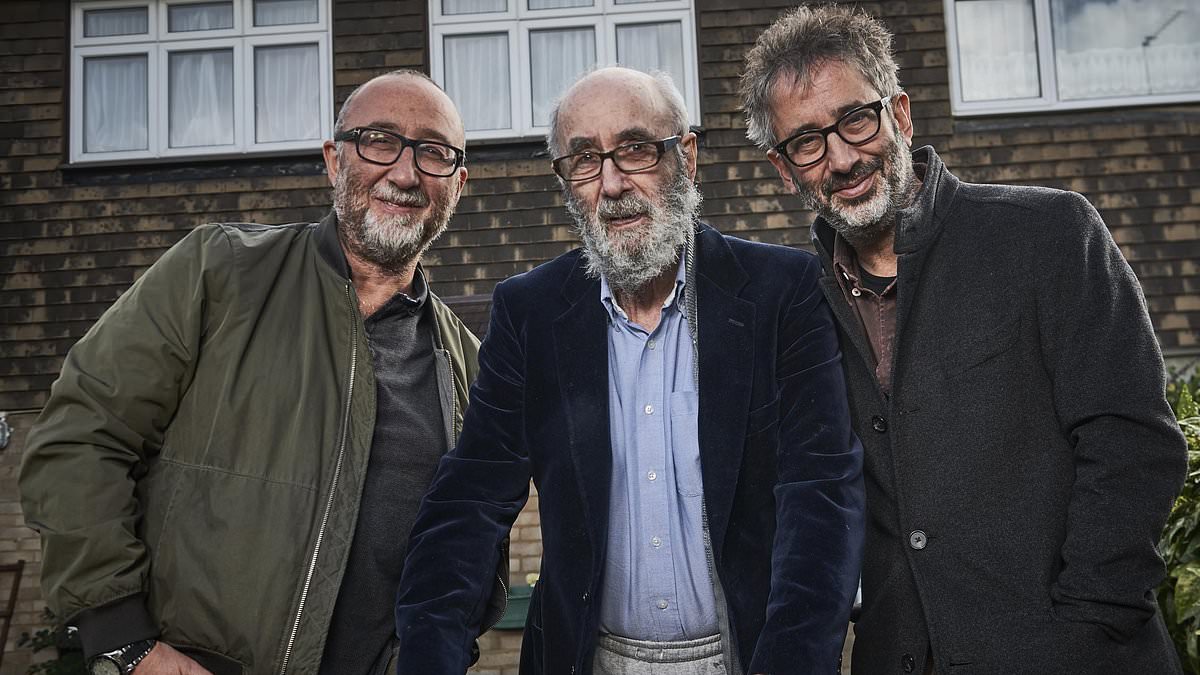
Colin Baddiel was never an easy man. Irritable, often angry, hard and emotionally shuttered, but also very clever, funny, with a passion for pubs, eating, drinking with his mates, Welsh football and a seemingly inexhaustible and alarmingly noisy sex drive.So when, in his mid-60s, he was diagnosed with a rare form of dementia called Pick’s disease that increases irritability and anger and reduces sexual inhibitions, in some ways he seemed like a more extreme version of himself.He’d tell anyone and everyone to f*** off. Dish out the V signs. Stick his tongue out and make sexually inappropriate comments in restaurants. At his wife Sarah’s funeral in 2014, he propositioned half the female congregation. And he was banned from a Jewish Care centre after punching a man in an altercation after insulting the size of his nose.We know all this because his middle son, David, is a famous comedian, novelist, playwright, screenwriter, columnist, TV presenter, essayist and performer. And David’s way of coping – as his father became increasingly locked in and lost – was to write about it. To find the dark humour behind the despair. Tell jokes about his unusual family.In 2017, he made a brilliant Channel 4 documentary with his elder brother, Ivor, called The Trouble With Dad, which highlighted their bizarre, often darkly funny interactions.But most of all, through comedy he dragged his father’s dementia out from the shadows, into the open, and talked about it.‘It was good for me psychologically – my way of processing it,’ he says today. ‘But also I was able to reach people who were in that position and who felt some kind of relief to talk and laugh about it, without shame.’Because while dementia is the UK’s biggest killer (responsible for 76,000 deaths a year) and more than a million people are currently living with this relentless erosion of personality, memory, brain power and dignity, unlike other illnesses there’s still an element of shyness. Shame, even, in talking about what dementia really means, not just for the sufferers, but for their carers, too. Ivor, Colin and David Baddiel in The Trouble With Dad, a Channel 4 documentary which highlighted their bizarre, often darkly funny interactions Colin, who had a tough upbringing as an only child (after his twin died aged two) in Swansea, playing in the pool with his sons on holidayWhich is why David is giving his support to The Mail on Sunday and Alzheimer’s Society’s Dementia Carers Together campaign and sharing the honest, unvarnished truth about his father’s illness. Along with his thoughts on life, death, our obsession with keeping our loved ones alive at all costs, and how we view dementia.‘As a culture, we have a tendency to write people off as soon as they get the diagnosis and that’s unbelievably unfair,’ he says. ‘There are many different types, stages and lots of light and shade and in lots of cases the person is still there.’Pick’s disease, or frontotemporal dementia, affects just 16,000 people and is caused by atrophy of the frontal lobe, the part of the brain that controls our emotions, behaviour, personality and language.For Colin, this meant that his behaviour became so antisocial that no care home would take him. It also meant that, at the start, his illness was hard to broach.‘It is very hard, getting the courage up to say to someone, I’m worried about your memory,’ says David. ‘I felt trepidatious, I felt nervous. I was frightened of my dad anyway when I was a kid.’When Colin was formally diagnosed, he remained in total denial: ‘I never once heard him accept he had dementia’, says David.Colin’s wife Sarah, however, reacted with fury. ‘She used to go to a carers’ support group in Harrow where women shared their experiences of living with people with dementia and talk about how much they loved their husbands, how much they cared,’ says David.But not Sarah.‘She’d tell me, “I’m so angry, I’m so annoyed! I see other women who’ve got husbands who are 90 years old and out on the golf course. Why can’t I have one like that?”‘And I found that refreshing,’ he says. ‘She wasn’t trying to be saintly, just honest. Because they had a complicated, fractured relationship, my parents.’As, of course, do many couples who have been married for the long haul. But perhaps not quite this complicated. Or with quite so much baggage.First there was Colin, who had a tough upbringing as an only child (after his twin died aged two) in Swansea, which left him angry and emotionally closed. He was very clever and funny and battled his way up to work as a research scientist for Unilever.But he was made redundant in the 1980s, was unhappily unemployed for two years, later sold Dinky Toys from a stall at Grays Antique Market in Mayfair and was always angry – with life, with his sons, with Sarah.She, meanwhile, was a Holocaust survivor. A refugee from Nazism whose Prussian family from Konigsberg [now Kaliningrad] were robbed of their considerable wealth and then mostly murdered. And who railed against her suddenly suburban family life in Cricklewood with a torrid 30-year affair with a golf memorabilia salesman called David White, to whom she’d send wildly sexual letters and in whose thrall she set up her own golf memorabilia business called Golfiana, exactly the same name as his business, to become the golf memorabilia queen of north London.‘I think she spent her whole life reaching for this other life she felt she’d missed out on,’ says David.None of which got in the way of his parents’ alarmingly noisy sex life – ‘they had loud sex virtually every night. I was terrified of the noises that my dad would make’ – and a lot of arguments. An old photograph of Sarah, Colin and David Baddiel – who says that his parents had a 'complicated, fractured relationship' David would visit three times a week and his father would insult and berate him – which is perhaps why he was so adept at focusing on the dark humour of it all But for all that, as Colin’s illness took hold, Sarah stepped up, just as thousands of husbands and wives, sons and daughters do all around the country every week. For years being his sole – if, in her case, very angry – carer as they both pretended to their three sons that things were better than they were.‘He was very refusing of help and she was very coping,’ says David. ‘But I felt we should maybe have got professional help for my dad in sooner.’But then, in 2014, Sarah died suddenly. ‘I think she died from an overdose. Not a deliberate one. She’d had an operation in her 50s and took a lot of painkillers for the pain, but also to zone out a bit, and she took too many one night.’David and Ivor spent an incredibly difficult day in hospital as she dipped in and out of consciousness, but worried sick about Colin at home alone. ‘He wasn’t there because it would have been impossible. And when we got back and told him she had died he went completely to pieces – which was interesting because they hadn’t had that good a relationship, but there was clearly deep co-dependence,’ says David.‘And then about 45 minutes later, we had to tell him again. And he went to pieces again.’And that went on for about a year until, with the help of a note taped to his tray that said Sarah had died, he ‘sort of knew’, but would still occasionally ask how it happened.Without Sarah, the nightmare really began. For a few months, David’s younger brother Dan moved back from his home in America to look after Colin, but it was too much.They tried several homes, but no one wanted him – or not without paying for the extra carers that they said would be needed to look after him.‘Luckily, between us we could afford live-in carers and used a company called Consultas,’ says David. Which meant Colin could stay in his home, where everything was familiar, so he was much more content.‘And because he’d always been an innately lazy man, he just sat in his chair watching telly, so we didn’t have the really difficult thing of people who have dementia who go on walkabout and are picked up on the high street.’So the years passed.David would visit three times a week and his father would insult and berate him. ‘He was constantly abusing me,’ he says. ‘But he’d always been a bit like that.’Which is perhaps why David was so adept at focusing on the dark humour of it all.The time they went to the pub in Harrow and Colin locked himself in the car with the keys in the ignition, and a crowd of about 30 people gathered to help.The total lack of sexual inhibition that made him so obscene and sweary that, if they ever went to a restaurant, David had to warn the waiters and waitresses.The trip to hospital for a hip operation where they had to trick him to get him through the door.‘He sat there shouting and telling people to f*** off and even as he was trolleyed into the operating theatre, he was sticking up V-signs at the nurses.’ But what about behind the humour – was it ever too much?‘Yes, completely,’ says David, more quietly. ‘There were times when I found it unbearable.’He tells of a picture he took of Colin in Wetherspoons in Harrow that he still has.‘It’s very sad. At some level I can feel the person he was – very clever and funny – and that’s all locked in.’And how, as the illness ground on, it started wiping out memories for David, too.‘I’d forgotten he could occasionally be a good dad, like the time he came backstage at one of my shows and told me how good it was,’ he says.He also worried about his own health. ‘Of course, as an adult child [of someone diagnosed with dementia] you become hyper-vigilant about any forgetfulness you might have.’But he never stopped visiting. Through the abuse, rudeness and sexual inhibitions of the early years, to the desperate dead-eyed blankness later.‘I did love him, even though he was a difficult man,’ he says. ‘I needed to feel I was still in a relationship with him – I couldn’t bear the thought that this difficult guy had gone. But I never really felt he’d gone – more locked in, buried under the rubble of dementia.’ Colin died in January 2022 – and despite the years of trauma, David was still knocked for sixAs the disease progressed, Colin stopped talking.‘Often he wouldn’t say anything, or maybe just stick his tongue out and I’d catch up with the carers.’And then drive home, often in tears.And then he realised that, like so many people who have family members with dementia, he was doing it for the rare moment the old, difficult Colin might pop out. Perhaps repeat one of his silly catchphrases – ‘Your face, my a***!’ Or engage with the football on telly.Towards the end, Colin had myriad other health issues but no idea of what was going on. Endless UTIs, which saw him rushed to hospital, seemingly at death’s door, but never quite crossing the threshold.‘It’s a very complicated thing in our culture that we keep people alive after a point in time when nature has said this person should not be alive,’ says David.Eventually, in January 2022, Colin Baddiel died. And despite the years of trauma, despair and anticipation, David was still knocked for six.He posted a wonderful photo of his father and the three boys laughing in the sea on social media and wrote that his father left ‘a huge hole in my sky’.‘No matter how reduced a person is, they are still very, very significant in your life,’ he says today. ‘You are disoriented by their absence – you don’t know how to process it. You’re left with this huge gap.’Losing someone you love to the steady grinding-down and diminishment of dementia is a monstrous thing.Some people hide away to cope. Others seek comfort in support groups. David dealt with his loss by sharing the challenges that his extraordinary family faced, becoming an ambassador for Alzheimer’s Society and helping others in the same bewildering boat.But, most of all, by celebrating his very complicated, but rather brilliant, parents with humour. Dementia Carers Together Dementia Carers Together is raising money to fund new courses across the UK to give tens of thousands of struggling unpaid dementia carers vital emotional and practical support. For further information, visit dailymail.com/dementiaHow you can donateOnline: Click here.By Text: To donate £10, text CARER to 70115. To donate £20, text LOVE to 70115. To donate £30, text HEART to 70115. Texts will cost your donation amount plus your network charge.By phone: Call 0300 1234577. Standard charges may apply.By cheque: Send cheques made payable to Mail Force Charity to:Dementia Carers Together, 42 Phoenix Court, Hawkins Road, Colchester CO2 8JY
Gallows humour that helped David Baddiel cope with the years caring for his irascible father 'buried under the rubble of dementia'
Full Article
Original Source
Read the full article at Dailymail →KhanList aggregates and links to publicly available news content. We do not host full articles from third-party sources. Always verify important information with original sources.