
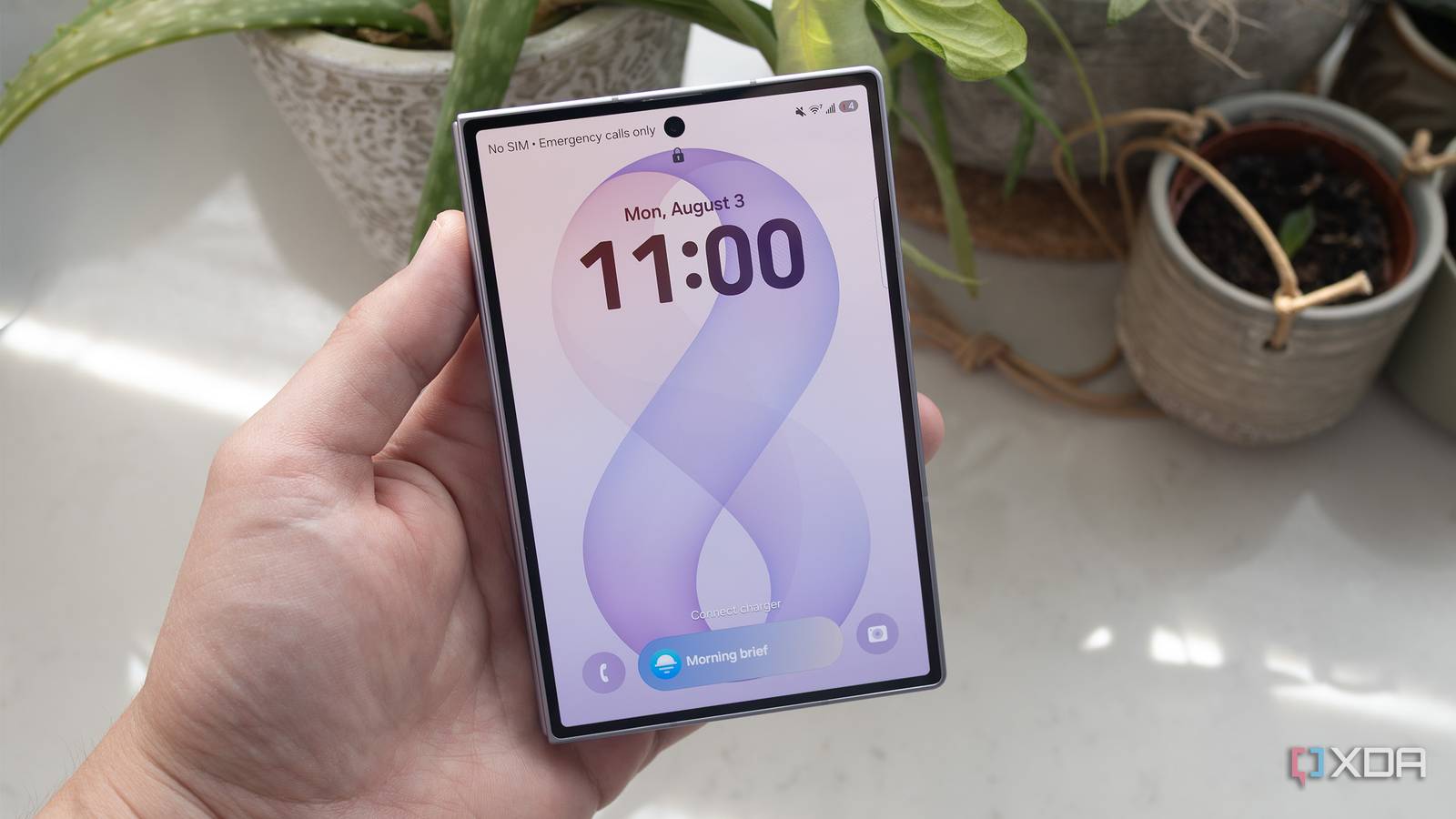
Published Aug 7, 2026, 9:51 AM EDT Patrick O'Rourke is XDA's News Editor and Entertainment Segment Lead. Previously, he was Pocket-lint's Editor-in-Chief, the Editor-in-Chief of Canadian tech publication MobileSyrup, and earlier in his career, he worked as the technology editor at the Financial Post and Postmedia. He's based in Toronto. Over the past 15 years, he's written thousands of articles. Patrick has also interviewed dozens of tech industry executives and covered GDC, E3, Gamescom, WWDC, Apple keynotes, Samsung Unpacked events and more. Patrick has a BA in journalism from Toronto Metropolitan University. Sign in to your XDA account After spending roughly two weeks with the Galaxy Z Fold 8, it's clear Samsung's latest smartphone is destined to become the future of foldables — and unfortunately, that future is very expensive right now. Samsung is confident the wider foldable aspect ratio is the direction foldables are headed, backed up by the fact that the Z Fold 8 is, well... called the Z Fold 8 and not something else — the Galaxy Z Fold 8 Ultra is the true successor to last year's Galaxy Z Fold 7, making this year's Z Fold names a bit perplexing. Confused yet? I don't blame you. There's also a ton of tech media buzz behind the foldable, and while much of that excitement is justified, some of it comes from the fact that the Galaxy Z Fold 8 clearly stands out in an increasingly boring smartphone world, and people that cover tech tend to get hyped on that sort of thing. That said, I get it to some extent. Samsung's latest foldable is an undeniably eye-catching device that turns heads when you pull it out in public. It's also just straight-up fun and practical, especially when you unfold its inner screen. At the same time, the Galaxy Z Fold 8 isn't as perfect as some tech influencers might want you to believe. It's awkward to use folded, especially when typing, and apps don't always adapt to the unique screen, or switch between the two displays easily. On top of that, dropping from three cameras to just two is a clear downgrade for a phone that costs nearly $2,000. Still, there's a lot to like about the Galaxy Z Fold 8, and with Apple's rumored wide foldable iPhone looming on the horizon, it's clear this is the start of something genuinely new in the smartphone space, and yet another example of Samsung beating the Cupertino, California-based tech giant to the punch. Samsung sent XDA the Galaxy Z Fold 8 for review. It did not have any input on the contents of this article. Galaxy Z Fold 8 8.5/10 SoC Snapdragon 8 Elite Gen 5 Display Cover Display: 120Hz Dynamic LTPO AMOLED 2X, 120Hz, Corning Gorilla Glass Ceramic 3, 5.5 inches, 1248 x 1972 pixels Foldable display: 120Hz 7.6-inches 1848 x 2448 pixels RAM 12GB / 16GB Storage 256GB / 512GB / 1TB Rear camera f/1.8 50-megapixel wide, f/1.9 50-megapixel ultrawide Front camera f/2.2 10-megapixel wide, f/2.2 10-megapixel wide Battery Si/C Li-Ion 4,800 mAh Dimensions Unfolded: 161.4 x 123.9 x 4.5mm, Folded: 81.9 x 123.9 x 9.7mm Weight 7.09oz (201g) IP Rating IP48 dust and water resistant Pros & Cons Aspect ratio is eye-catching Overall design is sleek Inside screen feels more useful than ever The cover screen can be difficult to use There are only two rear cameras It's expensive Galaxy Z Fold 8 pricing, specs, and availability Samsung's Galaxy Z Fold 8 features a 5.5-inch 1,248 x 1,972-pixel resolution AMOLED 120Hz Cover Display and a 7.6-inch Dynamic LTPO AMOLED 2X (16:9), 120Hz, 1,848 x 2,448-pixel resolution (4:3 ratio) inner screen. Its processor is the top-tier Qualcomm Snapdragon 8 Elite Gen 5, while RAM comes in at 12GB or 16GB (only with the 1TB storage configuration). Speaking of storage, options include 256GB, 512GB, and 1TB. The phone's battery comes in at 4,800mAh with support for both 45W wired and 20W wireless charging. The Z Fold 8's durability rating hits IP48 dust and water resistance. Unfolded dimensions come in at 161.4 x 123.9 x 4.5mm, while the phone hits 81.9 x 123.9 x 9.7mm when folded. It weighs 7.09oz (201g). On the camera side, the Galaxy Z Fold 8's cover camera is an f/2.2 10-megapixel wide, while its inside shooter is another f/2.2 10-megapixel wide camera. The rear-facing shooters are an f/1.8 50-megapixel wide and an f/1.9 50-megapixel ultrawide. In terms of pricing, the Galaxy Z Fold 8 starts at $1,900 and is available in Cream, Graphite, Lavender, and Pistachio (exclusive to Samsung's online store). Galaxy Z Fold 8 SoC Snapdragon 8 Elite Gen 5 Display Cover Display: 120Hz Dynamic LTPO AMOLED 2X, 120Hz, Corning Gorilla Glass Ceramic 3, 5.5 inches, 1248 x 1972 pixels Foldable display: 120Hz 7.6-inches 1848 x 2448 pixels RAM 12GB / 16GB Storage 256GB / 512GB / 1TB Rear camera f/1.8 50-megapixel wide, f/1.9 50-megapixel ultrawide Front camera f/2.2 10-megapixel wide, f/2.2 10-megapixel wide Battery Si/C Li-Ion 4,800 mAh Dimensions Unfolded: 161.4 x 123.9 x 4.5mm, Folded: 81.9 x 123.9 x 9.7mm Weight 7.09oz (201g) IP Rating IP48 dust and water resistant A worthwhile, unique design with a few quirks The Cover Display has key advantages, but also a few clear issues The first noteworthy thing about the Galaxy Z Fold 8 is its wider, more stout 5.5-inch outer display. It still unfolds like a book, just like the Galaxy Z Fold 7 and new Galaxy Z 8 Ultra, and it isn't a clamshell like the new Galaxy Z Flip 8. This results in the phone being comfortable to hold with two hands while folded, making it great for reading content on, whether I'm catching up on articles I saved with Instapaper or reading a book in the Kobo app. It's also maybe a little bit too good for scrolling vertical video on TikTok and Instagram. I've found that I've lost several hours to the algorithm gods over my past few weeks with the phone. If you're looking for a clear way to set the Z Fold 8's size in context, I'd say it's nearly identical to a passport. It's kind of wild when you sit back and look at how sleek the phone looks when it's folded. At the same time, the Z Fold 8 also feels a bit too wide to use with one hand (I'd say I have pretty average-sized hands). There are several instances where I tried to use the Z Fold 8 with one hand while carrying my one-year-old son around, and I almost dropped the phone because I couldn't quite wrap my hand around its wider design. Adding to this, one-handed typing feels pretty awkward and forces me to stretch my thumb to reach the keyboard awkwardly. On a more positive note, I've really enjoyed sliding the Galaxy Z Fold 8 in my pocket. Thanks to its shorter design, barely-there thickness, and lightweight, I sometimes forget I'm even carrying the foldable around in the front pocket of my jeans. It also doesn't feel notably thicker or heavier than my usual daily smartphone, the iPhone 17 Pro. The inner display is where it all makes sense The aspect ratio is great for pretty much everything Unfolding the Z Fold 8 is where things clicked more for me. The 7.6-inch 4:3 inner screen is an absolute joy to use and feels more like an iPad than any Z Fold I've used, which as far as I'm concerned, is definitely a very good thing. It makes the Z Fold 8 great for browsing the web, watching videos with apps like YouTube or Netflix, and even playing games. I spent a lot of time playing the recently released Pokémon Red and Blue Gen1Recomp on the Galaxy Z Fold 8, and the inner aspect ratio and screen size are perfect for the unofficial PC port and its 3D voxel look, even with on-screen controls. Reading on the inner screen is also great when you rotate it to a portrait orientation. Both the inner and outer displays look solid overall with vibrant colors and ample brightness, and the foldable screen lacks the plastic feel of early Fold devices. However, you can't use the Z Fold 8 in Flex Mode, which feels like a mistake on Samsung's part. I'm not saying I half-folded past Samsung Fold devices a lot, but it came in handy if I wanted to prop up the phone to watch a YouTube video while washing the dishes or getting ready to go to sleep. For a phone that costs this much, I just expected it to support Flex mode. On a more positive note, the dreaded foldable display crease (which I've never found to be a big issue) is nearly invisible on the Galaxy Z Fold 8's inner screen when the phone is entirely unfolded. There have been a few instances where I'm watching content on the device, and I nearly forgot it's even there — you can barely even feel it, which actually surprised me. There are a few noteworthy app compatibility issues. Apps rarely switch between the outer and inner screens, and in some cases, I've run into social media platforms like Instagram failing to load entirely. It's even a bit weird to access Samsung's One UI Quick Settings panel, which requires you to scroll to the bottom to view all the settings. I'd bet that a lot of the third-party app issues and at least some of the One UI quirks will be ironed out in the coming weeks. With all of that said, for the first time, I find myself actually wanting to unfold a Galaxy Z Fold device to use its inner screen, and for me, that speaks volumes. As much as I've liked Samsung's past foldable efforts, I always felt I needed to force myself to take real advantage of their inner screens. That just isn't the case at all with the Galaxy Z Fold 8. There's new battery technology under the hood The rest of the Z Fold 8's core specs are expected One other thing I've noted about the Galaxy Z Fold 8 over the past few weeks is that it has very solid battery life, pushing well into the evening with moderate use that includes texting, ample social media doom-scrolling, and spending a few hours playing the Pokémon Red and Blue Gen1Recomp. The foldable's battery is actually even bigger than the Galaxy Z Fold 8 Ultra's at 4,800mAh thanks to Samsung finally adopting more dense silicon-carbon battery technology. This has led some to be concerned that we're possibly in store for another Galaxy Note 7-like battery disaster, but I really don't see that happening given the massive hit the tech giant's reputation took at the time. Samsung will never let that happen again. That said, we'll know for sure in a few weeks. It's going to be interesting to see what smartphone manufacturers start using silicon-carbon battery technology moving forward (it's already very common with China-based phone makers). Once again, there's no magnetic Qi2 with Samsung's foldables this year, which remains a perplexing decision on the company's part and continues to feel like a sneaky way for it to sell more magnetic-equipped cases. To be fair, this likely keeps the phone a bit thinner and lighter, but I'd take the trade-off for built-in Qi2. It's disappointing that the Galaxy Z Fold 8 only features IP48 protection, leaving it more open to dust and debris than Google's Pixel 10 Pro Fold and likely its soon-to-be-revealed Pixel 11 Pro Fold. It's not a deal-breaker, but this is another odd misstep by Samsung, just like it was with the Galaxy S26 Ultra. Lastly, as far as core hardware is concerned, the Galaxy Z Fold 8 features Qualcomm's powerful Snapdragon 8 Elite Gen 5 chip, which benchmarks at 3,544 for single-core and 10,795 for multi-core with Geekbench 6. In real-world use, I encountered a few instances of lag, both on the Cover Display and the inner screen, and with several different apps. This isn't the end of the world, but it was still annoying nonetheless. Hopefully, Samsung fixes this with future updates, because I'm doubtful that it's at all related to the 8 Elite Gen 5's power. On that note, the phone also gets really, really hot, even when performing relatively simple tasks. It's never uncomfortable to touch, but anecdotally, every time I pick up the Galaxy Z Fold 8 it's at least somewhat warm, and tends to get pretty hot if you're watching videos or playing games for a while. I've oddly run into authentication issues with the Z Fold 8, both with my fingerprint and facial recognition. I re-added both my face (with glasses on/off), and the situation improved a bit, but my thumbprint still doesn't work consistently. It's likely the eczema I have on my thumb, coupled with the fact that the side-set power button and fingerprint sensor are very thin. Still, I think it's worth noting, since this is a problem other people might also encounter. It's also important to note that it isn't an issue I've encountered with other Samsung smartphones. It really should feature three rear cameras Camera performance is adequate but doesn't stand out On the camera side, the Galaxy Z Fold 8 is a clear step down from the Galaxy Z Fold 7 (this downgrade is also the reason the Z Fold 8 Ultra exists, which basically features the Galaxy S26 Ultra's camera array). There are only two rear 50-megapixel lenses, including a main shooter and an ultrawide. Both lenses feature a narrower aperture and a smaller sensor compared to last year's Z Fold 7. This means the nearly $2,000 phone lacks a true telephoto lens and has lower specs than its predecessor. There's digital zoom, of course, but it doesn't look quite as good as what a real telephoto offers. On the plus side, the images the Z Fold 8 shoots are solid, both under low-light and in great-looking natural light. I've noticed that some photos shot with both the rear and front-facing cameras tend to get a bit blown out, which is disappointing. Additionally, as is always the case with Samsung's phones, the colors are a bit out there and over-the-top, but that comes down to my personal taste. Some people swear by the way Samsung processes images, but I prefer the more subdued, realistic look the Pixel and iPhone offer. The 10-megapixel Cover Display camera and inner camera are decent, too. Unless you're really pixel-peeping, you'll likely be happy with any selfie you shoot with the Galaxy Z Fold 8's inner shooters. At a base level, the Galaxy Z Fold 8 takes solid photos, but for its price, I find it difficult to wrap my head around the fact that it's a step back from last year's camera specs and also doesn't feature a telephoto shooter. Still, most people will be pleased with the shots they get from the Galaxy Z Fold 8's various cameras. There's a slew of AI features that I haven't really spent much time with, but at the same time, I don't view them as make-or-break functionality for the Galaxy Z Fold 8 (some also take at least a month of use before they really start working). There's Now Nudge (Samsung's version of the Pixel's Magic Cue), which makes contextual suggestions as you use your phone. It just hasn't really popped up on my device yet. I also haven't been able to try Gemini Intelligence Task Automation because it isn't available in Canada yet (yes, I live in the 51st state), though early impressions of the futuristic AI feature that can deliver food or call rideshare services for you, aren't very positive. Should you buy the Galaxy Z Fold 8? You should buy the Galaxy Z Fold 8 if: You're really into the wider design and overall sleek look You don't mind making a few key camera compromises You're cool with spending a lot of money on a smartphone You should not buy the Galaxy Z Fold 8 if: You're on the fence about the wider look You really care about camera specs You're not looking to drop $2,000 on a smartphone Above everything, you really need to be a big fan of the new Galaxy Z Fold 8's wider design and the advantages it offers for this foldable to make sense for you. And to be clear, there's absolutely nothing wrong with that — it's okay to like cool-looking things. You also need to be prepared to make a few key sacrifices as far as camera specs are concerned, as well as, of course, be willing to drop a ridiculous amount of money on the device. It feels like there's a real groundswell of hype pushing the Z Fold 8 in a way that reminds me a lot of the ill-fated Galaxy Note 7 (I mean this in a good way), and Samsung's pre-order numbers for the phone back that up. As much as I like the Galaxy Z Fold 8 and feel like this wider foldable design is likely the future of smartphone design, the expensive price tag is a big obstacle. For wide-set foldables like this to truly become the future of phones, that price needs to drop considerably, and unfortunately, it doesn't seem like that's happening any time soon. Galaxy Z Fold 8 8.5/10 SoC Snapdragon 8 Elite Gen 5 Display Cover Display: 120Hz Dynamic LTPO AMOLED 2X, 120Hz, Corning Gorilla Glass Ceramic 3, 5.5 inches, 1248 x 1972 pixels Foldable display: 120Hz 7.6-inches 1848 x 2448 pixels RAM 12GB / 16GB Storage 256GB / 512GB / 1TB
Galaxy Z Fold 8 review: The first foldable I don't want to put down
Full Article
Original Source
Read the full article at Xda-developers →KhanList aggregates and links to publicly available news content. We do not host full articles from third-party sources. Always verify important information with original sources.