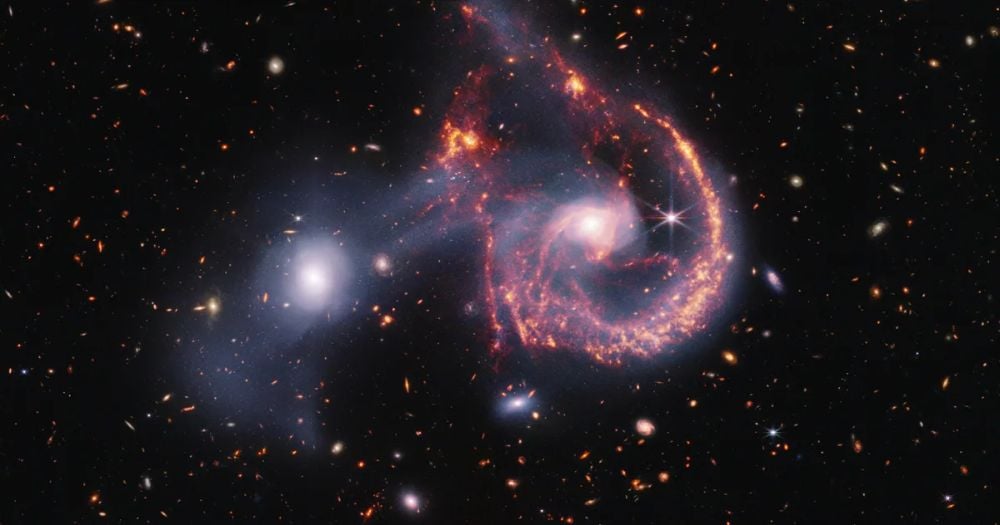
A galaxy's star formation rate (SFR) is one of its defining properties. Some galaxies are undergoing furious star formation, and they're called starburst galaxies. Others, like our Milky Way, form stars steadily at a more modest rate. Still other galaxies are quenched, meaning star formation has ceased. Astrophysicists point to multiple mechanisms that could be responsible for quenching a galaxy. Powerful AGN jets are one, and so is strangulation, where something cuts off the flow of cold star-forming gas into the galaxy. And there are more. One of the proposed mechanisms is galaxy mergers. At first, a merger can trigger rapid star formation, as cold gas floods into the newly merged core. But then two things happen, according to research. The large numbers of newly formed stars, especially the most massive ones, create stellar winds that heat gas and drive it away. The influx of gas also drives the galaxy's supermassive black to actively accrete more material. That creates an extremely luminous active galactic nuclei (AGN) called a quasar, and its powerful jets and outflows also heat gas and drive it away. So after an astronomically brief period of enhanced star formation, the resulting galaxy is quenched. But new research raises questions about this merger-driven quenching. The research is "Beyond the merger–quasar–quench paradigm I: mergers are neither necessary nor sufficient to quench central galaxies in illustrisTNG," and it's published in Monthly Notices of the Royal Astronomical Society. The lead author is Camilo Casimiro, a grad student in the Physics Department at Florida International University. Galaxy mergers aren't rare or difficult to find. This JWST image shows a pair of merging galaxies about 500 million light years away known as II ZW 96. Their chaotic, mixed-up shape is evidence of how mergers can reshape galaxies and affect the supply of star-forming gas. But new research shows that mergers don't quench galaxies nearly as often as thought. Image Credit: ESA/Webb, NASA & CSA, L. Armus, A. Evans “I’ve always been fascinated by galaxy evolution and the question of why some galaxies continue forming stars while others stop completely,” lead author Casimiro said in a press release. “Challenging a long-standing idea in galaxy evolution is something I never expected to be doing so early in my career,” he said. "One of the most important parts of science is being willing to test even widely accepted ideas against new data and better simulations.” To investigate what role mergers could play in galaxy quenching, the researchers turned to IllustrisTNG, an ongoing set of powerful cosmological magnetohydrodynamical simulations that focus on galaxies. They simulated more than 11,000 central galaxies in TNG over the history of the cosmos. "The cessation of star formation in galaxies, known as ‘quenching’, is a complex, multiscale process, which has been theorized to be linked to galaxy mergers," the authors write. "We compare their star formation and merger histories to test whether mergers are necessary or sufficient for inducing quenching in the simulation," the researchers explain. The Illustris TNG simulations cast doubt on the prominent role mergers might play in quenching galaxies. The results show that only a small percentage of mergers quench galaxies. "Only a very small fraction of mergers (~3 per cent of major mergers and 12 per cent of all mergers) lead to quenching within 1 Gyr, indicating that mergers are not sufficient by themselves to cause quenching," the authors report. The results also shows that the vast majority of quenchings aren't preceded by a merger. This chart illustrates the simulation results. The large majority of the 11,000 + galaxies in the simulations remain star forming. It divides the quenched galaxies into fast and slow quenching, and also shows that a very small number of merged galaxies rejuvenate their star formation. A small number of galaxies were already quiescent, and a similar number of galaxies are Green Valley galaxies, which are slowing their star formation. Overall, the results show that mergers are not the dominant galaxy-quenching force that astrophysicists thought it might be. Image Credit: Casimiro et al. 2026. MNRAS. "Once random coincidences are accounted for and a stellar-mass-matched control sample is applied, no merger excess is observed," the authors write. "Hence, mergers are clearly not necessary for quenching to occur in the simulation." The researchers also worked with the idea of the merger-quenching association window (MQAW). It establishes a time frame between a merger event and a subsequent quenching and provides a way to test whether or not mergers are responsible for any galaxy that becomes quenched. They worked with MQAW1, which is a quenching that takes place within 1 billion years of a merger, and MQAW2, which is 2 billion years. "This approach, which we refer to as the ‘given merger’ framework, effectively asks: given that a merger occurs, how likely is quenching to follow? In other words, it tests whether mergers are sufficient to lead to quenching in the tng simulation," the authors write. This figure shows the fraction of mergers that are followed by quenching within two time windows. The left-hand panel shows the fraction of all major mergers that take place within the MQAW1 Gyr before the onset of quenching to the completion of the transition. The extended light-shaded section of the pie chart represents the corresponding fraction when extending this window to 2 Gyr before quenching begins. Right-hand panel: the same analysis as in the left-hand panel, but here considering any mergers. Since the fractions in both panels are low, this implies that mergers – especially major mergers – are not sufficient to cause quenching on their own. Nonetheless, they may still contribute to quenching in combination with other processes. Image Credit: Casimiro et al. 2026. MNRAS. These results show that the large majority of star forming galaxies that endure both major or minor mergers maintain star formation after the mergers. "Therefore, mergers (of any type) by themselves do not cause quenching," the authors write. "Nonetheless, it remains possible that, whilst not sufficient to cause quenching, they may be necessary to engender this transition." It makes sense to look at mergers as a dominant force that quenches galaxies because they're so visible and so disruptive. But this research suggests that more mundane factors lead to quenching over longer timescales, without the need for a catastrophic event like a merger. These results are important because they challenge the dominant idea in mergers and quenching that has developed in the last couple of decades. "It is particularly important to appreciate that this is a radically different view of galaxy evolution to that presented in the commonly held ‘merger–quasar–quench’ paradigm, which has been hugely influential over the past two decades," the authors conclude.
Galaxy Mergers May Not Stifle Star Formation After All, According to Illustris TNG
Full Article
Original Source
Read the full article at Universetoday →KhanList aggregates and links to publicly available news content. We do not host full articles from third-party sources. Always verify important information with original sources.