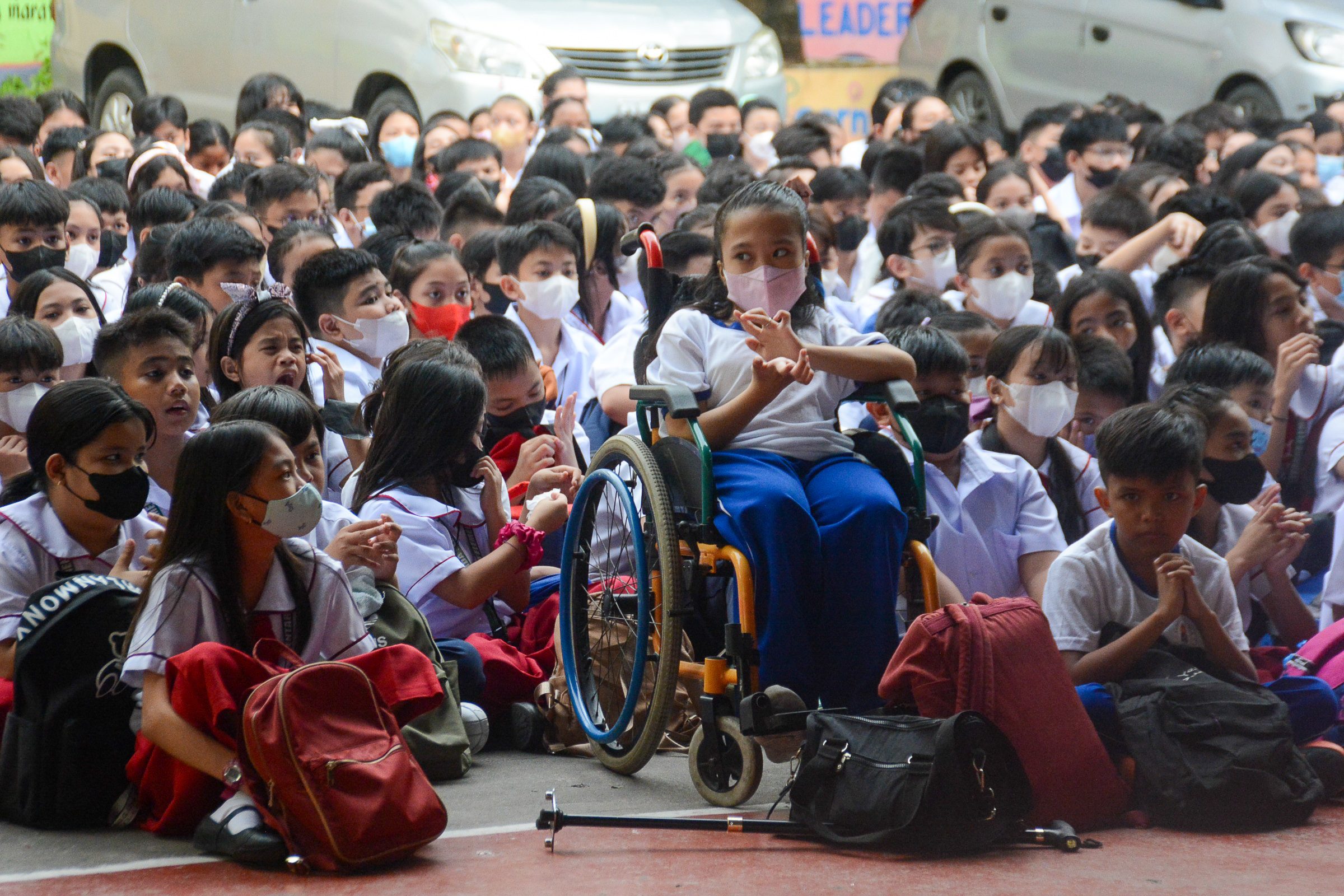
A House committee finds that inclusive education is not yet a reality for many learners with disabilities MANILA, Philippines – Lawmakers questioned the pace of implementation of Republic Act No. 11650, a law mandating inclusive education for learners with disabilities (LWDs), four years after the measure’s passage in 2022. During a Department of Education (DepEd) briefing before the House basic education committee on Monday, July 20, Pasig City Representative Roman Romulo flagged the lack of multidisciplinary teams (MDTs) in all three Inclusive Learning Resource Centers (ILRCs) in Metro Manila. The ILRCs are at Batino Elementary School in Quezon City, Alabang Elementary School in Muntinlupa City, and P. Gomez Elementary School in the City of Manila. DepEd SPED Advisor Roland Montes initially described the ILRCs as operational, but Romulo responded, “How can it be operational when you don’t have an MDT?” An MDT, according to the law, facilitates assessments, monitoring, and evaluation of LWDs. The goal is to integrate these students into the basic education system through the guidance of professionals. According to Section 8, “Each ILRC shall have an ILRC Supervisor and a multidisciplinary team.” The team shall be composed of any or all of the following: Educational Psychologist Guidance Counselor Psychometrician Developmental Pediatrician Neurological Psychiatrist Physical Therapist Occupational Therapist Speech and Language Therapist or Speech Correction Teacher Speech Language Pathologist Reading Specialist Specialist for Braille and other augmentative and alternative modes of communication FSL (Filipino Sign Language) Specialist FSL Interpreter Sign Communication or Visual Specialist Special Needs Teacher ILRC Supervisor Romulo, the House basic education committee chairperson, said: “I just don’t want any parent to question us. That is why mayroong listahan. In fact, do’n sa mismong batas eh naglagay kami ng listahan (That is why there’s a list. In fact, we even included the list in the law itself).” DepEd Assistant Secretary Jerome Buenviaje admitted that while the ILRCs are deemed operational, they have incomplete staff. “According to our records, they’re partially operational, and MDTs are coming from partnerships from universities and other health agencies…. The MDTs aren’t complete yet, but we do have professionals in place,” he said in a mix of Filipino and English. Romulo pointed out that certain professionals in MDTs, such as a developmental pediatrician, are essential in assessing each learner’s abilities and needs before they can be integrated into the education system. “Ang inclusivity, kailangan may assessment. So kung walang assessment, dapat hindi natin [tatawaging] inclusivity kasi we don’t know how to handle [the students],” he said. (Inclusivity requires assessment. So, without assessment, we shouldn’t call it inclusivity, because we don’t know how to handle the students.) A study released by the Second Congressional Commission on Education (EDCOM 2) in November 2025 showed that most children with disabilities remain out of school. “In SY 2024-2025, only 391,089 learners with disabilities were enrolled in public schools, representing just 8% of the estimated 5.1 million children with disabilities nationwide. The vast majority of children with disabilities remain either out-of-school or in-school but with an unidentified disability, indicating significant gaps in identification and enrollment,” states the study. Not enough funds, materials During the briefing, EDCOM 2 Executive Director Karol Mark Yee also pointed out that while the Special Needs Education Program budget increased to P1.04 billion in 2026, the funds are “unevenly distributed” among schools, “insufficient,” and “usually delayed.” The funds are meant to cover learner assessments, additional teacher training, and inclusive learning materials, among others. Given the budget, the DepEd estimates that there should be an average allocation of P1,400 per LWD for the school year. But EDCOM 2 findings show that some schools received as little as P333 per learner. There is also a shortage or lack of access to educational materials for LWDs in most schools. The usual learning aids are supposed to be converted into various inclusive formats, such as braille, large print, audio, digital copies, augmentative and alternative communication, and Filipino sign language. “Under the IRR (implementing rules and regulations), the DepEd is authorized to convert learning resources into accessible formats. It also requires publishers to provide digital copies so it can then be adapted to the needs of learners with special needs,” Yee said. Romulo told the education department to get a clear picture of what is actually happening in schools. “The issue really is walang feedback sa inyo eh (there’s no feedback). You are not aware that this is happening on the ground…. We have to be more proactive,” the lawmaker said. – Rappler.com
Funds, resources for learners with disabilities still not enough despite 2022 law
Full Article
Original Source
Read the full article at Rappler →KhanList aggregates and links to publicly available news content. We do not host full articles from third-party sources. Always verify important information with original sources.