
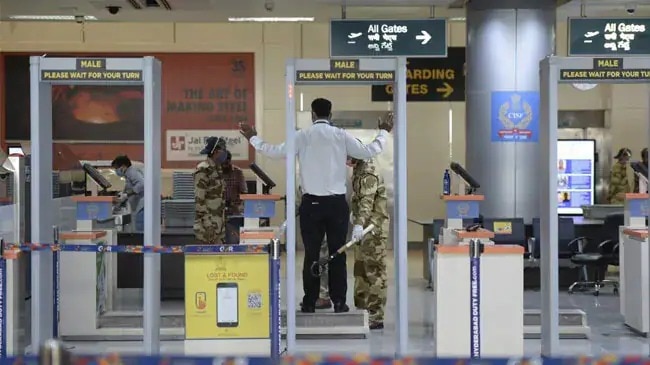
Full-body scanners (FBS) are set to be introduced at more Indian airports as the government looks to strengthen aviation security following the flydubai horror. The Ministry of Civil Aviation (MoCA) said it was reviewing security measures at airports following the incident, in which the flight's co-pilot apparently attempted to hijack the aircraft and crash it in Israel. However, the Omani co-pilot's plans were thwarted by Indian captain Smit Machchhar, who valiantly fought him off despite suffering multiple stab wounds.MoCA secretary Sameer Sinha said full-body scanners would be rolled out at eight airports in the first phase. "Machines have been delivered to three airports. The remaining five will get it soon," Sinha said. Simultaneously, the ministry is also collecting and analysing data from the devices.While details of what unfolded inside the cockpit of flight FZ 1073 remain sketchy, the Indian captain was brutally stabbed by the co-pilot two hours into the Tel Aviv-bound flight. It is not confirmed whether the co-pilot, who has now been arrested, carried a knife or used the fire axe that is factory-fitted in the cockpit to attack Machchhar.If the co-pilot indeed carried a knife, it will be seen as a massive security breach. Pilots in the Middle East go through the same security screenings as passengers, meaning they would not be able to bring weapons such as knives or guns on board. Civil Aviation Minister Ram Mohan Naidu said the incident was being investigated by the agencies."We will act as per the outcome of the probe. After the preliminary report from flydubai, India will also act to further tighten the security aspect," Naidu told India Today.WHAT ARE FULL-BODY SCANNERS? The official suggested that full-body scanners are set to become a more visible part of airport security. Presently, Indian airports rely on metal detectors and manual frisking.Full-body scanners are already being used on a trial basis at Delhi, Bengaluru, Hyderabad, and Kochi airports. Pilot testing started earlier this year, with the Bureau of Civil Aviation Security (BCAS) pushing for a wider rollout by next year.Unlike conventional metal detectors, full-body scanners, as the name suggests, are designed to detect objects concealed within a person's body. Even non-metallic items can be detected by them.These scanners use millimetre-wave technology to scan the body without physical contact or removal of clothing. The system then analyses the scan and flags areas where an object may be concealed.However, the biggest concern surrounding full-body scanners has been privacy.The MoCA secretary said the scanners installed at Indian airports would be "picture agnostic". Simply, this means that instead of producing the specific image of a passenger's actual body, the scanner will display a generic representation or model of the body."It will be picture agnostic. The specifics won't come out. Only the object imagery on the body will show," Sinha said.According to a written reply in Parliament in 2024, the government said the first phase had been planned for Delhi, Mumbai, Bengaluru, Hyderabad, Chennai, Kolkata and Ahmedabad. Following the flydubai incident, the government is likely to speed up its implementation.- Ends
Full-body scanners soon: India plans big security upgrade after flydubai horror
Full Article
Original Source
Read the full article at Indiatoday →KhanList aggregates and links to publicly available news content. We do not host full articles from third-party sources. Always verify important information with original sources.