
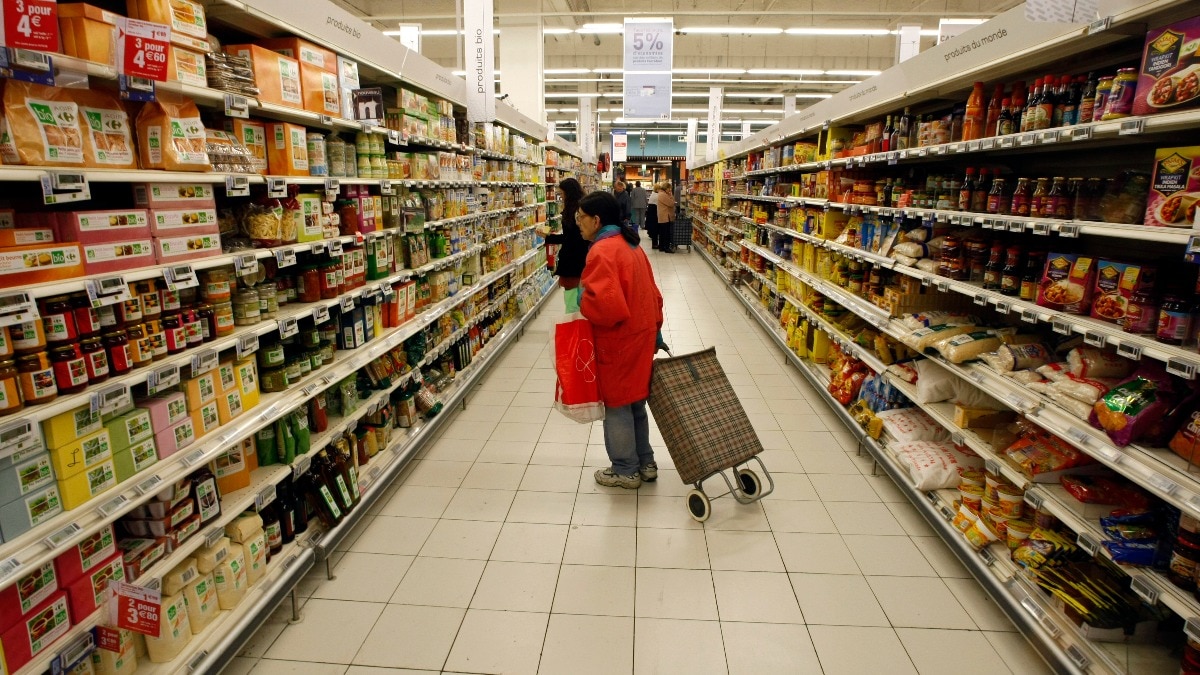
The proposal envisages a red, hexagonal warning symbol on the front of packaged foods, with labels such as 'High Sugar,' 'High Salt,' 'High Fat' and 'Highly Sweetened Beverage.' The regulator says the objective is to give consumers a simple and easily comprehensible warning and help them make informed food choices.Experts say the FSSAI's proposal still contains loopholes that could significantly weaken the impact of the labels. (Representative photo. Credits: Reuters)The Food Safety and Standards Authority of India (FSSAI) has finally proposed front-of-pack warning labels for packaged foods high in sugar, saturated fat and salt. But public health experts say the proposal, submitted to the Supreme Court on August 28, still contains loopholes that could significantly weaken the impact of the labels.The proposal envisages a red, hexagonal warning symbol on the front of packaged foods, with labels such as "High Sugar," "High Salt," "High Fat" and "Highly Sweetened Beverage." The regulator, in its affidavit to the apex court, says the objective is to give consumers a simple and easily comprehensible warning and help them make informed food choices.The move follows months of pressure from the SC, which has repeatedly pushed the regulator towards interpretive warning labels rather than nutrition information that requires consumers to do the calculations themselves.The case began after FSSAI's proposed star-rating system for packaged foods came under criticism from public health experts. The system was withdrawn after concerns that products high in individual nutrients of concern could still receive a favourable overall rating, potentially creating a "health halo." The matter was subsequently taken to the SC by the Kerala-based 3S and Our Health Society.In February 2026, the Supreme Court directed FSSAI to consider clear warnings such as "High in Sugar," "High in Salt" and "High in Saturated Fat." But instead of adopting such a system immediately, FSSAI's August 3 affidavit proposed displaying recommended daily limits alongside nutrient quantities, effectively leaving consumers to compare numbers and determine whether a product was unhealthy. The Court was not satisfied and on August 13, it gave the government a final two-week window to reconsider its position, making it clear that the earlier direction was not merely a suggestion.On Friday, FSSAI returned with the red-hexagon proposal. While the move is being seen as an important shift, experts say the details matter enormously.LOOPHOLES IN WARNINGThe biggest concern is that FSSAI proposes a warning when a product is high in two or more of the specified nutrients – added saturated fat, added sugar and salt. This means a product containing a very high amount of sugar could potentially escape a warning if it does not simultaneously cross the prescribed thresholds for fat or salt.Nutrition experts argue that the trigger should operate independently: a product high in any one nutrient of concern should carry a warning. They also want energy to be included as a separate parameter, pointing to front-of-pack systems used in countries including Chile, Mexico, Canada and Israel.The proposed phased approach is another concern. While the current proposal focusses on products high in two or more nutrients, a later phase is expected to address products high in any one nutrient. However, there is no clear binding timeline for moving to this second phase.Public health advocates say a phase without a deadline could effectively postpone the stronger warning system indefinitely. They want FSSAI to specify a firm timeline, preferably within 12 months of the first phase, while using the country's existing high-fat, sugar and salt (HFSS) framework to establish the thresholds.There are also questions over the regulator's reliance on added sugar and added saturated fat. Experts point out that the Indian Council of Medical Research - National Institute of Nutrition (ICMR-NIN) Dietary Guidelines for Indians provide thresholds for total sugar and total fat, while added sugar can be difficult to independently assess from the information available to consumers.The concern is that focusing narrowly on "added" nutrients could allow products with substantial overall sugar or fat content to avoid warnings.The size of the proposed warning is another potential weakness.The food regulator has proposed that the warning be displayed in a font one point larger than the nutrition information table on the back of the package. Experts argue that if the underlying nutrition table uses a very small type, increasing it by just one point may still leave the warning difficult to notice from a normal viewing distance.Dr Arun Gupta, coordinator of the Nutrition Advocacy in Public Interest (NAPi) said the proposal is a step forward but warned that its design could undermine its public-health purpose."FSSAI's red hexagonal warning label is a step forward, but the 'two or more' threshold is a massive loophole. A product with high sugar carries no warning if it is low in fat and salt. That is not public health; that is regulatory capture. Further, definition of HFSS is critical to include total sugar and fats," he underlined.WHY THE DESIGN MATTERSThe debate is not simply about how a packet looks. It is about whether consumers are given an immediate warning or asked to interpret nutritional information themselves.Evidence cited before the SC has suggested that warning labels can make it easier for people to identify products high in nutrients of concern. In a six-state randomised field experiment, 60.8% of participants correctly identified products as high in a nutrient when shown a warning label, compared with 55% using a numerical table and 45% using a star-rating system.The issue has particular significance for India, where unhealthy diets are a major contributor to diseases.ICMR-NIN has estimated that 57% of the country's total disease burden is attributable to unhealthy diets. Rising consumption of foods high in sugar, salt and fat is also closely linked to growing concerns around obesity, diabetes and cardiovascular disease.For consumers, therefore, the difference between a warning that is immediately visible and a number buried in a nutrition table can be substantial.FSSAI's latest proposal brings India closer to a warning-based system, but whether it becomes an effective public-health intervention will depend on the final thresholds, the definition of HFSS foods, the size and visibility of the warning and, crucially, whether products high in just one harmful nutrient are covered.The matter is now expected to come up before the SC on the 10th of next month, when the court will consider the compliance position.- EndsPublished On: Aug 29, 2026 12:40 IST
FSSAI proposes junk food warning labels, but loopholes remain
Full Article
Original Source
Read the full article at Indiatoday →KhanList aggregates and links to publicly available news content. We do not host full articles from third-party sources. Always verify important information with original sources.