
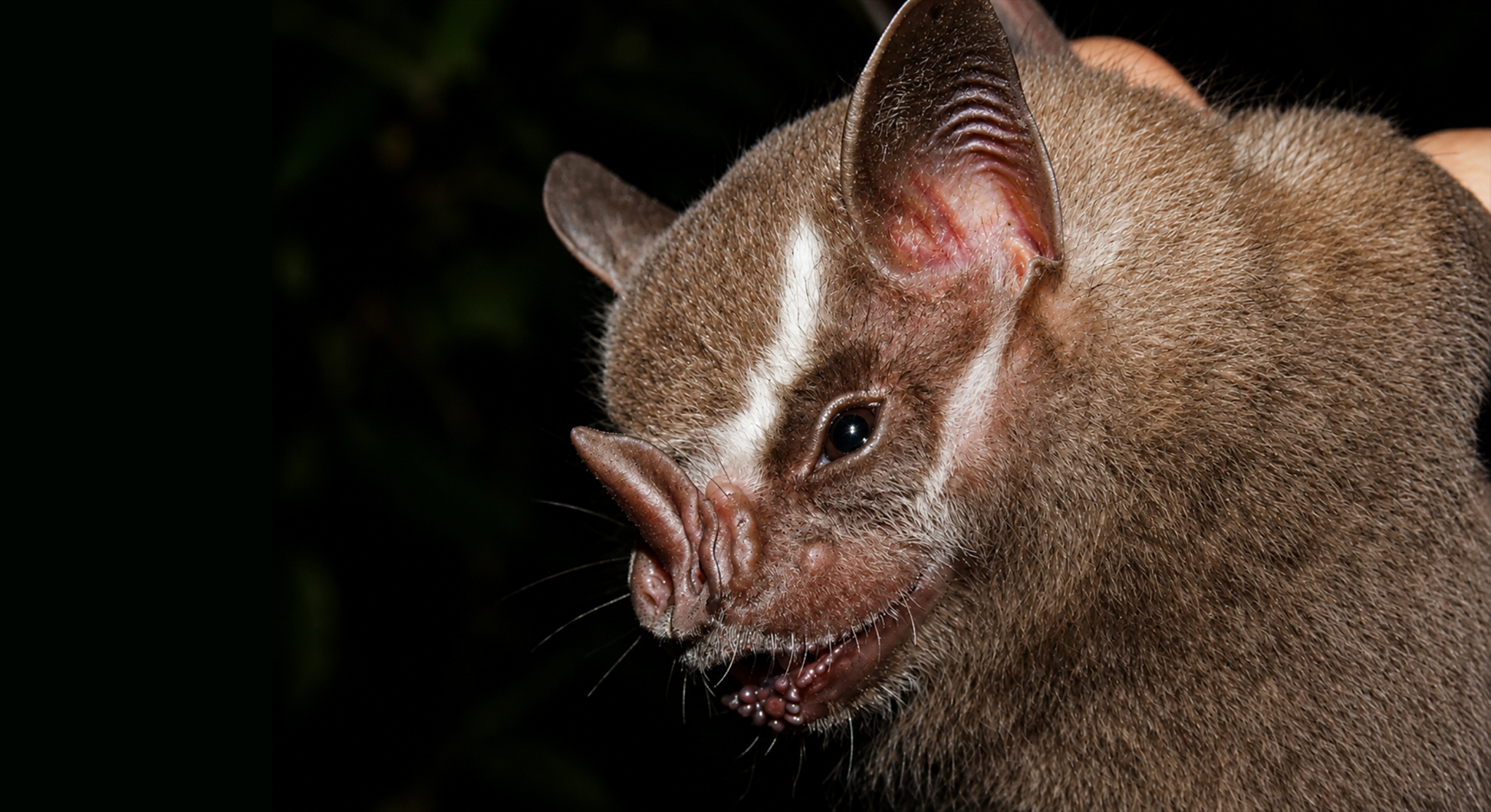
Fruit-eating bats disperse the seeds of more than 140 plant species in the Atlantic Forest, with the potential to deposit more than 25,000 seeds per hectare per day in degraded areas.For more than two decades, researchers have studied these mammals’ sense of smell to determine how to lure them into fragmented forest tracts in need of regeneration.Experiments using fruit essential oils and synthetic compounds have shown that bats can be directed to specific locations. Experts say the strategy could complement conventional forest restoration techniques. Bats have long occupied a sinister place in Western pop culture. Ever since Bram Stoker published Dracula in 1897, these nocturnal mammals have been associated with vampires. Outside fiction, however, only three of the world’s roughly 1,500 known bat species feed on blood — and only one targets mammals such as cattle and other livestock. Even then, humans are rarely on the menu. Bats represent the second most diverse group of mammals, behind rodents. They also provide essential ecosystem services, including insect pest control, pollination and seed dispersal; around a third of all species feed on fruit or nectar. A fruit-eating bat won over Lays Cherobim Parolin early in her career. As she was about to graduate with a degree in biology, the scientist wanted to work with larger mammals but ended up joining a bat research project instead. The first time she held one, as she removed it from a mist net, she was hooked. “People have no idea that bats are seed dispersers and have the potential to restore [natural] areas. They never remember them, they only remember birds,” Parolin, now a professor at the Pontifical Catholic University of Paraná (PUC), said. Researcher Lays Cherobim Parolin sets up an experimental structure with essential oils to attract bats. Image courtesy of Gledson Vigiano Bianconi. The encounter left such an impression that Parolin got a tattoo on her arm of the great fruit-eating bat (Artibeus lituratus), a species identifiable by two pale stripes across its head. The tattoo serves as a personal keepsake, but it also reflects a decades-long shift in ecological thinking: Bats can play a decisive role when a forest needs to start over. Data from Embrapa Forestry show that frugivorous bats disperse seeds from more than 140 plant species in the Atlantic Forest, depositing between 600 and 25,930 seeds per hectare each day even in degraded areas. They feed on fruit in forests, cross agricultural areas for several kilometers and disperse seeds while flying — unlike most birds, which disperse seeds only when they land. For more than 20 years, researchers have investigated how to harness that natural behavior to accelerate forest restoration. The clue they needed lay in an adaptation bats already use to forage: An acute sense of smell. Scents that attract Knowing that bats track fruit by odor, researchers in the early 2000s wondered whether they could recreate the fragrance of ripe fruit to lure the animals into areas targeted for restoration. Sandra Bos Mikich of Embrapa Forestry and Gledson Vigiano Bianconi of the Federal Institute of Paraná (IFPR) later tested the idea with experiments in Paraná’s Vila Rica do Espírito Santo State Park (Pevres). They set out artificial fruits scented with essential oil of pariparoba (Piper gaudichaudianum), one of the bats’ preferred foods. Moving the dispensers into an agricultural field 50 meters (164 feet) from the forest edge drew the animals out into open terrain. The team then began analyzing the essential oils of favored fruits to isolate active ingredients. Their findings, published in another study, showed that certain compounds help bats locate food, while others signal that fruit is ripe. Pariparoba alone releases 95 different compounds, which shift in composition depending on the fruit’s ripeness and the time of day it is harvested. The goal was to identify synthetic alternatives. Extracting essential oils directly from wild plants would be expensive and ecologically damaging. “That would be bad in environmental terms,” Mikich said. “Because it would involve an extensive harvest of fruits. Consequently, I would be taking away food from those who are there [the wildlife] and compromising the seed dispersal of these plants.” To work around the problem, the researchers fractionated natural essences to test which components triggered the strongest behavioral responses. “We selected some synthetic compounds that manage to attract bats even without ‘all the rest’ of the oil,” Mikich said. A Seba’s short-tailed bat (Carollia perspicillata). Image courtesy of Michel Miretzki. The team focused on compounds found in the fruits of Ficus, Piper and Solanum, three plant genera that make up the bulk of the diet of the primary frugivorous bats under study. “They are compounds that are easy to purchase, as the pharmaceutical industry already produces them synthetically, without needing to extract them directly from fruits,” Parolin said. The next step is to reproduce the scents that bats already recognize in nature and bring them to places where forests need to regenerate. “I can place these scents exactly where I want seed arrival to increase,” Mikich explained. Related research by the team suggests the method could be adapted beyond Brazil. “Since frugivorous bats around the world use smell to seek and select their food, this tool has the potential to be global, depending on the presence of fruit-eating species,” Parolin said. From chemistry to restoration Fruit-eating bats such as the great fruit-eating bat, Seba’s short-tailed bat (Carollia perspicillata) and the little yellow-shouldered bat (Sturnira lilium) digest meals quickly, in about 30 minutes, and range widely between day roosts and foraging grounds. Along the way, they carry seeds far from the parent trees. A single bat can produce its own rain of hundreds of seeds over the course of a single night. That mobility allows the animals to traverse fragmented rural mosaics. Mark-recapture and radio-telemetry studies show that bats move regularly between forest fragments, crop fields, orchards and riparian corridors. “Throughout this research, we marked more than 1,800 individuals of two species, A. lituratus and C. perspicillata, and monitored 32 bats fitted with transmitters via radio-telemetry,” Bianconi said. “Perhaps the main contribution of this study was demonstrating that, although the agricultural matrix poses challenges and risks to bats, it does not prevent their movements between forest fragments.” Researcher Gledson Vigiano Bianconi in a captive bat facility. Image courtesy of Gledson Vigiano Bianconi. Field tests in open areas near forest patches highlighted another behavioral trait: Bats fly in exploratory circles around the point where the scent is released. This behavior can last up to four minutes, a period scientists consider sufficient for the animals to disperse thousands of seeds from different species. The experiment showed that 73.3% of the seeds found at the attraction points belonged to pioneer species, a term experts use for plants capable of establishing themselves in open and degraded areas, thereby preparing the ground for other species to grow. That combination of wide ranging behavior and scent responsiveness underpins the effort to use bats as reforestation partners. “I see this technology as a complementary tool to conventional restoration techniques. In many scenarios, it may reduce costs and increase the diversity of species that arrive naturally in degraded areas,” Bianconi said. “Today, the main challenge is to turn it into an operational restoration protocol that can be applied in a standardized way across different ecosystems.” A Seba’s short-tailed bat (Carollia perspicillata) hanging from a branch. Image courtesy of Gledson Vigiano Bianconi. Animal allies, not substitutes “Bats have an important role: They participate in several fundamental ecological processes,” Pedro Brancalion, a forest restoration specialist and professor at the University of São Paulo (USP), said. “They often disperse seeds of species that were not planted. And that’s important.” Experts, however, point to a challenge: Bats’ seed-dispersal activities can also spread undesirable plants. Brancalion cited the tropical almond (Terminalia catappa), an introduced tree, as an example. “Bats don’t care if they are exotic, native, invasive or threatened. They want to feed,” he said. Scientists recognize that bats can indeed contribute to forest regeneration, but they are not a technology that can replace the dynamics of the forest itself. Researchers say chemical attractants can increase the presence of seed dispersers, provided the animals already move through the area and have access to forest fragments that serve as habitat. Meanwhile, experts are also working to expand knowledge of different bat species in an effort to better understand their complexity. “[It was only] in the last 10 or 15 years that the animal side of the story began to be considered. You need the animals — seed dispersers, pollinators and others that provide natural biological control and decomposition,” said Marco Mello, a professor at the University of São Paulo who studies interactions between bats and plants. Mello maintains NeoBat, an open database compiling published research on ecological interactions between bats and plants. The project gathers records from peer-reviewed articles, books, dissertations, theses and technical reports. Noting the ecosystem services bats provide, Mello said negative cultural associations with the animals are not universal. “If we think about native cultures here in South America and Central America, the image was different. For example, in Maya culture, in Central [and North] America, bats were gods, gods of fertility,” he said. Banner image: A great fruit-eating bat (Artibeus lituratus). Image courtesy of Gledson Vigiano Bianconi. This story was first published in Portuguese here on Oct. 15, 2026. Brazil natural landscape degradation drives toxic metal buildup in bats New study points to private land as key to Atlantic Forest recovery Citations: Bianconi, G. V., Suckow, U. M. S., Cruz‐Neto, A. P., & Mikich, S. B. (2012). Use of fruit essential oils to assist forest regeneration by bats. Restoration Ecology, 20(2), 211–217. doi:10.1111/j.1526-100X.2010.00751.x de Brito-Machado, D., Felisberto, J. S., Queiroz, G. A. de, Guimarães, E. F., Ramos, Y. J., & Moreira, D. de L. (2024). From Leaves to Reproductive Organs: Chemodiversity and Chemophenetics of Essential Oils as Important Tools to Evaluate Piper mollicomum Kunth Chemical Ecology Relevance in the Neotropics. Plants, 13(17), 2497. doi:10.3390/plants13172497 Mikich, S. B., & Bianconi, G. V. (2011). Potencializando o papel dos morcegos frugívoros na recuperação de áreas degradadas. Pesquisa Florestal Brasileira, 31(65), 155–164. doi:10.4336/2012.pfb.51.155 Parolin, L. C., Lacher, T. E., Bianconi, G. V., & Mikich, S. B. (2021). Frugivorous bats as facilitators of natural regeneration in degraded habitats: A potential global tool. Acta Oecologica, 111, 103748. doi:10.1016/j.actao.2021.103748 Teixeira, S. D., Santos, T. G., Hendges, A. P. P. K., & Maia, B. H. N. S. (2025). Circadian Analysis in Volatile Organic Compounds from Piper gaudichaudianum Kunth Fruits and Their Potential Role in Attracting Carollia perspicillata Bats. ACS Omega, 10(2), 2130. doi:10.1021/acsomega.4c08768 Credits Topics
Fruit bats emerge as unlikely allies in the Atlantic Forest restoration
Full Article
Original Source
Read the full article at News →KhanList aggregates and links to publicly available news content. We do not host full articles from third-party sources. Always verify important information with original sources.