
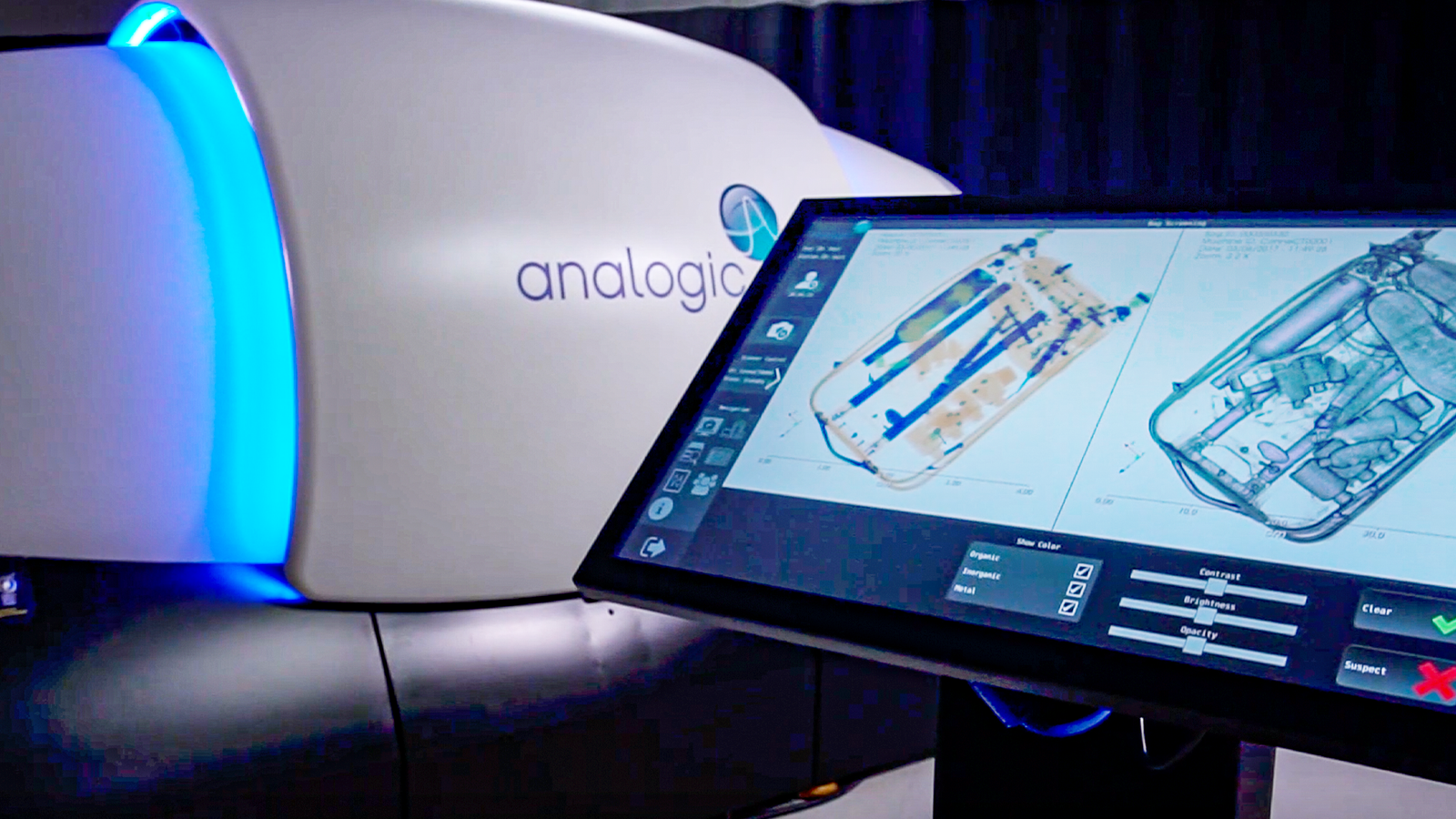
Published Oct 12, 2026, 1:00 PM EDT Jack comes to Simple Flying with a lifelong interest in all things aviation. He holds a degree in Aerospace Engineering from Georgia Tech, and is a certified private and remote pilot. Beyond these experiences, Jack previously worked for a corporate flight department where he gained first-hand experience in the world of business aviation. Currently, Jack works in the professional services industry and continues to build his flight hours outside of work. Air travelers flying with larger carry-on bags are facing a new practical constraint at US airport security checkpoints. Frontier Airlines and Southwest Airlines both allow cabin bags measuring up to 24 by 16 by 10 inches (61 by 41 by 25 cm), while the newer computed tomography, or CT, scanners being installed by the Transportation Security Administration (TSA) have tunnel openings of approximately 24.5 inches (62 cm) wide by 16.5 inches (42 cm) high. A maximum-size bag can therefore fit on paper, but it has only about half an inch of clearance in the two dimensions that matter at the scanner entrance. The machines are not changing either airline's published baggage allowance. Instead, they introduce a physical screening constraint that can become consequential when a soft-shell case expands, an exterior pocket is packed tightly, or wheels and handles add bulk. The TSA had installed 1,162 CT units at 296 airports by July 6, 2026, making the issue increasingly relevant across the US. The agency has acknowledged that not all larger carry-ons will fit and recommends that travelers check large items with the airline when necessary. This creates a practical gap between the size a carrier permits and the equipment available at a federal checkpoint. The 24-Inch Allowance Is Still Valid Credit: Ian Dewar Photography | Shutterstock Frontier's published policy permits a carry-on up to 24 inches high, 16 inches wide, and 10 inches deep, including handles, wheels, and straps, with a 35-lb (15.8 kg) maximum. Southwest lists the same 24-by-16-by-10-inch dimensional limit and likewise counts wheels, handles, and attachments. Neither carrier has announced a reduction to those dimensions because of TSA's scanner rollout. TSA does not establish the cabin-bag allowance used by either airline, so the federal screening agency is not replacing those published limits with a new nationwide measurement. The geometry explains why the situation is more nuanced than a simple conflict between federal screening equipment and airline policy. A rectangular 24-by-16-by-10-inch bag can be oriented so its 24-inch side passes through a 24.5-inch-wide opening, while its 16-inch side passes through a 16.5-inch-high opening. The remaining 10-inch dimension runs through the scanner. A bag manufactured and packed to exactly those measurements therefore has theoretical clearance. The problem is the word "exactly." Real luggage is rarely a rigid box. Soft-shell cases compress in one direction and bulge in another, while expandable models can change shape when filled. A traveler who stays within the airline's nominal dimensions can still have a bag whose actual profile is less cooperative at the checkpoint. Manufacturers also describe dimensions differently, so a nominal measurement may not make the shape of wheels, corner guards, or handles obvious. CT Scanners Bring A Different Physical Constraint Credit: Elliott Cowand Jr | Shutterstock The new machines are being deployed because CT technology improves the security screening process, not because TSA intends to create a new carry-on standard. Unlike conventional two-dimensional X-ray systems, CT scanners generate three-dimensional images that allow officers to examine the contents from multiple angles. TSA says the technology strengthens explosives detection, while its airport guidance notes that passengers using CT lanes can leave laptops and other electronics inside their bags. Travel-size liquids can also remain packed in CT lanes, subject to the applicable screening rules. That improvement comes with a different equipment footprint. The new CT tunnels have openings smaller than those on many legacy systems. The narrower entrance is therefore a mechanical characteristic of the screening equipment, rather than an airline baggage rule. TSA's own descriptions of the technology have acknowledged the smaller tunnel and warned that larger carry-ons may not fit. For most travelers, the change should have little effect. A widely used carry-on benchmark is 22 by 14 by 9 inches (56 by 35.5 by 22.8 cm), leaving substantially more room inside the CT opening. The travelers most exposed are those who deliberately choose luggage near the largest dimensions permitted by their airline, particularly when the bag has flexible walls or protruding hardware. Overstuffed Bags Are Where The Margin Disappears Credit: Markus Mainka | Shutterstock The greatest risk is not necessarily a suitcase that is formally oversized. It is a bag that meets its published dimensions when empty or compressed but changes shape once it is packed. Expansion zippers, exterior compartments, wheels, telescoping handles, and soft construction can all alter the profile presented to the scanner. That matters because the CT tunnel does not evaluate the marketing dimensions printed on a luggage box. It has a fixed physical opening. A hard-shell case with carefully contained dimensions is more likely to preserve its shape than an expandable soft-shell roller stuffed with clothing. Even a modest bulge can consume much of the available clearance when only half an inch separates the nominal bag dimension from the tunnel. A traveler may therefore be compliant with an airline's written rule while still presenting a shape that is difficult to feed into a particular machine. The practical implication is that travelers should measure the bag in its actual travel condition, rather than relying solely on its advertised dimensions. Handles, wheels, and attachments should be included, because both Frontier and Southwest incorporate them into their limits. Packing an expandable section to capacity can create a different object from the one measured before a trip. This also gives hard-shell and soft-shell luggage different practical profiles. A rigid case cannot easily be compressed to negotiate a tight opening, while a soft case can sometimes be reshaped, but it is also more susceptible to bulging. Neither construction is automatically preferable. The decisive factor is whether the packed case retains a predictable profile within the scanner's opening. A Scanner Rejection Can Become A Baggage Fee When a bag cannot pass through a CT scanner, TSA's response does not necessarily mean the passenger has violated an airline's baggage policy. Officers can use manual screening or direct the traveler toward another lane capable of handling the item. TSA has advised passengers with larger carry-ons to consider checking them with their airline before reaching security when necessary. The agency has also said officers can assist travelers with larger items or special needs. The operational concern is the time involved. A traveler who is redirected to another screening lane may lose minutes during a busy departure period. If the bag has to be checked, the passenger may need to leave the security area, return to the airline counter, pay any applicable fee, obtain a bag tag, and clear security again. Southwest itself instructs passengers whose carry-ons are too large to check them at the ticket counter before proceeding to the departure gate, while Frontier notes that oversized carry-ons can incur additional charges when they are discovered at the airport. The result is an unusual split in enforcement. Airlines can deem a bag acceptable for the cabin, while TSA equipment can determine that the same bag cannot be screened through a particular lane. The two standards govern different parts of the journey, but the passenger experiences them as one continuous baggage requirement. Rollout Makes Airport-Specific Planning Less Useful Credit: Daniel J. Macy | Shutterstock The issue is increasingly difficult to treat as an isolated airport quirk. Over 1,000 new CT scanners are already installed at nearly 300 airports across the country. The agency's deployment has therefore moved well beyond a few trial locations, although equipment can still vary between checkpoints and airports. The rollout follows years of testing and a major federal investment in checkpoint CT technology. That variation means passengers cannot assume every security lane will handle a maximum-size carry-on in exactly the same way. A bag that clears one checkpoint may encounter a different machine elsewhere, while a passenger redirected from a CT lane may still have an alternative screening option. Travelers connecting through multiple airports also have more opportunities to encounter the newer equipment. Airport-specific screening information may therefore be less useful than knowing the actual packed dimensions of the bag. For Frontier and Southwest, the longer-term issue is not necessarily whether either airline must immediately shrink its allowance. Their 24-by-16-by-10-inch policies remain usable within the stated limits. The more relevant question is whether passengers continue to perceive the full allowance as practical when airport screening infrastructure provides so little tolerance for deviations from those measurements. Real Limit Is Becoming A Three-Way Equation Credit: Ryken Papy | Shutterstock The emerging carry-on problem is less about a new federal baggage rule than about three systems that were designed around different requirements. Frontier and Southwest define what a passenger may take into the cabin, luggage manufacturers build cases to those dimensions, and TSA must move those cases through machines designed primarily around security performance. None of those systems is necessarily malfunctioning, but their boundaries do not align perfectly. For travelers, the safest response is straightforward: treat the airline's maximum as an upper boundary, not a target. A rigid bag slightly below the published limit provides more practical tolerance than an expandable case packed to its full advertised capacity. As CT deployment continues, luggage makers may also have an incentive to design future carry-ons around the physical realities of modern checkpoints, rather than simply maximizing the dimensions permitted by individual airlines. That could eventually produce a new de facto carry-on standard without any formal change to airline baggage policies. Airlines may also face pressure to explain more clearly how their maximum dimensions interact with modern screening equipment. The 24-inch suitcase is not disappearing, but the margin for packing it to the absolute limit is becoming much smaller.
Frontier & Southwest Airlines Allow 24-Inch Carry-Ons, But TSA's New CT Scanners Leave Half An Inch To Spare
Full Article
Original Source
Read the full article at Simpleflying →KhanList aggregates and links to publicly available news content. We do not host full articles from third-party sources. Always verify important information with original sources.