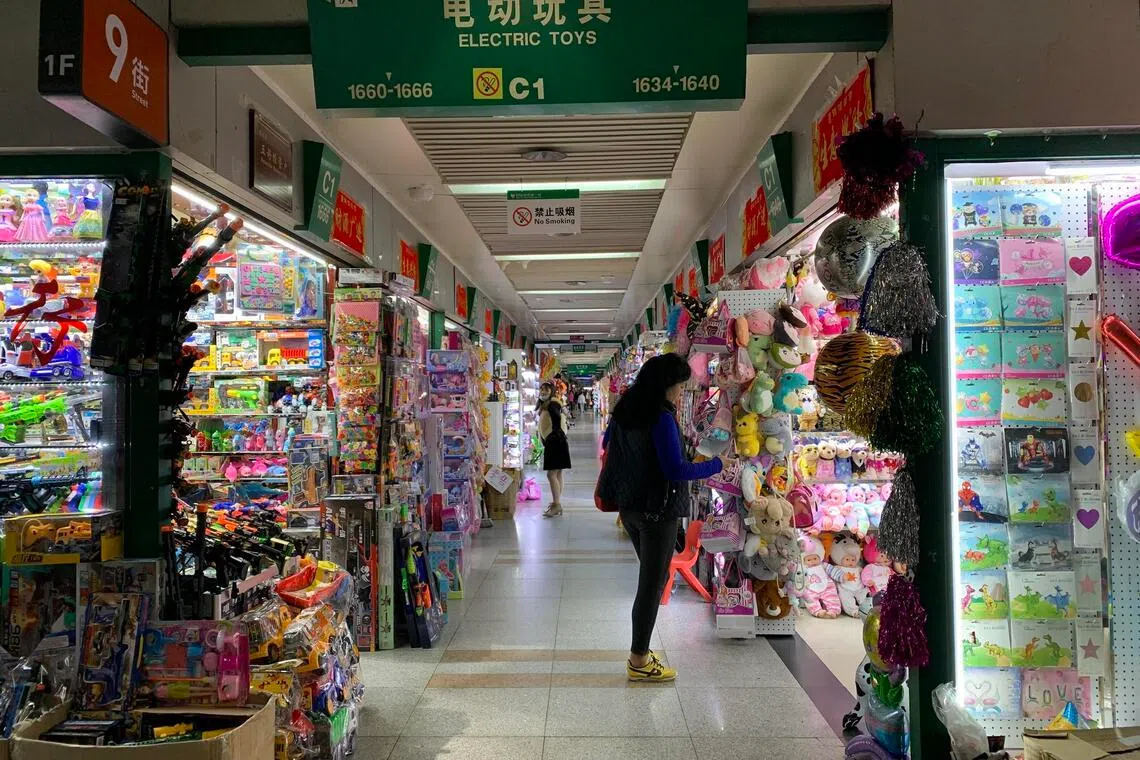
SINGAPORE – A growing number of foreign tourists are flocking to China’s wholesale markets to hunt for everything from the latest gadgets and gizmos to fashion and beauty products.Once the domain of professional traders, these markets and trading hubs have now become a common part of travel itineraries, those in the tourism industry told The Straits Times.This trend comes against the backdrop of Beijing’s broader push to stimulate flagging domestic consumption in the world’s second-largest economy, partly by attracting more foreign visitors and getting them to open their wallets.Since 2025, Chinese officials have begun promoting what they call the “Shopping in China” initiative, or zhongguo gou, while introducing a raft of measures to make it easier for foreigners to travel to China, be it through expanded visa-free arrangements or more seamless digital payments.These measures appear to have worked so far, with foreign arrivals hitting 22.9 million in the first half of 2026, up 20.4 per cent year on year.Notably, Chinese news outlet Global Times reported a 62 per cent year-on-year increase in flight bookings by foreign visitors to Yiwu city in the eastern Zhejiang province in the first half of 2026.The city is home to the sprawling Yiwu International Trade City, the world’s largest wholesale small commodity market, where more than 70,000 shops sell a variety of products, including cosmetics, stationery and backpacks.Official statistics showed that Yiwu received 681,000 inbound visitors in 2025. This is up 19.74 per cent from 2024.In the southern province of Guangdong, tech hub Shenzhen’s Huaqiangbei district, known for its vast electronics bazaar, ranked among the top 10 most popular areas nationwide for hotel bookings by international tourists in the first half of 2026, according to the Global Times report.In March, Shenzhen Daily reported an average daily footfall of about 750,000 in the Huaqiangbei area. More than 7,000 were foreigners, an increase of more than 50 per cent since the beginning of 2025.Leticia Zhang, 34, a Spanish-speaking tour guide in Shenzhen who hosts visitors from Spain, as well as Central and South America, told ST over WeChat that Huaqiangbei has become one of the city’s must-see spots.“Whenever I host foreign guests, if they are travelling independently and have shopping needs, we almost always go to Huaqiangbei.“Some guests even go there on their own to make purchases, and there are many foreigners in the Huaqiangbei market every day,” said Zhang, who takes an average of two tours in Shenzhen a month.She added: “Based on my experience leading tours, foreign visitors generally have a very positive opinion of Chinese markets. They appreciate the wide variety of products, high cost-to-performance ratios, and the technological advancements and convenience.”Kevin Zhao, general manager of boutique travel agency Travel to Qin in Shenzhen, which caters exclusively to foreign tourists, believes wholesale market tours are a growing trend in China.“We receive a lot of requests from clients who come to China wanting to do market tours,” Zhao said, adding that Shenzhen, Guangdong capital Guangzhou and Yiwu are the top three destinations by far.While he could not provide exact numbers, Zhao said about 70 to 80 per cent of his clients would include a trip to a wholesale market as part of their itinerary, with strong interest from visitors from India, South-east Asia and African countries.“The demands vary quite a lot because different clients have different goals,” Zhao told ST by phone.“Some just want to buy a few souvenirs. Others are curious about China because they know its manufacturing sector is advanced, so they want to check out the latest trends.“Then there are also serious businesspeople who come to China to source for products and export them back to their home countries,” he added.For Leanro Zhang, who runs Wayeast Travel, a United Kingdom-based China inbound tour company, the interest has been more muted.His company began offering specialised wholesale market tours after some customers requested that a shopping stop to one be added during their regular sightseeing tours.But of the 20 to 30 bookings his agency now receives each month, only two to three involve visits to such markets. “We have been getting such bookings since mid-2025, but haven’t seen a significant increase in volume,” he said.Wholesale markets and local governments have caught on to the trend too, with clothing markets in Guangzhou, such as the Huimei International Garment City and apM Times International Fashion City, now supporting single-item purchases, making it easier for individual shoppers as they no longer need to buy in bulk.In April, Guangzhou’s municipal government launched a two-year action plan to accelerate the development and upgrading of the more than 500 wholesale and specialised markets in the city, with the aim of growing annual transaction volumes from 1.5 trillion yuan (S$286 billion) today to two trillion yuan by 2028.The objective is to modernise and internationalise these traditional wholesale markets and establish some of them as bona-fide tourist attractions.“In the future, professional markets will not only be places for wholesale, but also for watching fashion shows, drinking coffee, strolling through night markets and taking photos,” Guangzhou newspaper Yangcheng Evening News reported in May.Gary Ng, a senior economist at financial services firm Natixis in Hong Kong, said China’s visa-free policy has been a game changer in terms of attracting more foreign tourists.It has also become more affordable to travel there, as accumulated inflation has been much higher globally than in China since the Covid-19 pandemic.He said: “While foreign tourism spending remains tiny to the overall economy, it can be important for small businesses and act as a lifeline amid decelerating local consumption.”
From trade hubs to attractions: China’s wholesale markets are becoming tourist hot spots
Full Article
Original Source
Read the full article at Straitstimes →KhanList aggregates and links to publicly available news content. We do not host full articles from third-party sources. Always verify important information with original sources.