
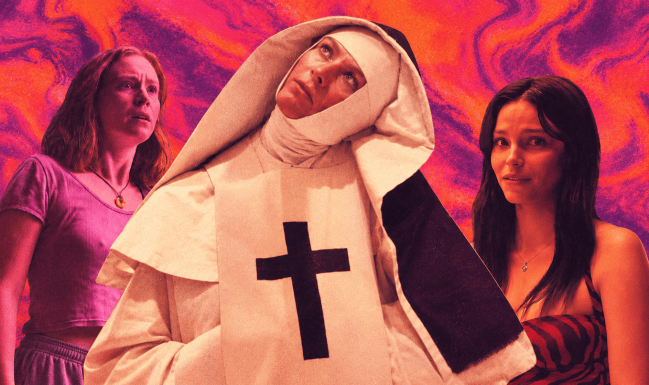
Has sexual violence always been a spectator sport? It certainly has an audience. Last week, prediction market Polymarket removed a contract that allowed users to bet on whether any of the seven men accused of sexually assaulting a Cornell University student in an alleged gang rape would face felony sex-crime charges. The men have broadly denied the allegations, and no one has been criminally charged. But before the Polymarket contract came down, bets about the Cornell case generated more than $450,000 in trading volume — suggesting that just the prospect of accountability for claims of alleged sexual violence can be repackaged and sold as dark entertainment today. Ken Russell’s “The Devils” understood the power of that spectacle 55 years ago. Now enjoying an extended theatrical run following its long-awaited restoration, the notorious 1971 film reveals how readily powerful institutions can turn women’s private experiences into public theater. In Russell’s feverish account of religious repression, a nun’s unrequited lust for a priest becomes a political weapon: a message that’s only grown more resonant in an era of increasing cruelty online. In the decades since, horror hasn’t stopped asking what happens when women want too much. If anything, the cultural fascination with female rage has made those questions more urgent and their resolutions more complicated. From Curry Barker’s “Obsession” to Jane Schoenbrun’s “Teenage Sex and Death at Camp Miasma,” this year has produced a striking collection of women whose desires — and other people’s attempts to control them — become sources of terror, humiliation, and transformation. The internet’s evolving concept of the “femcel” label offers a provocative lens through which to reconsider these characters, even if none fits its original definition of a woman denied romantic or sexual satisfaction particularly well. Offscreen, meanwhile, women are asking another question: What if the intimate relationships they’ve been taught to want aren’t worth wanting at all? Our Lady of Unrequited Lust Played with delirious conviction by Vanessa Redgrave, Sister Jeanne is a hunchbacked nun whose devotion to God takes a backseat to her passion for Father Grandier (Oliver Reed). Confined to a convent and ashamed of her body, Jeanne escapes into elaborate sexual fantasies about the handsome priest, imagining herself without her spinal deformity in a very public and passionate embrace. But Sister Jeanne doesn’t just want Grandier. She wants him to want her, and her conviction that he never will drives her toward increasingly destructive delusions. In the renewed online conversation surrounding “The Devils,” most of the overt thirst has understandably been reserved for Reed’s rakish priest. “I would let Father Grandier do unspeakable things to me,” declared one of many, many Reddit users speaking to that theme. Redgrave’s simultaneously sympathetic and villainous Sister Jeanne has inspired a more complicated fascination. “Sister Jeanne was the first femcel,” proclaimed one Letterboxd user after an October 17 screening. ‘The Devils’ (1971) Fifty-five years after her cinematic debut, Jeanne has become something like the patron saint of femcels. She’s lonely, sexually frustrated, and painfully conscious of her perceived undesirability. She’s also manipulative, vindictive, and complicit in a man’s destruction. Redgrave refuses to make either side easy to dismiss. Jeanne’s longing is pitiable, but its consequences are appalling. Russell, however, is interested in more than watching a woman go mad with desire. Jeanne’s accusations of demonic possession become politically useful to authorities determined to destroy Grandier, transforming her private anguish into an elaborate public performance. Even as she helps persecute the object of her obsession, Jeanne is herself raped under the guise of an exorcism, subjected to invasive sexualized rituals by the very men exploiting her testimony. Her culpability doesn’t erase her victimhood, nor does her victimhood absolve her. From the repressed Sister Ruth in “Black Narcissus” to the ostracized Carrie White and the desperately lonely heroine of “May,” horror has long made monsters of women whose desires exceed their circumstances. Their afflictions have been called everything from hysteria to demonic possession. Today, some viewers recognize them as cinematic femcels. (Hell, even Zendaya’s Emma in Kristoffer Borgli’s “The Drama” — a bullied teenager who once planned a school shooting — invites a more ideological reading of the archetype, her isolation having curdled into fantasies of violent revenge.) ‘The Devils’ (1971)Courtesy Everett Collection Ironically, the term “incel” itself originated with a woman. In 1997, a queer Canadian known as Alana founded an inclusive online community for people struggling to find sex and romance. Over time, male-dominated forums appropriated the label, and Elliot Rodger’s 2014 killing spree in Isla Vista helped make it synonymous with violent misogyny. Some male incels even rejected the legitimacy of female romantic frustration, arguing that women could always obtain sex by lowering their standards. Women helped create the language of romantic exclusion, only to find themselves excluded from it. Never mind that finding someone willing to sleep with you is hardly the same as finding someone who loves, respects, or even attracts you. Nor are femcels simply female versions of violent male incels. A 2024 study by Hannah Rae Evans and Adam Lankford found that femcel discussions showed less support for aggression and violence than researchers had documented among male incels. Then TikTok got involved. As researchers Jacob Johanssen and Jilly Boyce Kay explain, “femcelcore” transformed romantic exclusion into an often-ironic aesthetic of loneliness, resentment, self-loathing, and feminine rage. Literal femceldom and its more fashionable online performance are related but distinct phenomena, though popular culture increasingly treats them as interchangeable. What began as an identity for women who felt fundamentally undesirable became an aesthetic that made their alienation seem desirable. Whether anyone is getting better at understanding them is another question. The Monsters Men Make Curry Barker’s “Obsession” takes the nightmare of unrequited love and turns it inside out. Bear (Michael Johnston) is a romantically hopeless young man who uses a magical trinket to make his crush, Nikki (Inde Navarrette), fall hopelessly in love with him. It works a little too well. Nikki becomes the ultimate nightmare girlfriend: clingy, jealous, sexually insatiable, and eventually murderous. Her transformation recalls a long cinematic tradition of obsessive women, from “Fatal Attraction” to “Misery.” ‘Obsession’ (2026) But Barker’s clever reversal is that Nikki’s desires aren’t actually hers, and the monster is entirely of Bear’s making. Where Sister Jeanne’s authentic longing becomes a weapon for powerful men, Bear eliminates Nikki’s autonomy altogether. He wants the rewards of romance without the inconvenience of another person’s free will. Even after discovering the horrifying consequences of his wish, Bear struggles to relinquish control. The real horror in “Obsession” isn’t a woman who loves too much, but a man who believes being loved is something he’s owed. Barker makes the violation literal when Bear has sex with Nikki after discovering that his wish has effectively imprisoned her inside her own body. The scene is rape, even if the enchanted version of Nikki appears willing. And her vacant, tearful expression makes clear that the real woman has no say in what’s happening to her. Across five decades, “The Devils” and “Obsession” arrive at the same particularly ugly irony: Women portrayed as dangerous for wanting too much ultimately become victims of men who believe their bodies are available for the taking. Actual femcels, meanwhile, appear considerably less frightening than their fictional counterparts. A 2026 study by Brandon Sparks and Alexandra Zidenberg compared 61 self-identified femcels with 58 other women, finding elevated levels of sexual depression, anxiety, and dissatisfaction among the former. Particularly striking was their fear of abuse by potential partners. The small, demographically uneven samples limit broader conclusions, but the irony is difficult to ignore: While horror imagines sexually frustrated women as people to fear, some of the real women behind the label are themselves afraid of being hurt. ‘Obsession’ (2026)©Focus Features/Courtesy Everett Collection Plus, loneliness doesn’t necessarily mean desperation. According to Pew Research Center, only 35 percent of single American women were actively looking for a relationship or casual dates in 2022, compared with half of single men. Enjoying single life and having other priorities were among the leading explanations offered by single Americans who weren’t looking. Not every woman without a partner considers herself deprived of one. That distinction became politically charged after Donald Trump’s reelection in 2024, when some American women expressed interest in South Korea’s 4B movement, which rejects dating men, heterosexual marriage, sex with men, and childbirth. Born from feminist resistance to misogyny and sexual violence, 4B treats abstention not as romantic failure but as an exercise of autonomy. Its American visibility hardly established a mass exodus from heterosexuality, but it revealed something about the appeal of opting out. Here, the language of femceldom begins to break down. Women who want relationships but cannot find them aren’t the same as women who no longer consider those relationships worth pursuing. Amid growing discussions of “heteropessimism,” or disillusionment with the promises of heterosexuality, the difference between being unwanted and refusing to participate matters more than ever. And for a genre that has spent decades imagining women’s unsatisfied desires as a threat, that opens up some interesting possibilities. What If She Never Wants Him? For Kris Williams (Hannah Einbinder), the object of her obsession is already a horror movie. In Jane Schoenbrun’s “Teenage Sex and Death at Camp Miasma,” the young queer director is hired to revive a slasher franchise she’s worshipped since childhood. Her first priority is finding Billy Presley (Gillian Anderson), the reclusive actress who played its original final girl. Kris has spent years experiencing desire at a safe remove, through other people’s images. Meeting Billy threatens to collapse the distance between watching and wanting. Like Sister Jeanne, she’s fixated on someone seemingly beyond her reach. Unlike Jeanne, she might actually get to find out what happens next. ‘Teenage Sex and Death at Camp Miasma’ (2026) The franchise has its own messy history. Once protested by the religious right, “Camp Miasma” is now considered transphobic, thanks to its gender-nonconforming killer. Enter Kris, hired to give the aging property a suitably progressive makeover. Yesterday’s moral panic is today’s branding opportunity. Schoenbrun’s satire cuts in both directions. The studio cares little about the franchise’s ugliness or its pleasures, beyond whatever might make a reboot profitable. Kris, inconveniently, understands that making something politically acceptable isn’t necessarily the same as understanding its appeal. This tension extends beyond Schoenbrun’s fictional studio. Barker’s “Obsession” has earned more than $520 million worldwide, compared with roughly $8.7 million for “Camp Miasma.” Their vastly different theatrical releases make those grosses an imperfect referendum on audience tastes, but the disparity illustrates how differently the industry markets stories about desire. Female obsession is profitable. Female autonomy is a harder pitch. ‘Teenage Sex and Death at Camp Miasma’ (2026)©Mubi/Courtesy Everett Collection Billy knows more about that distinction than her admirer realizes. She reveals that an encounter previously understood as sex was, for her, an experience of sexual violence. The fantasy Kris treasured as a fan means something very different to the woman who lived it. Suddenly, the gap between the image and the person inside it becomes impossible to ignore. Schoenbrun doesn’t suggest that desire can erase trauma. Instead, Kris and Billy’s growing intimacy makes room for something transformative: the freedom to explore fantasies without surrendering the right to decide what happens to their bodies. For once, the question isn’t whether a woman wants too much, but whether she gets to decide what she wants in the first place. There’s a visual kinship with Russell, too. Derek Jarman’s blinding white architecture makes “The Devils” a cathedral of repression, while Schoenbrun’s candy-colored gore and hand-painted backdrops turn “Camp Miasma” into an ecstatic playground. Both directors abandon realism to give desire a world of its own. ‘The Devils’ (1971)Courtesy Everett Collection But where Russell’s world turns longing into persecution, Schoenbrun lets it become a creative force. When Kris’s increasingly personal ideas clash with the studio’s plans, it looks less like a defeat than a beginning. Reclaiming horror, it turns out, might require more than giving an old franchise a new coat of paint. Female rage became a lucrative entertainment category by making women’s anger legible as power. Femcelcore sells something slipperier: the misery of being unwanted as an identity other people might actually desire. Neither transformation settles the question of who profits from women’s pain, much less who gets to control its meaning. For Sister Jeanne, wanting a man she cannot have becomes the engine of her destruction. For Nikki, being wanted by a man who refuses to accept her autonomy is just as catastrophic. Kris and Billy offer a more liberating possibility: desire needn’t end in possession, punishment, or even the conventional romance women have spent centuries being told to pursue. The point isn’t that horror needs to become gentler, or that its ugliest fantasies should disappear. It’s that women deserve the freedom to make, watch, and reclaim these movies on their own terms. It’s easy to picture Kris and Billy taking in a screening of “The Devils” on date night. But would they recognize themselves in Sister Jeanne? Pity her? Laugh at her? Maybe they’d just admire Russell’s outrageous imagery. Either way, the thought of two women, on a date, watching a nun want too much — and enjoying themselves immensely — feels like heaven. From Warner Bros. Clockwork, “Ken Russell’s The Devils” is in theaters now.
From ‘The Devils’ to ‘Obsession,’ How ‘Femcel’ Horror Handles Horny Women
Full Article
Original Source
Read the full article at Indiewire →KhanList aggregates and links to publicly available news content. We do not host full articles from third-party sources. Always verify important information with original sources.