
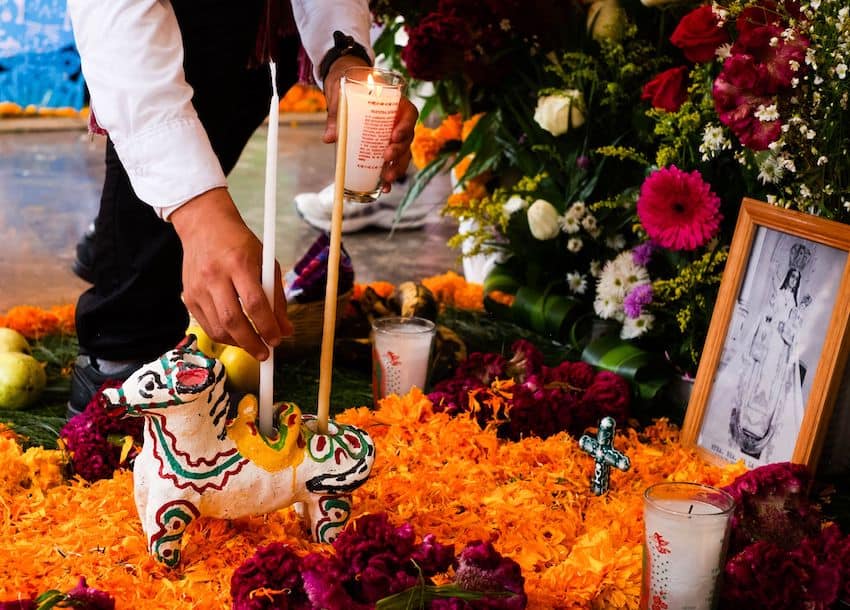
The goal of our “From the archive” series is to revisit popular stories that capture the unique history and culture of life in Mexico. This Sarah DeVries article — originally published in October 2019 — shows us how remembering lost loved ones can be a colorful celebration of life, love and the memories that keep them with us. Day of the Dead is by far my favorite holiday in Mexico. My first experience with it was in 2002, when I was here as a university student. The director of my study abroad program here in Xalapa piled a few of us into his pickup truck and we drove to Naolinco, a picturesque mountain town known for its leather products. I was immediately enchanted. Altars were all over the place — in people’s homes, in public spaces, in restaurants and stores. As we walked along the street, people invited us into their homes for tamales, bread and homemade wine. There were carolers at the cemetery. Carolers! With guitars! The brightly colored petals and exquisite smell of cempasúchil, “marigolds,” were everywhere. Since then, Day of the Dead has caught on north of the border as well. Even before the popular movie “Coco” came out, the southern Texas city I return home to was starting to embrace its Mexican heritage in more expansive ways than it ever had before, with altars, decorated skulls and papel picado, “colorful tissue paper with designs,” suddenly appearing alongside Halloween decorations. Real-life ‘Mamá Coco’ remembered with altar in Michoacán Who knew that the dead could bring us together? Each year in my home we set up our altar with the same enthusiasm with which we decorate the Christmas tree. As the years pass and more people we know and love die, we’ve had to switch to a bigger table, as our collection of dead has grown. My grandmother is there, as is my mother. Traditionally, the flower petals are to be sprinkled from the altar to the front door so that the dead can find their way back home from the other side to enjoy the offerings laid out for them. My grandmother, in life, would not have appreciated her place on the altar. Like many Protestants of a certain age, she was suspicious of the “magical” elements mixed in with modern Catholicism. Day of the Dead makeup is inspired by a famous high-society skeleton woman created by artist José Guadalupe Posada. (Canva) Day of the Dead is, of course, a mixture of Catholic and Indigenous tradition, one that the Spaniards were only partially successful at co-opting. At least they got to move the dates to the ones they wanted. (I like to think that my grandmother, now on the other side, would be totally cool with it.) Death is a universal reality, and all cultures have different ways of dealing with it. When I was growing up in central Texas, death was taboo, something no one wanted to talk about; it was sad at best and terrifying at worst. Halloween was a time not to think about the dead we knew, but to have fun dressing up and getting candy (and subsequent cavities). When I learned later of the history of Halloween from pagan tradition to Catholicism’s version, All Saints’ Day, I felt decidedly more creeped out. Why should we spend any time at all thinking about death? How uncomfortable! Why you should celebrate Halloween with a Guillermo del Toro binge watch How to confront death My attitude since has evolved considerably. Now that I’m an adult, death has moved closer and closer to me in the form of the passing of actual people I’ve known and loved, and in the reality and certainty of my own mortality as the years go by. I’m hopefully still a long way from it, but none of us really knows, do we? For something that’s such a firm fact of life, we sure do avoid thinking about it a lot. Mexicans don’t (as much), and I think there’s something to be learned from that. We can accept that we’re going to die. We can paint skulls on our faces to remind all of us that life is for the living — that we won’t be around forever, so we’d better get to it! What does Day of the Dead do for us? It keeps the memories of our loved ones alive. It keeps this culture alive and reminds us of the people we came from. Feel guilty about not thinking enough of your loved ones that have already passed on? Don’t: remembering to do that is built into an annual holiday here. I am not religious myself. I don’t pretend to know what happens after death, though as an agnostic I fully expect that we simply cease to exist in the way a flame from a candle goes out. As Richard Dawkins has said, we know that consciousness is wrapped up in the brain, and we know that the brain rots, so I have no illusions. The Catrinas are one of the most famous symbols of Day of the Dead festivities in Mexico. (Daniel Augusto/Cuartoscuro) To me, this news is not too disappointing, as I’m fairly certain that, as a dead person, I would not have the consciousness to care. Disappointing would be getting to that point of not existing and not having done anything worthwhile. That said, I do believe that there is a way to keep our dead alive, and Day of the Dead helps us to do that. Because while they might not still be around, they live on in us, and this holiday helps us remember that in an active way. The ways they shaped us, influenced us, taught us and loved us live on. Death is sad. We don’t usually wish for it, but learning to accept it and not fear it (at least not too much) is a worthy exercise. Celebrate, remember and love your dead. Sit and chat with them a while. Share some hot chocolate, some tamales, some pan de muerto, play their favorite music, decorate your face the way their faces look now. Welcome them back, at least for a couple of days, and celebrate your own beating heart. Sarah DeVries is a writer and translator based in Xalapa, Veracruz. She can be reached through her website, sarahedevries.substack.com.
From the archive: How Mexico’s Day of the Dead helps us remember the people we’ve lost
Full Article
Original Source
Read the full article at Mexiconewsdaily →KhanList aggregates and links to publicly available news content. We do not host full articles from third-party sources. Always verify important information with original sources.