
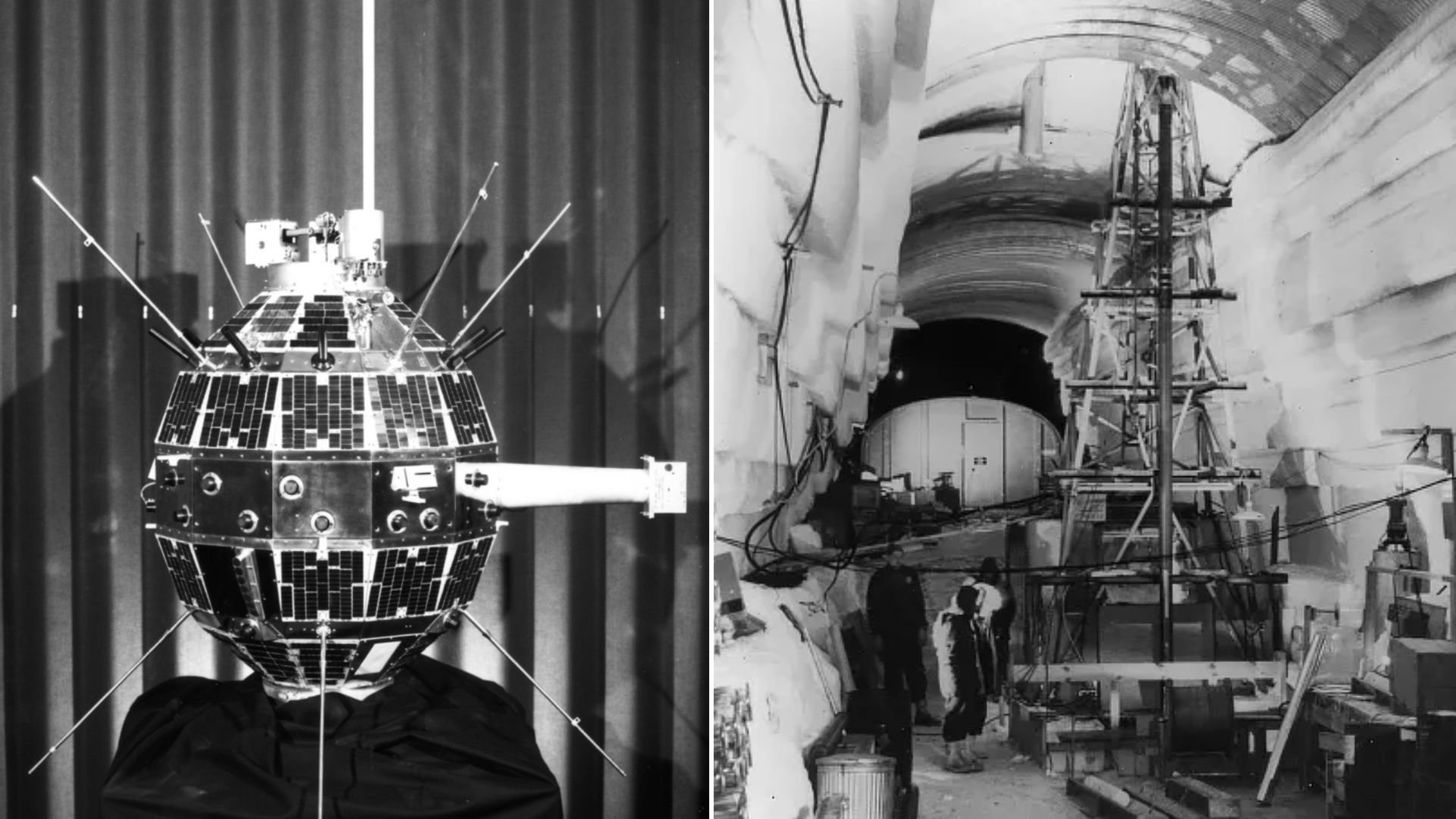
The Cold War wasn’t fought only with tanks, bombers, and nuclear missiles. Behind closed doors, scientists, engineers, and intelligence agencies pursued some of the most ambitious and secretive projects in military history. Some never entered service, while others quietly revolutionized reconnaissance, stealth, precision warfare, and intelligence gathering. Many of the technologies that underpin modern military operations can trace their origins back to these classified programs. Here are seven secret Cold War projects whose influence can still be seen on today’s battlefield. 1. Project CORONA: The spy satellite that changed intelligence forever Before satellites, gathering intelligence on the Soviet Union relied heavily on risky reconnaissance flights such as those carried out by the U-2 spy plane. Launched in 1960, Project CORONA became the world’s first successful photographic reconnaissance satellite program. It captured images on film, ejected the film canisters back to Earth, and remarkably had them caught mid-air by specially equipped aircraft. Although the first dozen missions failed, CORONA eventually returned more imagery in a single mission than all previous U-2 overflights combined. The program dramatically reduced uncertainty about Soviet military capabilities and laid the technological foundation for today’s military reconnaissance satellites. 2. Have Blue: The birth of stealth aircraft Long before the F-117 Nighthawk, there was Have Blue. Developed by DARPA and the U.S. Air Force during the 1970s, the highly classified demonstrator explored whether careful shaping and radar-absorbing materials could dramatically reduce an aircraft’s radar signature. The two prototype aircraft looked unlike anything that had flown before, featuring sharply faceted surfaces designed by computer algorithms to scatter radar waves. The project proved the concept worked and directly led to the F-117, fundamentally changing how modern air forces think about survivability. Today, nearly every fifth-generation fighter incorporates lessons first demonstrated by Have Blue. 3. Project AZORIAN: Stealing a Soviet submarine from the ocean floor Few intelligence operations matched the sheer engineering ambition of Project AZORIAN. After a Soviet ballistic missile submarine sank in the Pacific Ocean in 1968, the CIA secretly built the Hughes Glomar Explorer, disguised as a deep-sea mining vessel, to recover the wreck from nearly 5,000 meters (16,500 feet) below the surface. Although the recovery was only partially successful, the project pushed the limits of deep-ocean engineering and heavy-lift technology while becoming one of the Cold War’s most remarkable intelligence operations. It also gave rise to the famous “Glomar response,” the government’s refusal to “confirm or deny” classified activities. 4. A-12 OXCART: The aircraft that paved the way for the SR-71 The legendary SR-71 Blackbird might never have existed without its lesser-known predecessor. Developed in complete secrecy by Lockheed’s Skunk Works for the CIA, the A-12 OXCART first flew in the early 1960s and became one of the fastest aircraft ever built, cruising at Mach 3+ above 90,000 feet. To achieve those speeds, engineers pioneered titanium manufacturing techniques, advanced fuel systems, electronic countermeasures, and high-temperature materials. Many of those innovations later found their way into the SR-71 and continue to influence high-speed aerospace engineering today. 5. Project Pluto: The nuclear-powered missile that was almost too dangerous If any Cold War concept sounds like science fiction, it is Project Pluto. The program sought to develop a nuclear-powered ramjet cruise missile capable of flying at low altitude for thousands of miles while carrying multiple nuclear warheads. Because its reactor remained exposed during flight, the missile would have left radioactive contamination along its path even before reaching its target. Although engineers successfully tested the revolutionary reactor, the project was ultimately canceled in 1964 as ballistic missiles emerged as a more practical, and less environmentally catastrophic alternative. 6. POPPY: Listening to the Soviet Navy from space While CORONA photographed military installations, another secret satellite program quietly listened. The POPPY reconnaissance satellite constellation, operated under the National Reconnaissance Office, intercepted radar emissions from Soviet naval vessels and other electronic signals. The program helped the United States map enemy radar networks, monitor naval deployments, and improve electronic intelligence during the Cold War. Many of the electronic intelligence techniques pioneered by POPPY continue to underpin modern signals intelligence satellites. 7. Project Iceworm: A nuclear missile base beneath Greenland’s ice Perhaps one of the Cold War’s boldest ideas never progressed beyond the experimental stage. Project Iceworm envisioned constructing thousands of kilometers of tunnels beneath Greenland’s ice sheet to secretly deploy hundreds of nuclear missiles capable of surviving a Soviet first strike. Engineers even built Camp Century, a nuclear-powered research station beneath the ice, to test whether the concept was feasible. Ultimately, the constantly shifting Greenland ice sheet proved too unstable for such an enormous underground missile network, and the project was abandoned. Despite its failure, Iceworm remains one of the most ambitious military engineering proposals ever conceived. The legacy of Cold War innovation Not every secret Cold War project succeeded, but many reshaped military technology in ways their creators could scarcely have imagined. Stealth aircraft, reconnaissance satellites, electronic intelligence networks, and advanced aerospace engineering all owe part of their development to highly classified programs carried out during one of history’s most technologically competitive eras. While some projects faded into obscurity, others quietly laid the foundation for capabilities that continue to define modern warfare decades after the Cold War ended.Recommended ArticlesGet the latest in engineering, tech, space & science - delivered daily to your inbox.Kaif Shaikh is a journalist and writer passionate about turning complex information into clear, impactful stories. His writing covers technology, sustainability, geopolitics, and occasionally fiction. A graduate in Journalism and Mass Communication, his work has appeared in the Times of India and beyond. After a near-fatal experience, Kaif began seeing both stories and silences differently. Outside work, he juggles far too many projects and passions, but always makes time to read, reflect, and hold onto the thread of wonder.
From stealth aircraft to spy satellites: 7 secret Cold War programs shaped today’s military tech
Full Article
Original Source
Read the full article at Interestingengineering →KhanList aggregates and links to publicly available news content. We do not host full articles from third-party sources. Always verify important information with original sources.