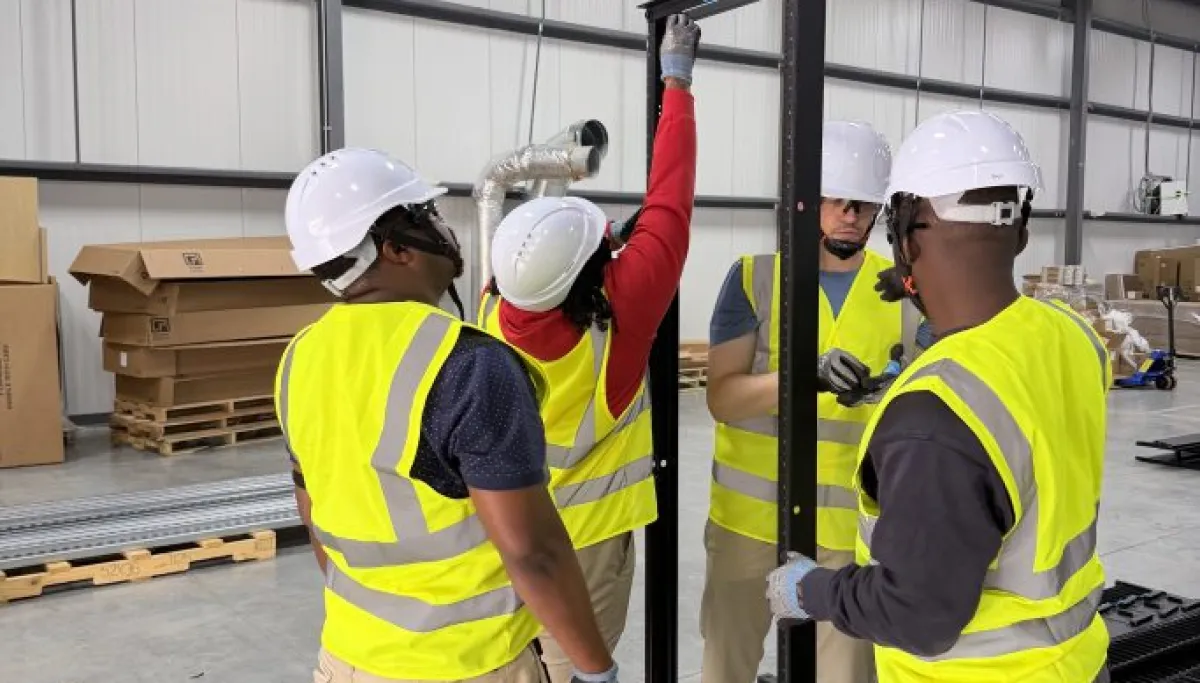
Mike Rowe said that the shift in how Americans think about vocational work has been both quixotic and an overnight success for the man who has been an evangelist for the trades for over 15 years.“Who was it? Hemingway? I forget who said it, but things happen very slowly and then suddenly,” he says of the shift in how Americans think about vocational work and the success of Meta’s launch of America’s Workforce Academy.For a man who has spent nearly two decades trying to change how the country talks about careers in the trades and dignified labor, it’s the perfect description of what is happening right here in Indianapolis, where the first class arrived for Meta’s new nationwide program that is aimed at fast-tracking long-term careers in skilled trades for artificial intelligence infrastructure. The program is cost-free and supports students while they learn. It also guarantees them a job at the end of the four-week training bootcamp. There is an overwhelming sense of gratitude coming from the first wave of participants. Most of them had worked in jobs in the service industry with no real path toward moving up or prosperity. And it captures the life-changing potential that this program has on them and their communities.Those who have been accepted receive a guaranteed job offer from a Meta contractor partner. And after completion, they are immediately employed and assigned to work on-site at Meta’s data center construction sites.Meta funds training, tuition, airfare, lodging, and even offers a stipend while in training. No degree or prior work experience is needed; only a willingness to learn.SALENA ZITO — REIGNITING THE AMERICAN DREAM: DONALD TRUMP, DAVID MCCORMICK, AND JAMIE DIMON UNVEIL A MASSIVE MANUFACTURING PUSH IN PENNSYLVANIAThe Dirty Jobs host and mikeroweWORKS Foundation CEO doesn’t take credit for launching AWA, a skilled trades initiative that Meta unveiled in June under President and Vice Chairwoman Dina Powell McCormick. Instead, he frames his role as something closer to a witness with a microphone.The 15-year runway that Rowe references is not a rhetorical flourish. His foundation has quietly awarded work-ethic scholarships for over a decade, laying the ideological groundwork for exactly this kind of large-scale, private-sector intervention.What changed with Meta is both speed and scale. The company launched AWA on June 8 and backed it with an initial $115 million first-year investment, described as the largest private-sector commitment to skilled trades with a job guarantee in American history.It is a program that Rowe had wanted for two decades, executed at Meta velocity. “What Meta is doing is reinvigorating entire towns with financial commitments to do what building looks like in 2026,” he explains. “That’s huge, and that’s easy to quantify. You can point to it and you can say, ‘Go team, awesome.’ But what has to happen next, in my opinion, is that the stories of these parishes, towns, and individuals must be told.”He describes his job now as “tapping the country on the shoulder every week” to point out ordinary people who changed their lives by learning a trade and going to work — what he calls “the essential American story that’s got to be told.”Ask Rowe what dignified work actually means, and he pushes back on the conventional answer. Most people, he says, define it by conditions: pay, perks, a 401(k), a lunch break. Those things matter, but they miss the point. “Shouldn’t dignified work really come down to work that blesses someone else? Work that contributes, even if it’s just to your family, but someone other than the worker,” he said. “There has to be something about effort that’s more noble when it builds up the community.”It’s the same philosophy that kept Dirty Jobs on the air for years, he observed. At its core it was a show about people doing unglamorous work that was, without exception, necessary and community-building.That framing matters for AWA specifically because of who it’s designed to reach. Powell McCormick has repeatedly described the program’s target population as people boxed out of the trades not by lack of interest but by lack of a runway: people living paycheck to paycheck who can’t afford to take unpaid time off to train for a job that may or may not materialize. SALENA ZITO: HOW MIKE ROWE’S ‘BUILD FREEDOM’ AIMS TO RESTORE THE DIGNITY OF AMERICAN WORK“This is an opportunity for people like Uber drivers, waitresses, grocery store clerks, and anyone out there who is living paycheck to paycheck,” she said at the program’s launch, framing AWA as the answer to exactly the barriers that Rowe describes.Rowe sees the visible gratitude in the workers themselves. He traces it back to the “sweat pledge,” a 12-statement creed his foundation has attached to its scholarships for 15 years. Its opening line, he says, is the whole philosophy in miniature: “I believe I have won the greatest lottery of all time. I’m alive. I walked the Earth. I live in America. Above all things, I’m grateful.”For Rowe, gratitude isn’t just a byproduct of getting a good job — it’s a precondition that makes the whole enterprise work. “In the end, if you’re upright and walking and living in this country and not feeling fundamentally grateful, then that’s a choice that you’ve made,” he says, adding that “it’s very difficult to feel sorry for yourself when your default position is gratitude.”Interviews with three AWA students reflect that sentiment.Until recently, Lanyia Brooks worked as a custodian in a data center, where she spent her days maintaining the facility while watching tech professionals build the infrastructure around her. Laniya Brooks and Ethan Blake of Fishers, Indiana, are in the first class at the Meta training center in Indianapolis. (Photo courtesy of Meta) Brooks said that perspective changed completely when a data center technician noticed her work ethic and remarked that she “worked too hard to be just working as a custodian,” and sent her a link to a specialized career training program. Despite waiting two anxious months to hear back, Brooks was accepted, conquering her fears to take her very first airplane flight to Indianapolis for the opportunity.One week into the intensive program, Brooks says she is thriving in a high-energy environment alongside a deeply positive and ambitious cohort of classmates. “My immediate goal is to master my training and learning the ins and outs of physical servers and networking — with long-term plans to transition into an advanced technician role within a year,” she said.Backed by supportive instructors and employer-provided accommodations, Brooks said, “This opportunity is my direct path to achieving the American dream.”Ethan Blake didn’t have to fly to get here, but he said that he felt just as stuck working in retail sales with little opportunity to move up. “I felt a growing desire to move beyond customer service and explore my true interest in technology,” he said.Despite the 26-year-old’s efforts to break into the field, Blake said he hit a discouraging wall when searching for local employment and faced the daunting reality that his only visible career paths required relocating across the country to tech hubs such as California. “This workplace training program provided the critical local bridge I needed and bypassed the need to relocate and unlocked a clear career in the industry that will drive the future of this country,” Blake told the Washington Examiner.Born in Haiti and raised in Florida, 31-year-old Anne Lubin found her true sense of place in Indiana, where she spent nearly a year immersed in an intensive cybersecurity and information assurance associate program at Ivy Tech Community College. While her academic foundation gave her a strong grasp of digital security, Lubin said she realized that she needed tangible, hands-on experience to break into the tech sector.“When I discovered Meta’s America’s Workforce Academy, I instantly jumped at the opportunity. The program provides the perfect marriage between my cyber background and the physical world of fiber optics and allows me to navigate both worlds,” she said.As a proud member of the very first cohort at the Indiana pilot site, Lubin views her training as a profound opportunity to fulfill the American dream and establish a blueprint for future generations of tech workers. “This journey is deeply rooted in human connection and has given me the opportunity to welcome peers from across the country,” Lupin said. America’s Workforce Academy trainers Kenny Johnson of Kentucky and Johnston Wilson of Virginia training the first cohort of Meta’s AWA program in Indianapolis. (Photo courtesy of Meta) The first wave of students has formed a real bond, organizing poker games at their hotel and fostering a tight-knit community out of the strangers who left their families behind for a shared purpose.All of the trainees in this fiber technician training program will earn 30 National Center for Construction Education & Research portable, industry-recognized credentials, including OSHA 10 and other construction safety certifications.Rowe is candid about why he thinks Meta in particular has “the inside track” to proving that a private company can actually move the needle on the country’s skilled-labor shortage. It isn’t just the $115 million — it’s distribution. “Instagram alone has 3 billion users,” he points out.Powell McCormick put the stakes in similarly historic terms, tying AWA to the country’s earlier industrial mobilizations: “Skilled workers electrified rural America one pole at a time. They manned the factories that built the arsenal that won World War II. Now a new generation will pour the foundations and lay the fiber that secures American strength in this new age.”The math behind that urgency is stark: the United States will need roughly 500,000 new electricians over the next two years just to support AI infrastructure buildout, according to Powell McCormick’s own estimates.NextEra Energy CEO John Ketchum said he is proud to partner with Meta on the AWA program: “We look forward to working together with them to create opportunities to employ the skilled workforce that will build America’s energy future and strengthen our nation’s competitiveness.”Sam Rathert of the Stoner Electric Group, a hiring partner for America’s Workforce Academy, said that they are proud to provide opportunities for workers who are interested in the skilled trades: “Over the past couple of months, alongside our local [International Brotherhood of Electrical Workers] representatives, we have held three hiring events to place workers on our union-operated job sites, and we look forward to continuing to support AWA in connecting talent with skilled trade careers.SALENA ZITO — FOUNDRY FOR THE FUTURE: THE SILICON VALLEY OF APPALACHIAOn-site trainers Kenny Johnson of Kentucky and Johnston Wilson of Virginia said the AWA program serves as a critical engine for the modern American economy by bridging the massive labor gap in high-tech infrastructure development. “The fast-paced nature of data center construction leaves little room for on-the-job training, making the foundational skills taught in this academy essential,” said Johnson.Both Johnson and Wilson said that by turning raw aptitude into specialized technical expertise, the program successfully democratizes access to the tech boom and injects sustainable wealth back into local communities, strengthening the domestic economy and national security from the ground up.
From slow to sudden: Inside Meta’s bet on the dignity of work
Full Article
Original Source
Read the full article at Washingtonexaminer →KhanList aggregates and links to publicly available news content. We do not host full articles from third-party sources. Always verify important information with original sources.