
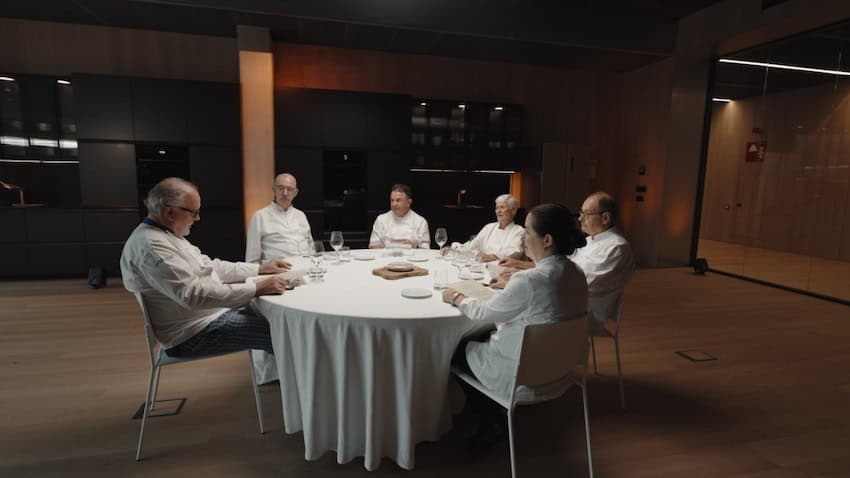
The story of Nueva Cocina Vasca, or New Basque Cuisine, began with youthful dreams, curiosity and the ambition to share the landscapes, flavors and traditions of the Basque Country with the world. It was 50 years ago that its pioneers took their first steps: venturing into French territory, just a few kilometers from home, daring to taste and spend money they simply did not have. Their goal was to discover the intricacies of French nouvelle cuisine and meet in person the chefs who were setting new trends. They were eager to immerse themselves in the country where the modern concepts of the restaurant, the menu and service had developed in the 18th century. They could never have imagined they would become the architects of a great culinary revolution that would shake the foundations of the established order. Nor could they have imagined that their influence would reach across the Atlantic. Nor were they aware that their principles would remain relevant well into the new millennium. Pedro Subijana, chef of the three-Michelin-starred Akelarre restaurant, crouches in the front row on the left, alongside fellow members of the New Basque Cuisine movement. He is easily recognizable by his distinctive moustache. (Akelarre) The revolution, 50 years later Today, there is a growing trend toward reviving ancestral recipes, embracing sustainability and the circular economy, and fostering close partnerships with producers, whose role is becoming increasingly important. One of the first major steps toward that revolution would be taken by chef Juan Mari Arzak, the movement’s most visible figure, who is always said to be five minutes ahead of everyone else. In 1971, he broke with convention by creating pastel de cabracho, a dish made with scorpionfish, a fish considered ugly and full of bones despite its excellent flavor. As they themselves have often recalled, those young chefs didn’t have much. What they did have was the excitement of creating something new and the freedom to interpret the world in their own way. That spirit would go on to change the way we think about cooking. (Arzak Restaurant Archive) He was inspired by a friend’s recipe made with hake, and that friend taught him how to prepare it. Arzak added cream to give it a lighter, French-style texture, and voilà! He had invented a fish pudding that would become much talked about. Today, it is a classic of Basque cuisine. In 1976, Arzak and Pedro Subijana met Paul Bocuse in Madrid, the rock star of the moment, a chef with three Michelin stars and one of the great figures of nouvelle cuisine. It was a defining encounter. Among the principles of that French culinary revolution were the celebration of fresh ingredients, shorter cooking times, a more restrained use of sauces, and the exploration of new techniques. Above all, it championed the freedom to let the imagination run free, without constraints. Arzak and Subijana struck up a friendship with Bocuse, who welcomed them into his Maison. Thus, they entered through the front door into a universe that also included Michel Guérard and the Troisgros brothers, chefs in whose kitchens Elena Arzak would train years later. Juan Mari’s daughter is part of the generational continuity of that initiative, in which Luis Irizar, Karlos Arguiñano, and others also took part alongside her father and Subijana. Juan Mari Arzak, the most prominent figure in New Basque Cuisine, leafs through a magazine. He has long been said to be five minutes ahead of everyone else. (Irma Aguilar) Changes in restaurant service Tatus Fombellida was the only woman in the group and, at the time, was head of the dining room at Panier Fleuri restaurant in Errenteria, Gipuzkoa. It was a family-run establishment, and she represented its third generation. She recalls that one of the major changes the New Basque Cuisine movement brought to restaurant service was the presentation of each dish as an individual portion, complete with its precise serving size, garnish and sauce. Previously, waiters would bring out a large serving platter and portion the food at the table. “That was a major contribution,” Fombellida says. “Every dish was beautifully presented. I think a great deal was gained by serving the food directly onto the plate.” Fifty years ago, Basque chefs gathered around the stove. Tatus Fombellida, at the time head of the dining room, recalls that they essentially got together to “talk about food instead of playing cards.” (Arzak Archive) Another topic of debate among them was the transformation of the menu, which had traditionally been divided into cold and hot starters, egg dishes, vegetables and fish, meat, and desserts. According to Fombellida, “It was the same everywhere. Then, gradually, things began to change. Chefs started coming out into the dining room, taking on a bit of the maître d’s role and explaining to diners what they were about to eat.” A further significant development was the greater recognition given to the role of the sommelier. “Wine now plays a major role in the dining room,” Fombellida says. She nevertheless believes there is still a long way to go when it comes to restaurant service that reaches beyond the realm of fine dining. Fombellida remembers that, essentially, they would get together to “talk about food instead of playing cards.” ‘Undisputed geniuses and artists’ Mexican chef Alberto Ituarte poses with Karlos Arguiñano, Juan Mari Arzak, Xabi Gutiérrez and José Uribe. Ituarte was the only Mexican member of the team at Tezka, which first opened in Mexico City’s Zona Rosa neighborhood before moving to Pedregal. (Alberto Ituarte) As experimentation and the exchange of knowledge gained momentum, new names and new ways of interpreting Basque cuisine began to emerge. It was then that Martín Berasategui became an overnight sensation. In time, rather than being a simple breath of fresh air, he would redefine the culinary landscape altogether. Today, the restaurants he runs have earned a total of nine Michelin stars. As an apprentice, he would hear people talk about the group. “They were people I admired, people who made history,” Berasategui says. “They were undisputed geniuses, artists who kept surpassing themselves.” Back then, there was a great deal of shyness within the profession, and they had the courage and generosity to put their ideas forward and build a professional family. That was key to becoming part of it. “Together, we revolutionized Spanish cuisine and introduced it to the world. We went further than we had ever imagined because we had the vision to create and seek out new things.” Fear is absolutely forbidden in the kitchen, he warns. “The only thing we should fear is poor health.” Berasategui advises young chefs to look ahead: to think about art for tomorrow and about avant-garde cuisine and innovation for the day after tomorrow. At the same time, he reminds them to always be grateful to those who came before them and shaped traditional cuisine. How Mexico and Türkiye connect through food, family and history New Basque Cuisine lands in Mexico In the 1990s, a whirlwind of curiosity and a desire to travel, see and learn sent these chefs, including Berasategui, off to distant shores. And so, more than three decades ago, Mexico appeared on the New Basque Cuisine movement’s map. Juan Mari Arzak was the first to arrive in Mexico, in 1994, with a project in mind: the restaurant Tezka. It first opened in the Zona Rosa neighborhood and later moved to Pedregal. It was run by Alberto Ituarte, the only Mexican on the team, who, incidentally, had worked in Berasategui’s kitchens. Ituarte describes him as “a great guy” for his ability to bring the group together. Ituarte believes Arzak brought Mexico a more evolutionary approach to cooking and a demand for excellence at the highest level. In turn, he came to know the Mexican philosophy of giving and giving of oneself. “Mexican staff are worth their weight in gold,” Ituarte says. “They’re cheerful; there’s always a joke, a laugh, a bit of playful banter.” Arzak was king of the dining room. He would explain the recipes, a pioneering practice that caused quite a sensation. “He was a great communicator.” Working with him meant understanding that gastronomy does not end at the plate, but also calls for personality and the ability to convey emotions. A photograph from four decades ago captures the camaraderie among Paul Bocuse and the Basque chefs around him. Pedro Subijana is to his left and Juan Mari Arzak below him, followed by Karlos Arguiñano and José Juan Castillo. Bocuse, Subijana and Arzak were among the founders of Euro-Toques in 1986, an organization established to protect Europe’s culinary heritage. (Euro-Toques España) The San Sebastián-born chef forged a deep friendship and exchanged knowledge with Carmen Ramírez Degollado, known as Titita, and Patricia Quintana, who had “a very clear determination to innovate and develop her own signature cuisine, while never losing sight of Mexico’s extraordinary gastronomic richness,” Ituarte says. Juan Mari Arzak traveled to Mexico twice a year, often accompanied by his daughter Elena. On their return, their suitcases would be overflowing with new ideas born from conversations with Alicia Gironella, Mónica Patiño and other chefs. A wealth of ingredients gradually came together to build their flavor bank, a creative tool that today brings together some 1,500 products. “I loved going there. It was like discovering a whole new world of moles and dishes buried underground, recipes made with ashes,” Elena Arzak recalls enthusiastically, reflecting on what Mexico has meant to her family. She felt that Mexican culture was much like Basque culture in its respect for traditions, its taste for innovation, and its embrace of modernity. She found the Day of the Dead particularly touching. “Thanks to Mexican cuisine, we were able to evolve.” She recalls discovering huitlacoche, spicy flavors and chiles en nogada. She also remembers a conversation with Patricia Quintana about stews made with love, cooked slowly, and never left unattended for even a minute. “You had to keep stirring them the whole time,” Arzak says. It brought back memories of her grandmother offering her advice. A still from Ondarea, “50 Years of New Basque Cuisine,” a documentary paying tribute to the generation of chefs and culinary professionals who transformed the understanding of ingredients, cooking and the profession itself. (Baleuko) 50 images that define a movement Arzak’s romance with Tezka came to an end in 2009, but his passion for Mexico never faded. In fact, for nearly two decades, Mexican chef Cynthia Yaber has played a key role in his kitchen as head chef at Arzak. The legacy of the Arzak restaurant lives on in iconic dishes such as the cassava cromlech with huitlacoche, featuring a series of crisp shapes made with foie gras, onion, turmeric, cassava and green tea; and the prawn and corn dish, in which the grain becomes a velvety cream that melts into the crustacean, giving it a bold, distinctive flavor. “Thanks to Mexican cuisine, we were able to evolve,” says Elena Arzak. The restaurant’s iconic cassava cromlech with huitlacoche reflects the Arzak family’s interest in Mexican ingredients. (Arzak Archive) At the recent presentation of “Nueva Cocina Vasca. Pasado, Presente y Futuro” (“New Basque Cuisine: Past, Present and Future”), Miren Arzalluz, director of the Guggenheim Museum Bilbao, spoke with visible emotion. The book celebrates the movement’s 50 years and its continued international relevance. “It has been truly inspiring to look back at how a group of curious and committed professionals, grounded in the strength of their traditions and roots, devoted their efforts and energy to reinventing themselves through a contemporary lens, with the ambition of establishing Basque gastronomy as an international benchmark,” Arzalluz said. As a cultural professional, she said, it was truly “moving and inspiring to become aware” of how this movement, born in the world of gastronomy, transcended its original sphere to become a Basque cultural movement. “Probably the most important one my generation has witnessed, driving creation, creativity, innovation and dialogue with other disciplines.” Published by Mantala Basque Gastronomy, the book brings together 50 images by visual artist Andoni Beristain, many of them conceptual, evoking fishing, livestock farming, a particular ingredient, or a way of cooking. Each image is accompanied by a quote from people not only in gastronomy but also in sports, culture, the arts, and everyday life. They all share the dream of building a future that remains mindful of the past and the challenges of the present, all while continuing to inspire new generations. Irma Aguilar is a contributor to Mexico News Daily.
From San Sebastián to Mexico: The story of New Basque Cuisine
Full Article
Original Source
Read the full article at Mexiconewsdaily →KhanList aggregates and links to publicly available news content. We do not host full articles from third-party sources. Always verify important information with original sources.