
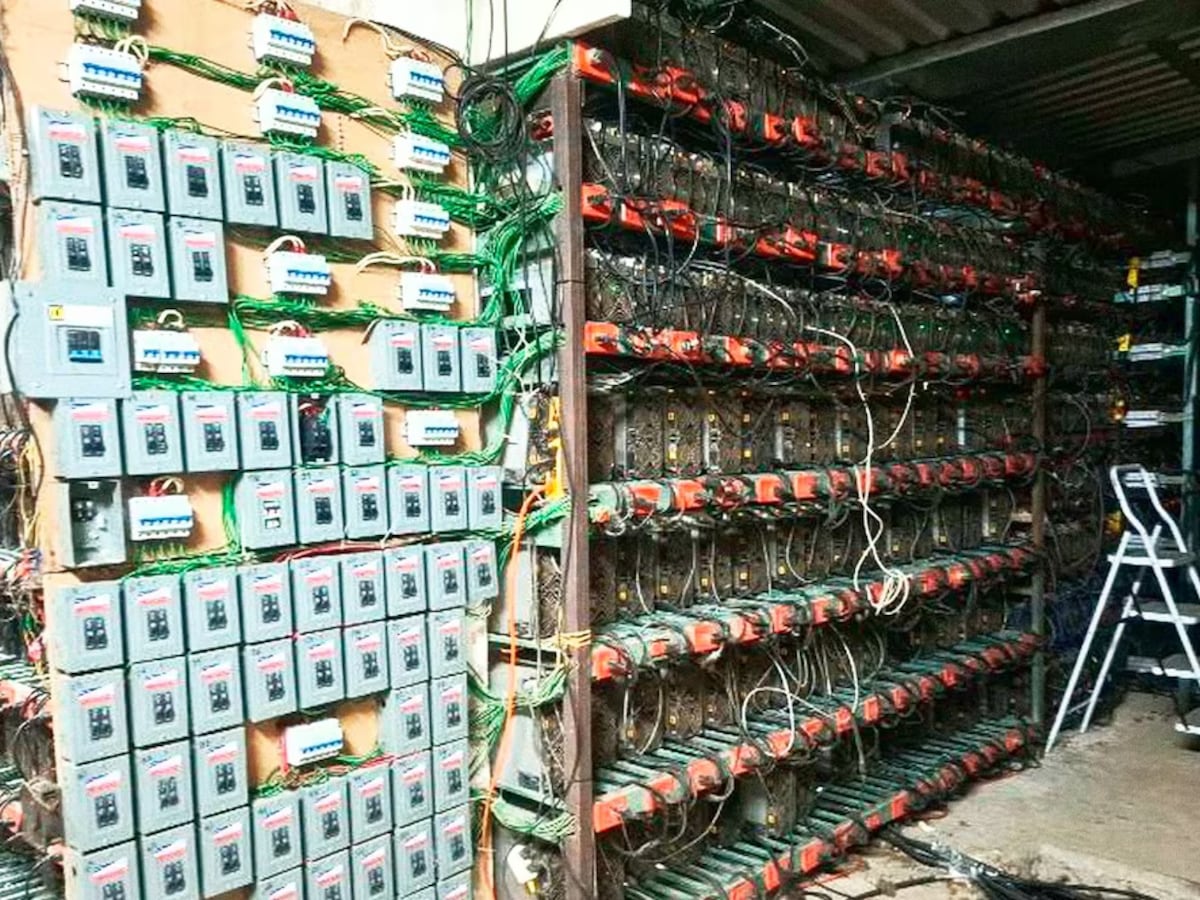
At least 100 graphics cards, 50 state-of-the-art computers and an industrial-grade electrical transformer were among the equipment seized by Mexican federal authorities last week at an isolated property in Tlaola, in the state of Puebla. The operation, carried out by Mexico’s Navy Ministry and the Public Security Secretariat, suggests that the site was not a simple warehouse but a clandestine facility dedicated to cryptocurrency mining for the Jalisco New Generation Cartel (CJNG). According to state authorities, investigators located the digital-asset farm after drones detected “unusual” thermal radiation.The facility, located on a property known as La Gallera, was operating illegally, connected to the grid of Mexico’s Federal Electricity Commission (CFE) without electricity meters. During the raid, authorities also arrested a person who was guarding the site.“We believe there are more cryptocurrency farms in this area and we are pursuing a line of investigation in this municipality and in neighboring municipalities,” Francisco Sánchez González, public security secretary in the state of Puebla, told local media.This is the second cryptocurrency farm dismantled in less than three months in the municipality of Tlaola. Last September, authorities uncovered another illegal digital-mining center at a site known as El Beneficio. There, they seized 300 specialized computers, 80 medium-voltage terminals and eight satellite antennas. Sánchez González said only that investigations into both operations were ongoing and that he could not provide further details.More than 870 miles (1,400 kilometers) away, in Culiacán, in the state of Sinaloa, state police dismantled another clandestine cryptocurrency-mining operation last week. According to official reports, officers seized 130 computers, three transformers and one video-surveillance system at the property.In addition to the facilities discovered in Puebla and Sinaloa, Mexican authorities have dismantled other illegal cryptocurrency-mining centers in Tlaxcala since last year.Cryptocurrency mining is the process by which transactions are verified and recorded on certain cryptocurrency networks. To mine cryptocurrencies such as bitcoin, operators use powerful computers to solve complex mathematical problems that validate those transactions. In return, they receive rewards in the form of digital assets.The process requires specialized equipment, consumes large amounts of electricity, operates around the clock, generates significant noise and heat, and depends on an efficient cooling system. Cryptocurrency mining is not illegal. But the secrecy surrounding the facilities in Puebla and Sinaloa, combined with the theft of electricity, suggests they were being run by people involved in criminal activity.A cryptocurrency operator, who requested anonymity, says that the largest upfront expense for this type of operation is the equipment, which can cost as much as $20,000 per unit. “Mining does not represent a fixed income; it is variable income that you have to balance: you may get nothing for some hours and then receive several rewards,” said the operator.The operator noted that, beyond shutting down and seizing the equipment, the next step in these investigations is to identify the cryptocurrency wallets being used, a key measure in determining whether money laundering is taking place. “Yes, they stopped the operation, but they haven’t taken away all the income it already generated, and there’s no real way to trace that revenue. On the other hand, the people running these centers may now be able to pay with a clean bitcoin,” said the operator, who added that the growth of these illegal mining farms is partly fueled by the negative public perception surrounding cryptocurrency mining, which also harms legitimate operators in the sector.Luisa María Acosta, a specialist in financial crime, says that organized crime groups are not abandoning traditional money-laundering channels but are instead adding cryptoassets to their toolkit. One reason is that the cryptocurrency ecosystem operates under a form of pseudonymity, with transactions linked to digital codes rather than real names, making it more difficult for authorities to trace them. What’s more, transfers can be completed in a matter of seconds.Acosta explained: “Because this is such a new issue, not all countries have legislation on the crypto world and each regulates it in its own way.”Sign up for our weekly newsletter to get more English-language news coverage from EL PAÍS USA Edition
From rural Puebla to Sinaloa: Mexico’s cartels tap into the cryptocurrency boom
Full Article
Original Source
Read the full article at English →KhanList aggregates and links to publicly available news content. We do not host full articles from third-party sources. Always verify important information with original sources.